Nigella Lawson’s rhubarb and custard trifle layers vermouth-soaked sponges, roasted pink forced rhubarb, homemade vanilla custard and softly whipped cream in one glass bowl. The rhubarb roasts at 200°C (180°C fan) for 30 minutes, the custard takes about 5 minutes on the hob, and the assembled trifle chills overnight.
The recipe comes from Cook, Eat, Repeat (2020), where Nigella admits she’d made this trifle for years without ever writing it down. She calls it “the one I return to most” of all her trifles, which is quite a claim from someone who has published several. What sets hers apart is the soaking liquid: roasted rhubarb juice mixed with red vermouth instead of the usual sherry.
The clever part is how she uses every drop of that juice. Roasting 1kg of rhubarb under foil gives you about 300ml of pink liquid, so she splits it: 175ml goes into the vermouth soak, and 125ml boils down to a syrup for the top. Nothing is wasted, and the trifle gets its colour and flavour from the fruit twice over.
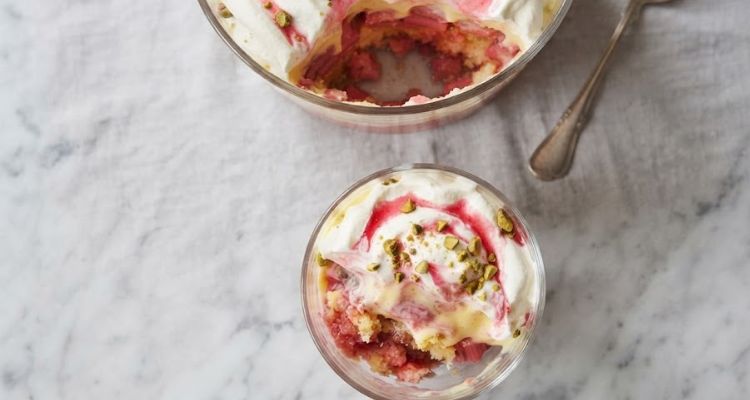
Nigella Lawson Rhubarb and Custard Trifle
Course: DessertCuisine: BritishDifficulty: Easy8-10
servings45
minutes35
minutes710
kcal1
hour20
minutesThe trifle Nigella kept for herself until Cook, Eat, Repeat. Built for a 20cm glass bowl and a table of 8 to 10, it needs starting the day before, because the custard sets overnight. Best made in forced rhubarb season, January to March.
Ingredients
- For the custard:
600ml double cream
1 vanilla pod or 2½ tsp vanilla paste (or extract)
6 large egg yolks, at room temperature
2 x 15ml tbsp plus 2 tsp caster sugar
1 x 15ml tbsp plus 1 tsp cornflour
- For the base:
1kg pink forced rhubarb (trimmed weight)
250g caster sugar
175ml red vermouth
12 trifle sponges
- For the topping:
300ml double cream
Approx. 3 x 15ml tbsp (20g) chopped or nibbed pistachios
Kit: a trifle bowl, approx. 20cm in diameter and 13cm deep.
Directions
- Infuse the cream: Pour the 600ml of double cream into a heavy-based pan. Split the vanilla pod, scrape the seeds in and drop the pod in too. Heat until it just starts to bubble, without boiling, then take it off the heat, cover and leave for 20 minutes before lifting out the pod. If you’re using paste or extract instead, simply warm the cream and stir the vanilla in once the custard is made.
- Make the custard: Whisk the egg yolks, caster sugar and cornflour together in a jug, then gradually whisk in the warm cream until smooth. Rinse and dry the pan, pour the mixture back in and cook over medium heat for a minute, stirring, then drop to low. Keep stirring for around 5 minutes until it coats the back of a wooden spoon, lifting the pan off the heat now and then and giving it a whisk so the base and edges don’t overheat.
- Chill: As soon as it’s thick, take it off the heat and pour it back into the jug, adding vanilla paste or extract here if you skipped the pod. Press a damp, scrunched piece of baking parchment onto the surface so no skin forms. Cool, then refrigerate.
- Roast the rhubarb: Heat the oven to 200°C/180°C fan. Cut the trimmed rhubarb into roughly 5cm lengths if the stems are thin, or 2½cm pieces if thick, and spread in a single layer in a large tin (Nigella uses one 37 x 34cm). Toss with the 250g of caster sugar, seal the tin tightly with extra-wide foil and roast for about 30 minutes until tender but still holding its shape.
- Rest and collect the juice: Uncover and leave the tin out of the oven for 20 minutes. The colour deepens to a bright candy pink as it stands. Lift the rhubarb into a separate dish with a slotted spoon, keeping the juice in the tin. You should have around 300ml, and more will pool under the resting fruit, so tip that in as well.
- Divide the juice: Set 125ml of the juice aside for the syrup. Measure another 175ml, topping up with orange juice if late-season rhubarb runs short, and mix it with the red vermouth.
- Reduce the syrup: Boil the reserved 125ml in a small pan for around 4 minutes until it halves to a thick, pourable 60ml. Stop there, because reducing further turns it to toffee. If that happens, loosen it with a splash of hot water from the kettle.
- Soak the sponges: Fit the trifle sponges into the base of the bowl, brushing off their sugar coating and tearing pieces to plug gaps, aiming for a layer 5-6cm deep. Pour the rhubarb and vermouth liquid evenly over and let it absorb.
- Layer and chill: Spoon the rhubarb over the soaked sponges along with any collected juices. Spread the cold custard on top, smoothing it to the sides of the glass. Cover and refrigerate overnight.
- Finish: Take the trifle out of the fridge a good 2 hours before serving. Just before the meal, softly whip the 300ml of double cream, spoon it over the custard and swirl with the back of the spoon. Drizzle with the rhubarb syrup and scatter over the pistachios.
FAQs
What can I use instead of red vermouth?
The Happy Foodie team answered this directly on the recipe page: swap the vermouth for a liqueur like Cointreau, but use half the quantity because the alcohol is stronger, and make up the rest with orange juice. For an alcohol-free trifle, replace the full 175ml with orange juice. The citrus works because it echoes the sharpness the vermouth brings.
Red vermouth is sweeter and spicier than the dry white kind, so don’t treat them as interchangeable. Nigella keeps a bottle of the dry white for savoury cooking, and you can see it doing a different job in her spaghetti carbonara with vermouth, where it deglazes the pancetta fat.
Can I make this when forced rhubarb is out of season?
Nigella says no to summer rhubarb, which she finds green, fibrous and far less appealing, and gives a full winter alternative instead. Warm 800g of frozen raspberries with 3 tablespoons (40g) of caster sugar and 4 tablespoons of orange juice, lidded, over low heat for about 5 minutes, stir in 2 teaspoons of vanilla paste, then rest for 15 minutes before adding the 175ml of vermouth.
For the syrup layer, she melts a tablespoon of seedless raspberry jam with lemon juice and 2 tablespoons of water, brings it to a bubble and cools it. If you like where raspberries and sharpness lead, her chocolate raspberry pudding cake runs on the same logic.
How do I know when the custard is thick enough?
Dip a wooden spoon in, run your finger across the back, and the line should stay clean without custard flooding back into it. The cornflour is your safety net here, since it thickens the mixture quickly and protects the yolks from splitting the way a classic crème anglaise can.
When I tested it, the thickening came on suddenly in the last minute, so stay at the pan. If you feel it catching at the edges, lift the pan off the heat and whisk hard for a few seconds before returning it. That rescues it every time without any loss of texture.
Does the trifle bowl size actually matter?
More than you’d expect. Nigella’s quantities are calibrated to her own bowl, 20cm across and 13cm deep, and she warns that a wider bowl spreads the same amounts into layers too shallow to look like a proper trifle. The depth is what gives you those distinct pink, yellow and white bands through the glass.
If your bowl is wider, scale everything up rather than accepting thin layers. A straight-sided glass bowl shows the stripes best, which is half the point of a dessert Nigella links to the rhubarb and custard boiled sweets of her childhood.
Why does Nigella insist on forced rhubarb?
Forced rhubarb is grown in dark sheds and harvested by candlelight, mostly in Yorkshire’s Rhubarb Triangle between January and March. The stems come out slender, tender and vividly pink, with a gentler acidity than outdoor rhubarb. That colour is what makes the middle layer of this trifle glow.
Don’t panic if the roasted fruit looks dull straight from the oven. The pink builds during those 20 minutes of resting, which is exactly why the recipe tells you to wait before assembling. Sabrine and I both doubted it on our first test, and both watched it turn the right colour on the worktop.
Can I make it ahead, and how long does it keep?
The trifle is designed to be made ahead, since the overnight chill is what sets the custard firmly over the fruit. Assemble everything except the cream layer up to a day before, keep it covered in the fridge, and bring it out 1-2 hours before serving so it isn’t fridge-cold at the table. The cream goes on at the last minute.
Leftovers keep, covered, in the fridge for up to 2 days, though the sponges soften progressively as they sit. It shares that assemble-early, top-late rhythm with her prodigious pavlova, another Nigella dessert where the cream only lands just before serving.