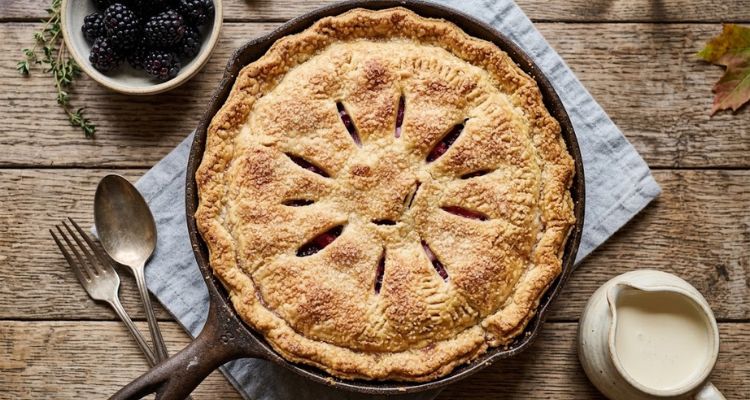
Nigella Lawson’s gluten-free apple and blackberry pie is a double-crust fruit pie with a sour-cream gluten-free pastry around spiced bramley apples and blackberries. It serves 6 to 8, from her book Simply Nigella.
She explains that her usual approach to gluten-free baking is to leave out flour altogether, as in her gluten-free cakes. But inspired by America’s Test Kitchen’s “The How Can It Be Gluten Free Cookbook”, she took on a proper pie using gluten-free flour and xanthan gum, both found at her local supermarket. (And yes, she notes, xanthan gum comes as a powder despite the name.)
She mostly follows the America’s Test Kitchen recipe with two changes of her own: she processes the dough continuously rather than pulsing at the end, and she rolls the pastry between sheets of baking parchment rather than cling film.
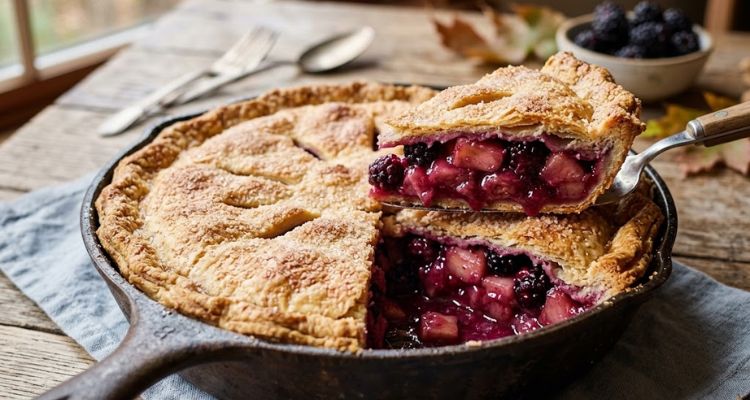
Nigella Lawson Gluten-Free Apple And Blackberry Pie
Course: DessertCuisine: BritishDifficulty: Easy6-8
servings1
hour10
minutes30
minutes440
kcal1
hour40
minutesNigella’s gluten-free fruit pie from Simply Nigella: a sour-cream gluten-free pastry around cinnamon-spiced bramley apples and blackberries. Serves 6 to 8.
Ingredients
- For the pastry:
200g unsalted butter
3 tablespoons sour cream
1 tablespoon rice vinegar
365g gluten-free flour
1 tablespoon white sugar
1 teaspoon table salt
½ teaspoon xanthan gum
- For the fruit filling:
500g bramley apples, peeled, cored and sliced or chopped
1 tablespoon unsalted butter
2 tablespoons white sugar
½ teaspoon ground cinnamon
pinch of xanthan gum
250g blackberries
1 large egg white
½ teaspoon white sugar
Directions
- Freeze the butter: Cut the butter into ½cm cubes and put in a flat dish in the freezer for 15 minutes.
- Mix the wet: Stir together 80ml ice-cold water, the sour cream and the vinegar in a jug.
- Make the dough: Blitz the gluten-free flour, sugar, salt and xanthan gum in a food processor to combine. Add the frozen butter and pulse about 10 times, until the butter is the size of large peas. Pour in half the sour cream mixture and pulse 3 to 5 times to a fine, crumbly mix. Add the rest and process until the dough just clumps around the blades.
- Chill: Tip out, form into two equal discs, wrap in cling film and rest in the fridge for 40 minutes (or up to 2 days). If baking straight away, preheat the oven to 200°C/180°C fan/400°F.
- Cook the fruit: Melt the 1 tablespoon butter in a wide pan, add the apples, sugar and cinnamon and cook about 3 minutes until the apples soften and make a caramelly liquid. Add the blackberries, stir gently, take off the heat and stir in the pinch of xanthan gum.
- Roll the base: Roll one disc between two sheets of parchment. Important: add no flour during rolling. Once wide enough to line the dish with about 4cm overhang, peel off the top paper, flip over your dish and peel off the remaining paper. Ease it in.
- Fill and top: Roll the second disc the same way. Tip in the fruit, dampen the pastry lip with cold water, then flip the lid over the top. Trim the overhang and seal by crimping or pressing with a fork.
- Glaze and bake: Cut slits in the centre for steam, paint with the egg white and sprinkle with the ½ teaspoon sugar. Bake 30 minutes, or until the pastry is cooked and golden (longer in a regular pie dish).
Notes
- (no flour when rolling): Unlike normal pastry, you must not dust with flour while rolling this out. Rolling between parchment is what stops it sticking and keeps the gluten-free dough manageable.
- (dish choice): Nigella loves the look baked in a cast iron skillet, but a pie dish works (metal rather than ceramic for preference). A 20cm/8-inch dish is less stressful than stretching the dough to a 22cm/9-inch.
- (serving): Nigella says it’s gorgeous with a dollop of her White Miso Ice Cream (also from Simply Nigella) alongside.
- (make ahead): Pastry can be made 2 days ahead (rest at room temperature 20 to 30 minutes before rolling). Filling can be made 1 day ahead. The pie can be assembled 3 to 4 hours ahead but glaze just before baking. It keeps warm up to 1 hour after baking.
- (store): Store in the fridge in an airtight container, or loosely covered, up to 5 days. Best reheated before serving: portions in a 150°C/130°C fan/300°F oven for 20 to 30 minutes.
- (freeze): Freeze the dough discs tightly wrapped up to 3 months (defrost overnight in the fridge). Freeze leftover baked portions in airtight containers, defrost overnight and reheat as above.
FAQs
What does the xanthan gum actually do?
It’s the key to making gluten-free pastry that behaves. Without gluten, the dough has nothing to give it stretch and hold, so it cracks and crumbles. The ½ teaspoon of xanthan gum acts as a binder and adds elasticity, as nigella.com explains, making the dough easier to roll out and handle. A pinch also goes into the fruit filling, where it thickens the juices so the pie isn’t watery.
If your gluten-free flour blend already contains xanthan gum, leave the added xanthan out, and make sure the blend has no baking powder in it. If you react to xanthan gum, Nigella’s team suggests guar gum as a straight swap in the same quantity, or trying the pastry without any (you may then need slightly less of the liquid). Despite the name, xanthan gum is a fine powder, not a gum you can see.
Which gluten-free flour should I use?
A plain, all-purpose gluten-free flour blend, ideally one based on rice flour. Nigella found hers at her local supermarket, and her team confirms well-known UK brands like Dove’s Farm work well. The main thing is that it’s an unflavoured, all-purpose blend without added raising agents.
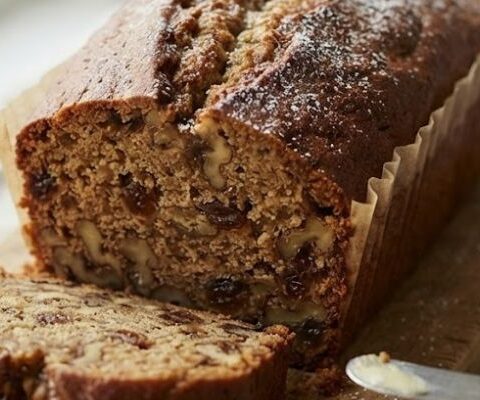
Watch for blends that already include xanthan gum, as many “1 to 1” baking mixes do. If yours does, skip the added xanthan in the recipe so the pastry doesn’t turn gummy, and double-check there’s no baking powder in it, which would make the pastry puff oddly. Beyond that, the recipe is based on America’s Test Kitchen’s gluten-free pastry, so it’s a well-tested formula. For other gluten-free bakes, there’s her gluten-free banana bread.
Why sour cream and vinegar in the pastry?
These are the clever touches that make a tender, workable gluten-free crust. The sour cream adds fat and a little acidity for a richer, more tender pastry, while the rice vinegar’s acidity helps keep it from toughening and adds to the flaky texture. Both come from the America’s Test Kitchen method Nigella adapted.
Her two tweaks to their recipe are worth knowing: she processes the dough continuously rather than pulsing to combine at the very end, and rolls between parchment rather than cling film, which she finds easier. If you need it dairy-free as well as gluten-free, nigella.com suggests using plant-based margarine in place of the butter and plant yoghurt in place of the sour cream, adding the second lot of liquid a tablespoon at a time.
Why bramley apples, and can I use other fruit?
Bramleys are the classic British cooking apple: tart, and they break down to a soft, fluffy texture when cooked, which is exactly what you want in a pie. Paired with blackberries, you get that quintessential hedgerow-autumn combination of sharp apple and sweet-sharp berry. The apples are pre-cooked briefly with sugar and cinnamon so they soften and release a caramelly juice before baking.
You can absolutely change the filling, as Nigella says you can make whatever filling you like, adapting recipes you already use, since the pastry is the gluten-free part that matters. Eating apples work but give a sweeter, firmer result, so you may want less sugar. Other berries, pears or a classic apple-only filling all suit this crust. Keep the pinch of xanthan to thicken the juices.
My gluten-free pastry keeps cracking. What am I doing wrong?
It’s the nature of gluten-free dough, but a few things help. First, keep everything cold: the frozen butter cubes and ice-cold liquid are there for a reason, and well-chilled dough rolls better (if it’s been in the fridge a while, let it stand 20 to 30 minutes so it’s not brittle). Second, and crucially, roll between two sheets of parchment and add no flour, which is how you move it without it tearing.
To transfer it, peel off the top sheet, flip the pastry over the dish, then peel off the second sheet, rather than lifting it by hand. If it does crack or tear, just press it back together in the dish; gluten-free pastry patches easily and no one will see once it’s baked. The xanthan gum and sour cream both make the dough more forgiving than you’d expect.
Can I make it ahead, store or freeze it?
Yes, it’s very flexible, which makes it good for entertaining. The pastry can be made up to 2 days ahead and kept wrapped in the fridge (let it sit at room temperature for 20 to 30 minutes before rolling). The filling can be made a day ahead. You can even assemble the whole pie 3 to 4 hours before baking, just add the egg-white glaze right before it goes in the oven.
Once baked, it keeps in the fridge up to 5 days and is best gently reheated (portions at 150°C fan for 20 to 30 minutes) rather than eaten fridge-cold. Both the raw dough and baked leftovers freeze for up to 3 months. Serve it warm with cream, custard or ice cream; Nigella likes her white miso ice cream, or try her no-churn matcha ice cream. There’s more on the Nigella Lawson recipes page.