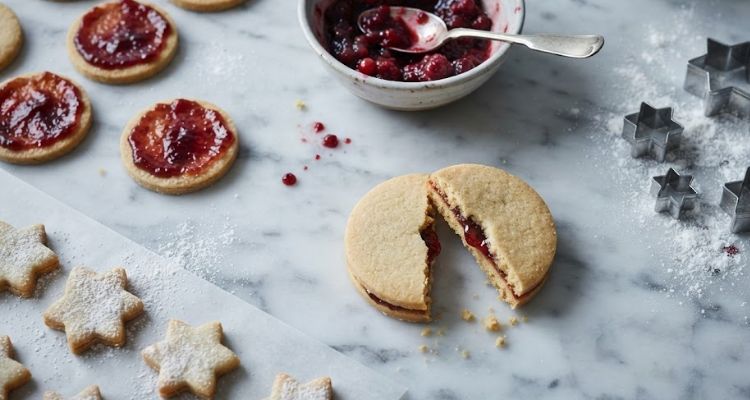
Nigella Lawson’s Linzer cookies are jam-filled sandwich biscuits made from a short dough of ground toasted hazelnuts, butter, plain flour and a whisper of cinnamon. They bake at 180°C (160°C fan) for just 9-10 minutes, and the recipe makes 28 finished cookies with redcurrant jelly and raspberry jam glinting through the cut-out tops.
The recipe is from Cook, Eat, Repeat (2020), and Nigella baked them on the book’s BBC Two Christmas Special that December. She frames them as what a jammy dodger dreams of becoming, crediting their “melting tenderness and celestial lightness” to the toasted hazelnuts in the dough. It’s her extravagant Austrian answer to a British lunchbox biscuit.
Those hazelnuts are also where the recipe goes wrong for most people. Nigella is firm that they must be completely cold before grinding, because warm nuts release their oil and turn to paste instead of the fine sand the dough needs. If you’re toasting your own, 10-15 minutes at 180°C (160°C fan), then walk away until they’re stone cold.
Nigella Lawson Linzer Cookies
Course: DessertCuisine: BritishDifficulty: Easy28
servings45
minutes10
minutes150
kcal3
hours55
minutesNigella’s Christmas biscuit from Cook, Eat, Repeat: 56 thin hazelnut rounds sandwiched in pairs around a redcurrant and raspberry filling. The dough divides into four discs, so you can bake half now and freeze the rest for December.
Ingredients
100g skinned toasted hazelnuts (see FAQ for almond swap)
125g caster sugar
300g plain flour, plus more for rolling out
200g unsalted butter (cold if using a processor, soft if making by hand)
¼ tsp ground cinnamon
⅛ tsp fine sea salt
1 large egg, at room temperature
1 large egg yolk, at room temperature
Icing sugar, to dust the cookies
Approx. 4 x 15ml tbsp redcurrant jelly
Approx. 4 x 15ml tbsp seedless raspberry jam
- Kit: a 6cm round cookie cutter (smooth, not crinkle-edged), plus mini Christmas cutters.
Directions
- Make the dough (processor): Blitz the hazelnuts with the sugar to a fine sand, then add the flour. Add the butter in 1cm dice along with the cinnamon, salt, whole egg and yolk, and keep the processor running until everything gathers into a dough. It takes longer than you expect, so don’t panic and add liquid.
- Make the dough (by hand): Stir the ground nuts into the flour, cinnamon and salt and set aside. Cream the soft butter with the sugar, whisk the egg and yolk together in a jug and beat them in very gradually, then work the dry mixture in a little at a time until a soft dough forms.
- Chill: Divide the dough into 4 equal pieces, roll each into a ball and flatten into a fat patty. Wrap tightly and refrigerate for 1 hour, or for up to 3 days if it suits you.
- Roll the bases: Let two discs sit out for about 15 minutes while the oven heats to 180°C/160°C fan, and cut two pieces of baking parchment to fit your cookie sheets. Roll one disc out to 2-3mm thick directly on the parchment, going between two sheets if it sticks.
- Cut the bases: Stamp out 6 circles with the floured 6cm cutter, leaving only modest gaps since the dough barely spreads. Peel away the trimmings, slide the parchment onto a cookie sheet and ball up the offcuts for re-rolling later.
- Cut the tops: Roll the second disc the same way, but this time stamp a small shape from the centre of each circle with a floured mini cutter, a heart, star, tree or plain hole, easing any stuck shapes out with a cocktail stick. In a warm kitchen, chill the cut cookies on their sheet for 10 minutes so the edges bake sharp.
- Bake: Bake for 9-10 minutes, until the edges are only just turning the palest gold. Move them straight to a wire rack, sliding the whole parchment across if lifting them feels risky.
- Repeat: Roll, cut and bake the remaining two discs plus all the gathered offcuts, making sure the cookie sheets have fully cooled before reloading them.
- Fill and sandwich: Once the cookies are completely cold, dust the cut-out tops with icing sugar. Stir the redcurrant jelly and raspberry jam together until smooth, spread ½ teaspoon over each whole cookie leaving a bare rim, then lower a dusted top onto each one, handling it by the edges only.
FAQs
Can I use ground almonds instead of hazelnuts?
Yes, and it’s Nigella’s own suggested swap: replace the hazelnuts with 100g of ready-ground almonds and skip the grinding entirely. That also solves the equipment problem, since without a processor you’d otherwise need a bullet blender to get the hazelnuts fine enough.
The trade-off is flavour. Toasted hazelnuts carry that deep, praline-like warmth that defines an Austrian Linzer bake, while almonds give a milder, more marzipan note. The texture stays just as short either way, so it comes down to what’s in your cupboard.
Why mix redcurrant jelly with raspberry jam?
Each half fixes the other. Redcurrant jelly sets firm and holds the sandwich together but tastes rather austere alone, while seedless raspberry jam brings fruit and sharpness but slides around. Mixed smooth, you get a filling that stays put and still tastes of something.
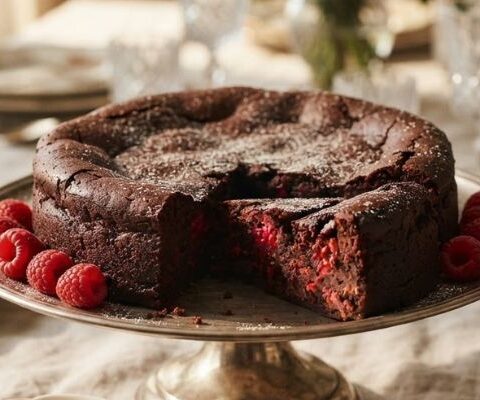
Stick to the ½ teaspoon per cookie and the bare frame around the edge, because the filling spreads under the weight of the top. If raspberry’s sharpness is your thing, Nigella pushes it much further in her chocolate raspberry pudding cake, where whole berries cut through dark chocolate.
Why are the cookies still pale when they come out?
Because that’s the finish line, not underbaking. The dough is high in butter and ground nuts, both of which scorch quickly, so the biscuits are done when the edges show only the faintest gold and the surface still looks pale. Push them to an even brown and the hazelnut flavour turns bitter.
In our kitchen the first sheet needed the full 10 minutes and the second was ready at 9, because the oven was properly saturated with heat by then. Watch the edges, not the clock.
Do I need proper Linzer cutters?
No. Nigella’s kit list is a smooth 6cm round cutter plus mini Christmas cutters, but she offers a workaround: the sharp end of a piping nozzle stamps a perfectly good small hole. That classic dot of jam through a plain circle is arguably the most traditional look anyway.
She does argue the mini cutters earn their place, predicting you’ll bake these more than once. Having made three batches since November, I can’t say she’s wrong.
What’s the difference between Linzer cookies and a Linzertorte?
Same family, different format. The Linzertorte is the ancestor, a jam-filled nut pastry tart from Linz in Austria, topped with a lattice of dough and often cited as one of the oldest named cakes in Europe. Linzer cookies shrink that idea into individual sandwich biscuits, with the cut-out top standing in for the lattice.
The dough principle survives the translation: ground nuts, spice and butter, with jam doing the talking. It’s why these feel more like pastry than biscuit when you bite in, closer to a torte than to anything from a British biscuit tin.
How far ahead can I make them?
The dough is the flexible part. Raw discs keep 3 days in the fridge or freeze, tightly wrapped and boxed, for up to 3 months, defrosting overnight in the fridge. Baked but unfilled cookies hold 3 days in an airtight container, or freeze for a month and defrost at room temperature.
The one deadline is filling: sandwich them only on the day you serve, because the jam softens the biscuits over time. That makes them ideal for staged Christmas baking, alongside make-ahead bakes like her vegan gingerbread or a batch of New Year doughnuts for the following week.