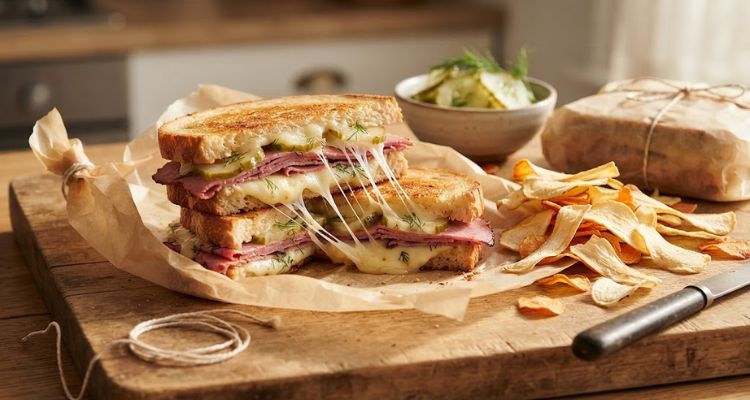
James Martin’s hot pastrami and cheese sandwich stacks three layers of sourdough, pastrami, fontina cheese and quick-pickled cucumber with dill, wraps each sandwich in parchment and bakes it until the cheese melts through. The parcels go into a 200°C (180°C fan, gas 6) oven for 10 minutes, served with deep-fried parsnip and carrot crisps. It serves four.
The recipe comes from BBC’s Home Comforts. Martin calls it a tasty portable snack for eating on the go, but it’s really a New York deli sandwich given the full treatment: fontina instead of processed cheese, quick-pickled cucumber instead of a jar of gherkins, and hand-cut root vegetable crisps instead of a packet. The parchment-parcel bake is what holds it all together.
The pickled cucumber is the detail that lifts this above a toastie. You dissolve sugar, salt and mustard seeds in hot rice wine vinegar, pour it over thinly sliced cucumber with dill, and it’s ready by the time you’ve built the sandwiches. That quick pickle brings sharpness and crunch that cuts through the rich pastrami and molten fontina.

James Martin Hot Pastrami And Cheese Sandwich
Course: Lunch, DinnerCuisine: BritishDifficulty: Easy4
servings20
minutes10
minutes1150
kcal30
minutesJames Martin’s parchment-baked pastrami sandwich from BBC’s Home Comforts: a triple-decker of sourdough, fontina and quick-pickled cucumber with dill, wrapped and baked until the cheese melts through. Served with hand-cut parsnip and carrot crisps. A deli sandwich done properly. Serves four.
Ingredients
150ml/5fl oz rice wine or cider vinegar
50g/2oz caster sugar
2 tsp sea salt
1 tsp yellow mustard seeds
1 cucumber, thinly sliced
1 small bunch fresh dill, leaves only, roughly chopped
12 slices sourdough bread, preferably a wheat and rye mix
40g/1½oz softened butter
1 tbsp Dijon mustard
300g/10½oz thinly sliced pastrami
400g/14oz fontina, sliced
vegetable oil, for deep frying
3 parsnips, peeled and cut into wafer-thin slices with a potato peeler
3 carrots, peeled and cut into wafer-thin slices with a potato peeler
sea salt and freshly ground black pepper
Directions
- Quick-pickle the cucumber:Bring the vinegar to a simmer with the sugar, salt and mustard seeds, stirring until the sugar dissolves. Pour over the thinly sliced cucumber in a bowl, stir in the dill and set aside.
- Toast and butter the bread:Toast all 12 slices of sourdough and spread with butter.
- Build the sandwiches:Spread 4 slices with mustard and top each with a layer of pastrami. Divide half the fontina among them, then arrange a layer of pickled cucumber on top. Repeat the layering with another slice of bread, butter, mustard, pastrami, remaining cheese and more cucumber. Close each sandwich with a final slice of bread.
- Wrap:Wrap each sandwich in a large sheet of baking parchment and tie with cooking string.
- Bake:Transfer the parcels to a baking tray and bake at 200°C/180°C fan/gas 6 for 10 minutes, until the cheese has melted.
- Fry the crisps:Heat the oil to 160°C in a deep-fat fryer or deep pan (hot oil is dangerous; don’t leave it unattended). Lower the parsnip and carrot slices in batches and fry for 4-5 minutes until crisp but not browned. Drain on kitchen paper and season.
- Serve:Serve the hot sandwiches in their parcels with the root vegetable crisps piled alongside.
FAQs
What is fontina, and can I use a different cheese?
Fontina is an Italian alpine cheese that melts into a smooth, creamy pool with a mild, slightly nutty flavour, which is why it works so well sealed inside a hot parcel. It’s a semi-soft cheese, widely available in most supermarkets or delis, usually found near the Gruyère and Comté.
If you can’t find it, Gruyère is the closest swap, melting just as cleanly with a nuttier, sharper edge. Martin used Gruyère in his brioche sandwich for the same reason: it melts reliably under heat without splitting. Raclette or Emmental also work. Avoid mozzarella, which melts stretchy rather than creamy and goes rubbery once it cools.
Why bake the sandwiches in parchment parcels?
The parchment traps steam inside as the sandwich heats, so the cheese melts evenly through all three layers without the bread drying out or burning at the edges. It’s gentler and more controlled than grilling or pressing, and it lets you build a tall, triple-decker sandwich that would fall apart under a panini press.
It also makes the sandwiches portable, which is Martin’s whole point: a tasty snack for eating on the go, handed to people in their wrappers. The parchment parcel is part presentation, part practical technique. Tie them neatly with string and they look like a proper package when they come to the table.
Do I have to make the pickled cucumber from scratch?
You don’t have to, but it takes 5 minutes and the difference is real. Martin’s quick pickle dissolves sugar, salt and mustard seeds in hot vinegar, pours it over thinly sliced cucumber with dill, and it’s ready by the time you’ve assembled everything else. It’s sharper, fresher and crunchier than anything from a jar.
Shop-bought dill pickles or cornichons work in a pinch, sliced thin. The important thing is that something sharp and acidic goes into the sandwich, because 400g of fontina and 300g of pastrami need cutting through. Without it, the sandwich is all richness and no lift.
What are the root vegetable crisps about?
They’re Martin’s upgrade on a packet of crisps alongside a sandwich. You peel parsnips and carrots into wafer-thin slices with a potato peeler, then deep-fry at 160°C until crisp but not browned, which dries them out into light, snappy crisps. The lower frying temperature is deliberate: too hot and they burn before they dry.
If you’d rather skip the deep-frying, you can bake the peeled slices on a tray at 180°C, tossed lightly in oil, for about 15 minutes, turning once. They won’t be quite as light, but they’ll crisp up. Or just serve the sandwiches with a sharp dressed salad for something fresher, the way Martin pairs his ultimate macaroni cheese with mustard-dressed Romaine.
How is this different from a Reuben?
Close cousins, but not the same. A classic Reuben uses corned beef (not pastrami), Swiss cheese, sauerkraut and Russian or Thousand Island dressing, griddled on rye bread. Martin’s version swaps in pastrami, fontina, his own quick-pickled cucumber with dill, and Dijon mustard, and bakes the whole thing in a parchment parcel rather than pressing it on a griddle.
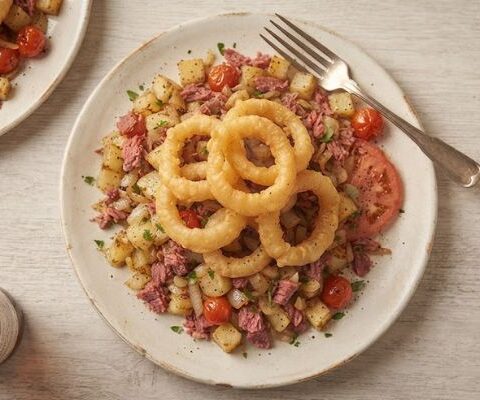
The spirit is the same, a hot, meaty, cheesy deli sandwich with something sharp to cut through, but Martin’s choices lean more refined and less salty. If you enjoy this kind of loaded sandwich, his corned beef hash uses that same deli-style corned beef in a completely different way, fried into a hash with beer-battered onion rings.
Can I make these ahead or serve them cold?
The parcels can be assembled, wrapped and chilled for a few hours before baking, which makes them practical for a lunch gathering: build them in the morning, bake when people arrive. The quick pickle also benefits from sitting longer, so making it a couple of hours ahead deepens the flavour.
Once baked, eat them hot while the fontina is still molten. Cold, the cheese sets and the bread firms up, losing the appeal of the melting, steamy parcel, so this isn’t one to make and refrigerate for later. The root crisps hold well at room temperature, though, so fry those whenever suits you.