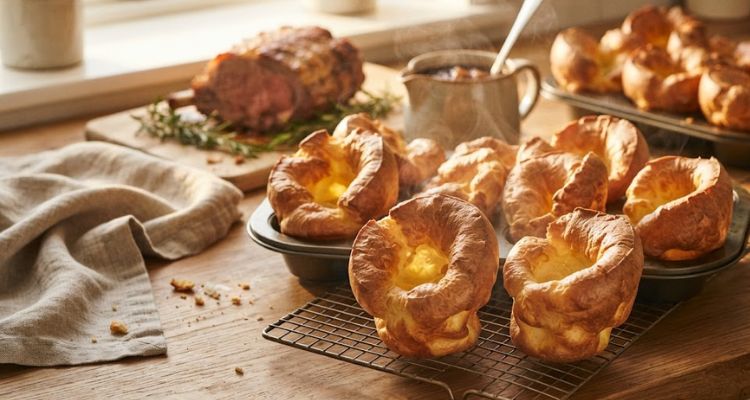
James Martin’s Yorkshire puddings use a generous eight eggs to a batter of plain flour and whole milk, cooked in smoking-hot beef dripping for tall, crisp-edged, soft-centred puddings. The batter rests overnight, then bakes at 220°C (200°C fan, gas 7) before a lower finish to set the shape, and the recipe makes 12 really big Yorkshires.
The recipe comes from his Granny, by way of his BBC show Saturday Kitchen. The eight eggs are the family’s slightly “controversial” secret, giving extra lift and a softer, richer texture than the usual three-egg batter. Martin is also firm that it has to be beef dripping, which he rates over duck or goose fat for flavour.
The make-or-break moment is the fat. It must be smoking hot before the batter goes anywhere near it, so the cold batter hits screaming-hot dripping and steam blasts it upwards into a tall pudding. Fill each hole only half full, which leaves room for that dramatic climb up the sides of the tin.
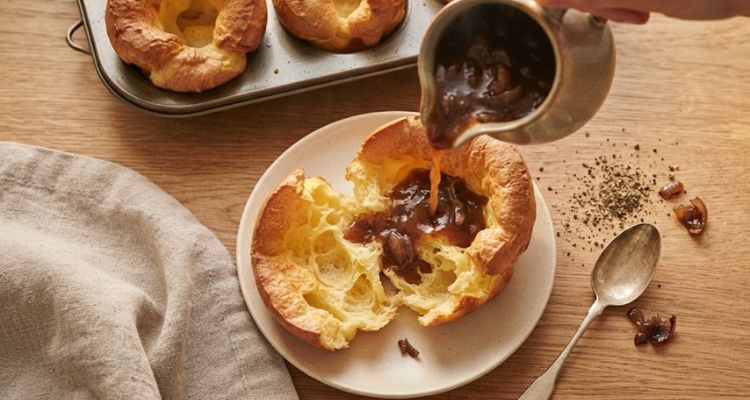
James Martin Yorkshire Pudding
Course: SidesCuisine: BritishDifficulty: Easy12
servings10
minutes35
minutes195
kcal45
minutesJames Martin’s Granny’s Yorkshire puddings from Saturday Kitchen, an eight-egg batter cooked in smoking beef dripping for maximum rise. Rested overnight, baked fierce then set at a lower heat. Makes 12 big puds, and any spares freeze well.
Ingredients
225g/8oz plain flour
salt and freshly ground black pepper
8 free-range eggs
600ml/1 pint milk
55g/2oz dripping
- Kit:three 4-hole Yorkshire pudding tins.
Directions
- Make the batter:Put the flour and a little salt and pepper in a bowl. Add the eggs and mix with a whisk or fork to a smooth paste, then gradually pour in the milk, mixing slowly so no lumps form.
- Rest it:Cover the bowl with cling film and chill overnight, or set aside for at least 2 hours.
- Heat the tins:Preheat the oven to 220°C/200°C fan/gas 7. Put a little dripping in each hole of the three tins and heat in the oven until smoking hot, 5-10 minutes.
- Add the batter:Remove the tins and quickly pour in the batter, filling each hole about half full. Return to the oven and cook for 20-25 minutes.
- Set the shape:Very briefly open the oven door to let the steam escape. Turn the oven down to 190°C/170°C fan/gas 5 and cook for a further 10 minutes, until crisp, so the puddings hold their shape and don’t collapse.
- Serve:Remove from the oven and serve straight away.
Notes
- Rest the batter. Chilling the batter, ideally overnight or for at least 2 hours, lets the gluten in the flour relax, so it stretches more and the puddings rise beautifully.
- Keep the oven hot. Make sure the oven is really hot and don’t open the door for the first 20 minutes. Opening it drops the temperature, and the puddings need that fierce heat to set their shape.
- Egg size. These eggs are medium (53-63g each). If yours are larger, use fewer, aiming for a total weight of around 450-475g (1lb-1lb 1oz).
- Rest Overnight (or 2 hours)
FAQs
Why does James use so many eggs?
Eight eggs is a lot for one batter, and it’s the heart of his Granny’s recipe. The extra eggs give the puddings more lift and a softer, richer, almost custardy centre, compared to the leaner three-egg batter many recipes use. Martin has called it a slightly controversial family habit, but it’s what defines these particular Yorkshires.
The eggs provide both structure and rise: their protein sets into the tall walls, and the water in them turns to steam that inflates the pudding. That’s also why egg size matters, and why the notes tell you to adjust for larger eggs, since too much liquid egg can make the batter too loose to climb.
Beef dripping or vegetable oil?
Martin comes down firmly on beef dripping, which he prefers even over duck or goose fat for the depth of savoury flavour it gives. It’s the traditional choice for a Yorkshire pudding served with roast beef, and it browns the edges beautifully. So if you want his exact result, use dripping.
That said, the BBC recipe notes you can use vegetable oil instead, which also makes the puddings suitable for vegetarians. Whichever you choose, the crucial thing is that it must be smoking hot before the batter goes in, since a lukewarm fat gives flat, greasy puddings rather than tall, crisp ones.
Why didn’t mine rise, or why did they collapse?
Almost always it’s a heat problem. If the dripping wasn’t smoking hot when the batter went in, or the oven wasn’t fully up to 220°C, the puddings can’t get their initial steam-driven surge and stay flat. Overfilling the holes past halfway also weighs them down and stops them climbing.
Opening the oven door too early is the other classic mistake, which is why the notes stress keeping it shut for the first 20 minutes: the temperature drop can make a rising pudding sink. The final 10 minutes at the lower 190°C is what crisps and sets the walls so they hold their shape once out of the oven, rather than deflating on the worktop.
Can I mix the batter in a blender or food processor?
Martin advises against it. He makes the point that a machine over-works the batter and toughens the gluten, which stops the puddings rising properly, so he mixes his by hand. The BBC method reflects this, using just a whisk or fork to bring the batter to a smooth paste.
You’re not trying to aerate or beat air in, simply to combine the flour, eggs and milk smoothly without lumps. Gentle hand-mixing does that while keeping the gluten relaxed, which, together with the overnight rest, is what gives you that stretchy batter capable of a big rise.
Can I make them ahead or freeze them?
Yes, and this is one of their strengths. Martin notes that any leftovers freeze well, so it’s worth making the full batch of 12 even for a smaller meal. Freeze them once cooled, then reheat from frozen in a hot oven for a few minutes until crisp and hot through, which revives them surprisingly well.
The batter itself is also a make-ahead component, since it rests overnight in the fridge anyway. That makes these practical for a Sunday roast: mix the batter the night before, and the puddings become a quick job that slots in around resting the meat and finishing the gravy.
What do I serve them with, and can I make fewer or smaller ones?
Yorkshire puddings are the classic partner to roast beef, and Martin’s own favourite is to serve them with a rich onion gravy for pooling into the crisp cups. They’re also good with any roast, or, in true Yorkshire tradition, eaten on their own with gravy before the main course.
If 12 large puddings is too many, simply halve all the ingredients for a smaller batch. For smaller, more canapé-sized puddings, use a 12-hole bun or muffin tin instead of the deep Yorkshire tins, and reduce the cooking time, watching them closely since they’ll crisp up faster.