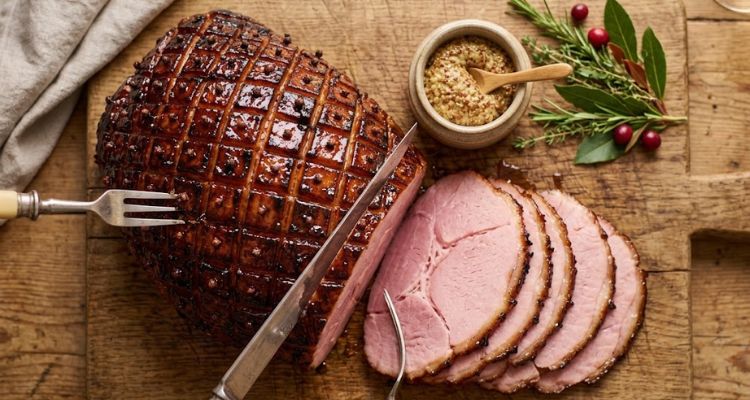
Nigella Lawson’s slow-cooked black treacle ham is a boneless gammon coated in black treacle, wrapped in foil and baked very low for 12 to 24 hours, then glazed with treacle, demerara and mustard. It serves 10 to 12 with leftovers, from her book Simply Nigella.
She’s clear it doesn’t replace her beloved Ham in Coca-Cola from Nigella Bites, in her heart or on her table, but calls this slow-baked version a revelation of a different sort. The meat comes out astonishingly tender, carves into thin slices with ease, shrinks very little, and spares you wrestling a big joint in boiling liquid.
It’s her holiday ham: spectacular served hot, and handy afterwards to have cold alongside cold turkey and for general sandwich duty. It was the centrepiece of her Simply Nigella Christmas Special, standing in for the traditional turkey.
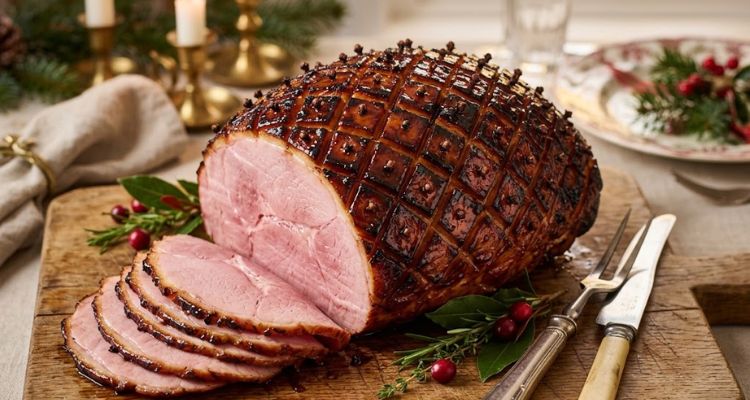
Nigella Lawson Slow-Cooked Black Treacle Ham
Course: Dinner, Lunch, MainCuisine: BritishDifficulty: Easy10-12
servings20
minutes12
hours350
kcal12
hours40
minutesNigella’s festive ham from Simply Nigella: boneless gammon slow-baked in foil for 12 to 24 hours, then glazed with black treacle, demerara and mustard. Serves 10 to 12.
Ingredients
- For the joint:
3½ kg boneless gammon joint, rind on
150g black treacle
- For the glaze:
1 tablespoon whole cloves
4 tablespoons black treacle
4 tablespoons demerara sugar
1 tablespoon Dijon mustard
Directions
- Treacle and wrap: Preheat the oven to 250°C/230°C fan/gas mark 9/450°F and bring the gammon to room temperature. Line a large roasting tin with foil and sit a wire rack on top. Lay two big pieces of foil across the rack in opposite directions (four corners to wrap with). Sit the gammon on top and pour the 150g treacle over, straight onto the rind, letting it run down both sides. Don’t fuss over spreading it; the oven coats it.
- Seal: Lift the sides and ends of the first foil layer and seal at the top, leaving room around the gammon, then seal the ends. Repeat with the second piece, pinching any gaps. Add a third piece over the whole parcel, well sealed.
- Slow bake: Cook for 30 minutes, then turn the oven down to 100°C/80°C fan/gas mark ¼/200°F and leave for a further 12 to 24 hours.
- Unwrap: Take out and open the foil (reserve the liquid to moisten the meat later). Lift onto a board, snip off the string and peel off the rind, leaving a good layer of fat. Increase the oven to 200°C/180°C fan/gas mark 6/400°F.
- Score and glaze: Cut a diamond pattern in the fat about 2cm apart. Stud the centre of each diamond with a clove. Mix the glaze treacle, demerara and mustard and spread over the fat, spooning back any that dribbles off.
- Finish: Bake 20 minutes until the glaze is burnished and blistered. Rest 10 to 20 minutes before carving into thin slices.
Notes
- (shorter method): If 12 to 24 hours doesn’t suit, cook it for 5 hours at 180°C/160°C fan/gas mark 4/350°F instead, then glaze as above.
- (the juices): The liquid from the first bake is gorgeously flavoured but very intense. Nigella pours a little over the carved slices, but go sparingly.
- (for the US / fully cooked ham): Fully cooked hams are more common in the US. Choose one with rind on, not spiral cut. Smear the rind with 2 tablespoons of molasses, wrap in a baggy foil parcel with sealed edges, and reheat in a roasting pan per the producer’s instructions. Reserve the juices (use sparingly), remove the rind leaving a good layer of fat, then glaze as above.
- (store): Cool leftovers as fast as possible, cover or wrap tightly in foil and refrigerate within 2 hours. Keeps in the fridge up to 3 days.
- (freeze): Freeze in an airtight container (or wrapped in foil in a resealable bag) up to 2 months. Defrost overnight in the fridge.
- Cook time: 12 to 24 hours (plus 20 min glazing)
FAQs
How can it cook for 24 hours without drying out?
Because it isn’t really roasting, it’s steaming gently in its own moisture. Nigella wraps the gammon in a tightly sealed triple layer of foil, so in the very low oven (100°C) it steams sweetly rather than drying out. That’s the secret to meat that comes out astonishingly tender and carves into thin slices with ease.
The long, slow cook also means very little shrinkage, unlike boiling a joint, and no wrestling a heavy pan of boiling liquid. The initial 30-minute blast at a high temperature gets things going before you drop the heat right down. The foil seal is what makes it work, so pinch every gap closed. If a full day doesn’t suit, there’s a 5-hour version below.
Can I cook it faster than 12 to 24 hours?
Yes. Nigella gives a shorter alternative for when the overnight cook doesn’t fit your plans: cook it for 5 hours in a 180°C/160°C fan/gas mark 4/350°F oven instead, still wrapped in the sealed foil, before unwrapping and glazing exactly as in the main method.
The 12-to-24-hour version is the most hands-off, as you can start it before bed and wake up to a cooked ham, which is why it’s such a good entertaining dish. But the 5-hour route gets you there the same day with similar tenderness. Either way, the glaze step at the end is identical, and that’s where the ham gets its burnished, blistered finish.
What’s the glaze, and why black treacle?
The glaze is black treacle, demerara sugar and Dijon mustard, and it’s what turns a plain cooked joint into something spectacular. The treacle gives a deep, dark, almost bitter-sweet molasses flavour and glossy colour, the demerara adds crunch and caramelises in the heat, and the mustard brings a sharp savoury edge that cuts the sweetness.
Black treacle is used twice: poured over the raw rind before the long bake, and again in the glaze at the end. It’s much darker and more intensely flavoured than golden syrup, closer to molasses (which is the US swap). Studding the scored fat with cloves adds warm, festive spice. A final 20 minutes in a hot oven blisters it all to a sticky, burnished crust.
How do I use the juices that collect?
The foil parcel makes a fair amount of liquid during the long bake, and it’s worth saving. Nigella calls these juices gorgeously flavoured but very intense, so her advice is to pour just a little over the cut slices of meat to moisten them, going sparingly. They’re concentrated and salty, so a drizzle goes a long way.
Don’t tip the lot over the ham or it can overwhelm. A spoonful over carved slices keeps the meat moist and adds flavour, especially if serving it hot. You could also save the juices to enrich a gravy or a bean dish, used in small amounts. Reserve them when you open the foil, before you move on to glazing.
Can I make it ahead, and how do I store leftovers?
This is very much a make-ahead dish by design, which is its whole appeal for the holidays. You cook it a day in advance, serve it hot as a centrepiece, then have cold ham to bring out alongside cold turkey and for sandwiches afterwards. Nigella built it around making your festive life easier.
For leftovers, cool the ham as quickly as possible, then cover or wrap tightly in foil and refrigerate within 2 hours of cooking. It keeps in the fridge for up to 3 days. It also freezes well for up to 2 months, in an airtight container or wrapped in foil inside a resealable bag; defrost overnight in the fridge before using. Cold leftover ham is brilliant in sandwiches, with eggs, or stirred through a rice dish. There’s more on the Nigella Lawson recipes page.
What should I serve with it?
As a festive centrepiece it wants proper sides. Nigella served it in her Christmas special with a bright sweet-and-sour vegetable slaw, and that acidity is the key: something sharp to cut through the rich, sweet-glazed meat. A tangy slaw, pickles or mustard on the side all work.
For a full holiday table, braised red cabbage with cranberries is a natural match, its sweet-sharp fruitiness balancing the salty ham, and roast red chicory adds a pleasant bitterness. Hot, it’s spectacular with roast potatoes and greens; cold, it’s all about sandwiches and salads. I’d serve something sharp and something green, and let the ham be the star.