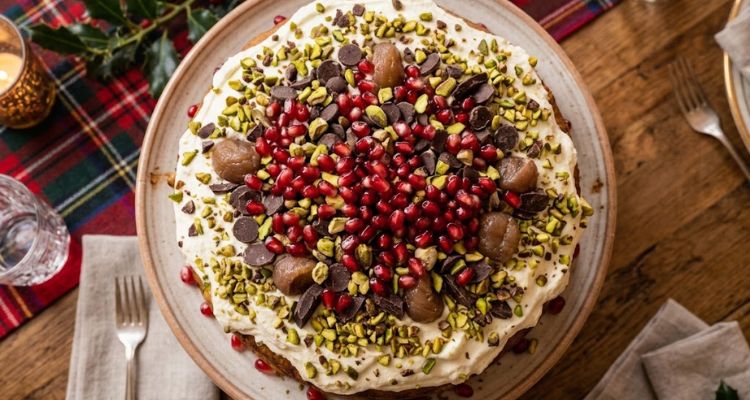
Nigella Lawson’s Italian Christmas pudding cake is a no-bake, tiramisu-style layered cake of liqueur-soaked panettone and a mascarpone cream studded with chocolate, marrons glacés and pistachios, jewelled with pomegranate. It yields 12 to 14 slices, from her book Nigellissima.
She describes it as her own recipe but a conflation of a couple of Italian Christmas must-haves: the glorious fruit-studded panettone and crema di mascarpone, which she calls tiramisu without the savoiardi layer, sometimes with chocolate stirred through. She adds a cassata element too, crumbling in marrons glacés (or any candied or dried fruit) and pistachios.
The pomegranate seeds tumbled over the top are there for their beauty and a seasonal touch, but importantly, she notes, they’re thought to bring luck, so should be an indispensable part of the Christmas table.

Nigella Lawson Italian Christmas Pudding Cake
Course: DessertCuisine: BritishDifficulty: Easy12-14
servings30
minutes550
kcal30
minutesNigella’s no-bake festive cake from Nigellissima: liqueur-soaked panettone layered with a mascarpone cream of chocolate, marrons glacés and pistachios, topped with pomegranate. Yields 12 to 14 slices.
Ingredients
approx. 625g panettone (or pandoro)
6 tablespoons Tuaca liqueur
2 large eggs, at room temperature
75g caster sugar
500g mascarpone cheese, at room temperature
250ml double cream, at room temperature
125ml Marsala
75g marrons glacés, in pieces
125g mini chocolate chips (or regular chips or finely chopped chocolate)
100g shelled pistachios, chopped
2 tablespoons pomegranate seeds
Directions
- Line the tin: Using a serrated knife, cut the panettone into 1cm slices. Use about a third to line the base of a 22 or 23cm springform tin, tearing pieces to fill any gaps (panettone is soft and mouldable). Drizzle over 2 tablespoons Tuaca to dampen.
- Make the cream: Whisk the eggs and sugar (a freestanding mixer is easiest) until very frothy and increased in volume. More slowly, whisk in the mascarpone and double cream, then gradually the Marsala, until thick and spreadable. Remove 250ml to a covered container and chill (this is for the top, added at serving).
- Stud the filling: Crumble the marrons glacés into the big bowl of cream, add 100g of the chocolate chips and 75g of the pistachios, and fold in.
- Layer: Spread half this filling over the panettone base. Cover with another third of the panettone slices (no gaps), dampen with 2 more tablespoons Tuaca. Spoon on the rest of the filling and spread. Top with a final layer of panettone and the last 2 tablespoons Tuaca.
- Chill: Cover tightly with cling film, pressing down a little, and fridge overnight or up to 2 days.
- Serve: Unmould onto a plate or stand (don’t lift the cake off the base, the bottom panettone is too damp). Spread with the reserved mascarpone mixture. Scatter the top (and sides, if you like) with the remaining chocolate chips, pistachios and pomegranate seeds.
Notes
- (food safety, raw egg): This contains raw or lightly cooked eggs, so it isn’t suitable for anyone with a compromised immune system, young children, the elderly or pregnant women.
- (egg-free version): To make it without raw egg, omit the eggs and caster sugar. Instead, whisk 50g icing sugar into the mascarpone and double cream, then carry on as normal. For the original’s eggy richness, add 2 tablespoons of Advocaat along with the Marsala.
- (pomegranate for luck): The pomegranate seeds are decorative and seasonal, but Nigella notes they’re thought to bring luck, so she considers them an indispensable part of the Christmas table.
- (the sprinkles hide the edges): The scattered chocolate, pistachios and pomegranate also conveniently camouflage any less-than-perfect edges left by the springform base.
- (make ahead): Assemble to the end of chilling and keep in the fridge up to 2 days, then finish as directed
- (freeze): Freeze up to 3 months. Spread the reserved mascarpone on top, chill 6 hours, unmould (leaving it on its base), open-freeze until solid, then double-wrap in cling film and foil. Defrost overnight in the fridge on a serving dish, adding the chocolate, pistachios and pomegranate before serving. Eat leftovers within 4 days of making, or 2 days of defrosting.
- Rest Time: Overnight
FAQs
What is this cake, exactly?
It’s Nigella’s own invention that marries several Italian Christmas classics into one no-bake showstopper. The base and layers are panettone (the fruity Milanese Christmas bread), and the filling is crema di mascarpone, which she describes as tiramisu without the savoiardi biscuit layer. She then adds a cassata touch with crumbled marrons glacés (candied chestnuts), chocolate and pistachios folded through.
So think of it as a cross between tiramisu, trifle and cassata, built in layers in a springform tin and set in the fridge. There’s no baking at all, just assembly and chilling, which makes it an easy but impressive festive centrepiece. The liqueur-soaked panettone softens into something between cake and pudding, hence the name. It’s rich, boozy and celebratory, like her chocolate salame in festive spirit.
Can I make it without raw egg?
Yes, and Nigella gives a specific method for this, which is useful given the cake is often served to a crowd that may include pregnant women, young children or elderly guests who should avoid raw egg. Simply omit the 2 eggs and the caster sugar. Instead, whisk 50g of icing sugar into the mascarpone and double cream, then carry on with the recipe exactly as normal.
If you miss the eggy richness the original has, she suggests adding 2 tablespoons of Advocaat (the egg-based liqueur) along with the Marsala, which mimics that flavour without any raw egg. The texture stays lovely and the cake sets just the same. As written, with raw egg, do note it’s not suitable for those vulnerable groups, so the egg-free version is the safer choice for a mixed table.
What liqueurs can I use?
The recipe uses two: Tuaca (an Italian vanilla-citrus liqueur) to soak the panettone layers, and Marsala (a fortified Italian wine) whisked into the mascarpone cream. Both give a warm, boozy, festive depth. Nigella notes you can use another liqueur of choice for the soaking, so rum, brandy, Amaretto or more Marsala all work in place of the Tuaca.
The Marsala is fairly traditional for this kind of creamy Italian dessert (it’s classic in tiramisu-style creams), but sweet sherry or Vin Santo would stand in. Don’t skip the soaking liqueur entirely, as it’s what transforms the panettone from dry bread into a damp, pudding-like layer, though you could use strong coffee or orange juice for an alcohol-free version. The cake is noticeably boozy as written.
Can I change the fruit and nuts?
Absolutely, it’s a flexible, forgiving recipe. The marrons glacés give a luxurious candied-chestnut sweetness, but Nigella says any candied or dried fruits could do, so chopped candied peel, glacé cherries, dried cranberries, figs or candied ginger all work. The pistachios add colour and crunch, and could be swapped for other nuts.
The chocolate (she uses mini chips) can be any chocolate, finely chopped. This adaptability means you can lean it towards whatever “Christmassy” flavours you like or have in. Keep the mascarpone-cream base as written, as that’s the structural heart of the cake. The pomegranate on top, though, is worth keeping for its jewel-like beauty and, as Nigella notes, its association with luck.
Why can’t I lift it off the springform base?
Because the bottom layer of panettone becomes too delectably damp, as Nigella puts it, from soaking up the liqueur and the moisture of the cream overnight. If you try to slide it off the metal base onto a plate, that soft, saturated bottom layer will tear or collapse.
So the trick is to unmould only the ring of the springform tin and serve the cake sitting on its metal base, placed on a flat plate or cake stand. This is completely normal for this cake and not a failure. The scattered chocolate, pistachios and pomegranate around the edges conveniently hide any unattractive bits of the exposed base. Just slice and serve straight from the base.
How far ahead can I make it, and can I freeze it?
It’s designed to be made ahead, which is ideal for Christmas entertaining. In fact it must be assembled at least overnight before serving so the layers set and the panettone softens, and it keeps in the fridge for up to 2 days before you add the final topping. So it takes pressure off the big day entirely.
It also freezes for up to 3 months: spread the reserved mascarpone layer on top, chill 6 hours, then unmould (leaving it on its base) and open-freeze until solid before double-wrapping in cling film and foil. Defrost overnight in the fridge on a serving dish, and add the chocolate, pistachios and pomegranate just before serving. Eat leftovers within 4 days of making, or 2 days of defrosting. There’s more on the Nigella Lawson recipes page.