Nigella Lawson’s roast red chicory is quartered red chicory roasted with olive oil, dry white vermouth and thyme until charred, wilted and mellowed. It serves 3 to 4, from her book At My Table.
She’s firmly of the “bitter-is-better” school and says barely a week goes by without her cooking it, often just to let it go cold and eat as a salad. But it’s also for the bitter-hesitant: the oven mellows the rasping bite of raw chicory, and the vermouth makes it sweeten as it cooks.
That sweetening is the magic, which Nigella admits she doesn’t quite understand. The dry white vermouth, along with the roasting, tames the chicory’s sharpness into something softened, caramelised and almost sweet, with juices worth pouring over every last drop.
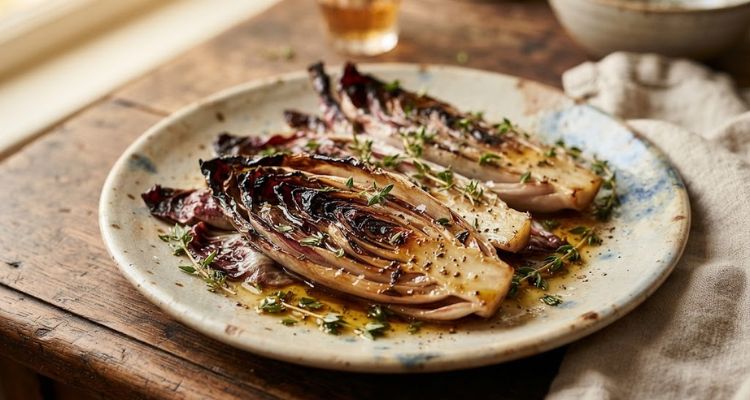
Nigella Lawson Roast Red Chicory
Course: Sides, AppetizersCuisine: BritishDifficulty: Easy3-4
servings5
minutes30
minutes130
kcal45
minutesNigella’s twice-weekly side from At My Table: quartered red chicory roasted with olive oil, dry white vermouth and thyme until charred, wilted and mellowed sweet. Serves three to four.
Ingredients
500g red chicory (4 to 5 heads), quartered lengthways
1 teaspoon Maldon sea salt flakes
4 x 15ml tablespoons (60ml) regular olive oil
6 x 15ml tablespoons (90ml) dry white vermouth
thyme (a few sprigs)
Directions
- Arrange and dress:Preheat the oven to 200°C/180°C fan/400°F. Arrange the quartered chicory spears cut-side up in a shallow roasting tin in which they sit snugly. Sprinkle with the salt and pour over the oil and vermouth. Turn the spears to coat, then sit them cut-side up again.
- Roast:Roast for 30 minutes, until the leaves are slightly charred and wilted and the cores soft.
- Rest and serve:Let the darkened, softened chicory sit in the tin for 10 minutes, then transfer to a plate, pouring every bit of juice over. Deglaze any sticky caramelised bits in the pan with a spoonful of boiling water and pour that over too. Strew with thyme and serve.
Notes
- (the thyme is not optional): Nigella says that although the thyme is just sprinkled on top, she doesn’t regard it as optional. Its flavour is essential to the dish, for her.
- (no vermouth): Replace the vermouth with 45ml of freshly squeezed orange juice mixed with the same amount of water.
- (white chicory): If you can’t get red chicory, use regular white chicory. Its bitterness is much more pronounced (not a bad thing in Nigella’s book, though you may want to add a little honey) and it’s less pretty, but the recipe works exactly the same way.
- (make ahead): Leftovers keep, refrigerated in an airtight container, for up to 5 days, and are lovely cold as a salad.
- Resting: 10 minutes
FAQs
Does it taste very bitter?
Less than you might fear, which is the point. Nigella loves bitterness, but even if you’re hesitant, the roasting mellows the rasping, sharp bite of raw chicory considerably, softening it into something gentler, deeper and almost sweet. So it’s a great gateway dish if bitter leaves usually put you off.
The dry white vermouth does a lot of the work too, somehow making the chicory sweeten as it cooks, which balances any remaining bitterness beautifully. If you use white chicory, which is sharper than red, and find it too much, Nigella suggests adding a little honey to take the edge off.
Why vermouth, and what can I use instead?
Dry white vermouth is the secret ingredient here. As it roasts with the chicory it mellows and, for reasons Nigella says she doesn’t quite understand, makes the chicory taste sweeter, while adding its own aromatic, herby depth to the pan juices. It’s a brilliant store-cupboard ingredient, since it keeps for weeks once opened.
If you’d rather not use alcohol, Nigella gives a specific swap: 45ml of freshly squeezed orange juice mixed with the same amount of water. The orange brings its own sweetness and acidity that works similarly to balance the bitterness. Either way, don’t skip the liquid, as it’s what creates the lovely juices to spoon over at the end.
What’s the difference between red and white chicory here?
Red chicory (also called red endive or radicchio’s relative) gives a prettier, more striking dish and is a little milder, which is why Nigella favours it. White chicory, sometimes called witloof or Belgian endive, is easier to find and works in exactly the same way, but its bitterness is much more pronounced.
Neither is wrong, it’s a matter of taste and availability. If you love bitterness, white chicory is great; if it’s too sharp, a drizzle of honey softens it, or stick with red. Radicchio also works as a substitute. Whichever you use, quarter the heads lengthways so they hold together and roast evenly.
Why is the thyme so important if it’s just sprinkled on top?
Nigella is emphatic that although the thyme only goes on at the end, it’s not optional: its flavour is essential to the dish for her. The woody, aromatic, slightly lemony notes of fresh thyme cut through the richness of the oil and the sweetness of the roasted chicory, pulling the whole thing together.
Strewn over the warm, softened chicory just before serving, it stays fresh and fragrant rather than cooking away. So don’t be tempted to leave it off thinking it’s a mere garnish. Fresh thyme is best; a little lemon zest can echo its brightness if you want to lift it further.
What do I serve it with?
It’s wonderfully versatile. Warm from the oven it’s an elegant side for roast meats, chicken, fish or sausages, its bitter-sweet character cutting through anything rich. Nigella herself loves it alongside a hearty stew, where its silky bitterness is just right against the richness.
She also often lets it go cold and eats it as a salad whenever the urge strikes, dressed in its own juices. It’s a lovely thing on a sharing or mezze table too. It pairs naturally with her chicken barley or chicken Marsala. There’s more on the Nigella Lawson recipes page.
Can I make it ahead or eat it cold?
Yes, and eating it cold is one of Nigella’s favourite ways: she often makes it specpartly to let it go cold and eat as a salad. The flavours settle and deepen as it sits, so it’s genuinely good at room temperature or chilled, dressed in its roasting juices.
Leftovers keep in the fridge in an airtight container for up to 5 days, making it a handy thing to have ready to add to salads, grain bowls or a plate of cold cuts. Pour all the pan juices over before storing, as that’s where much of the flavour lives. Bring it back to room temperature, or eat straight from the fridge.