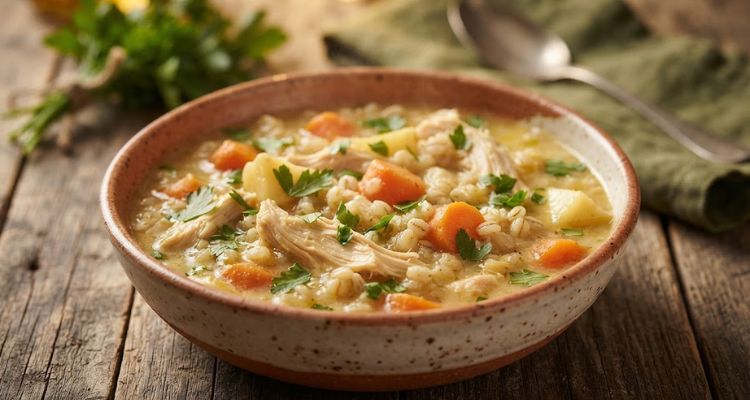
Nigella Lawson’s chicken barley is a thick, creamy one-pot pottage of chicken thighs, pearl barley and root vegetables simmered in mustardy stock. It serves 4 to 6, from her book At My Table.
She describes it as somewhere cosily between a stew and a slightly soupy, sticky risotto, offering instant comfort. It’s the sort of homely, unphotogenic food she says gets left behind in the Instagram age: not pretty to look at, but gratifyingly reassuring to eat.
The clever part is how little you do. Everything goes into one pot with mustard-stirred stock and simmers for an hour, with no browning or fuss. The pearl barley releases its starch to thicken the whole thing to a comforting, creamy pottage.

Nigella Lawson Chicken Barley
Course: Dinner, Lunch, SidesCuisine: BritishDifficulty: Easy4-6
servings15
minutes1
hour10
minutes440
kcal1
hour25
minutesNigella’s cosy one-pot pottage from At My Table: chicken thighs, pearl barley, leeks, carrots and parsnips simmered in mustardy stock into a thick, creamy stew. Serves four to six.
Ingredients
300g (trimmed weight) leeks (sliced)
300g carrots (peeled and cut into chunky batons)
300g parsnips (peeled and cut into very chunky batons)
175g pearl barley
6 chicken thighs, bone in and skin off
1½ litres hot chicken stock
4 teaspoons English mustard (from a jar)
leaves from 1 small (approx. 25g) bunch fresh flatleaf parsley
Directions
- Fill the pot:Tip the prepared vegetables into a heavy lidded casserole, then add the barley and chicken thighs.
- Add the stock:Pour the stock into a jug, stir in the mustard, and pour over the pan. Bring to the boil (skim the froth if you like, though Nigella admits she’s too lazy to).
- Simmer:Turn down the heat, partially cover and simmer for 1 hour, checking now and then that it’s not bubbling too hard or too gently, and giving a stir. If it looks like boiling dry, add a little boiling water.
- Rest:After the hour, the barley, vegetables and chicken should be tender and the juices all but absorbed (a little soupiness is fine). Off the heat, stand with the lid off for 10 minutes.
- Shred and serve:Pull the chicken meat off the bones with two forks and discard the bones. Stir some chopped parsley through the stew, and put the rest on the table for people to sprinkle over their own bowls.
Notes
- (skin off, bone in): Nigella prefers to remove the skin to keep the fat out, though keeping it on would do no harm. You can fry the removed skin to make chicken crackling. Do not even think about using boneless thigh fillets, as the bones give flavour and body.
- (for fussy eaters): If you’re feeding small children who object to “green bits”, don’t stir any parsley into the stew itself; keep it on the side.
- (make ahead / store): It’s not advisable to make ahead, but refrigerate leftovers within 2 hours of cooking, in an airtight container, for up to 3 days. Reheat in a saucepan with a splash of water until piping hot. Reheat only once.
- (freeze): Leftovers freeze for up to 3 months. Defrost overnight in the fridge and reheat as above.
FAQs
What is pearl barley, and what does it do here?
Pearl barley is barley grain with the tough outer husk polished off, so it cooks relatively quickly to tender, slightly chewy, plump little grains. In this dish it does two jobs: it makes the stew substantial and filling, and, crucially, it releases its starch as it simmers, thickening the whole pot to that creamy, risotto-like pottage.
That natural thickening is why the dish turns thick and sticky rather than staying a thin soup. It keeps absorbing liquid even after cooking, so leftovers thicken further and need loosening with water when reheated. Rinse it before adding if you like, though it’s not essential here.
Why bone-in, skin-off thighs, and why not boneless fillets?
Nigella is emphatic: don’t even think about using boneless thigh fillets. The bones are what give the stew its depth and body, releasing flavour and a little gelatine into the broth over the hour’s simmer, which boneless fillets simply can’t do. The meat also stays juicier on the bone and shreds beautifully at the end.
She takes the skin off because, for once, she prefers to keep the fat out of the dish, though she says keeping it on would do no harm. Don’t waste the removed skin, though: fry it separately to make crisp chicken crackling to crunch on. Pull the cooked meat off the bones with two forks before serving.
What does the mustard do?
Four teaspoons of English mustard stirred into the stock gives the dish a gentle, savoury warmth and depth that lifts what could be a plain chicken-and-grain stew. It melts into the broth as everything cooks, so you don’t get a fierce mustard hit, just a rounded, slightly piquant background flavour that works beautifully with the chicken and root vegetables.
You can adjust it to taste, and some cooks like a little more. Dijon gives a tangier note, or wholegrain adds texture, if you prefer. It’s a simple way to season the whole pot from the start, much as the mustard works in Nigella’s chicken Marsala.
Can I use different vegetables?
Yes, it’s a forgiving, adaptable one-pot. Leeks, carrots and parsnips give a sweet, earthy, wintry base, but other root vegetables work well: swede, turnip, celeriac or ordinary potatoes all suit it. Cut everything into chunky batons, as Nigella does, so they hold their shape over the hour rather than disintegrating.
Keep the total weight of veg roughly the same so the balance of liquid stays right. Celery adds a savoury note if you have it. It’s a brilliant way to use up a glut of winter roots, and a genuinely nourishing, one-pot meal in the same comforting spirit as her chicken and pea traybake.
What do I serve it with, and how thick should it be?
It’s a complete meal in a bowl, hearty with chicken, barley and vegetables, so it needs nothing more than crusty bread for mopping, if that. After an hour the juices should be all but absorbed into a thick, creamy pottage, though Nigella says a little soupiness is no bad thing, so cook it to the consistency you like.
If it’s thicker than you want, loosen it with a splash of hot stock or water; if too thin, simmer a little longer uncovered. Serve in warmed bowls with parsley scattered over. A slice of Nigella’s cheese garlic bread alongside makes it a feast. There’s more on the Nigella Lawson recipes page.
Can I make it ahead, store or freeze it?
Nigella advises against making it fully ahead, partly because the barley keeps drinking up liquid, so a made-ahead batch thickens and stiffens. But leftovers keep and freeze well. Refrigerate them within 2 hours of cooking, in an airtight container, for up to 3 days, reheating in a saucepan with a splash of water until piping hot, and reheat only once.
It also freezes beautifully for up to 3 months, which makes it great for batch cooking a comforting winter supper. Defrost overnight in the fridge and reheat the same way. Expect to add a good splash of water or stock when reheating from chilled or frozen, as it will have thickened considerably.