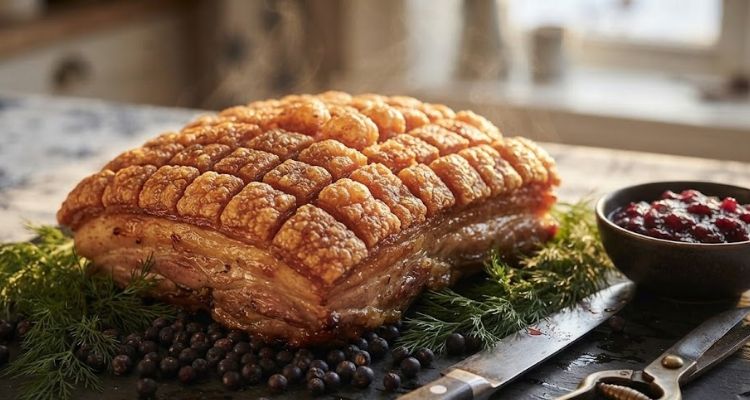
Nigella Lawson’s Norwegian pork ribs are a slow-roasted slab of bone-in pork belly, rubbed with a green paste of garlic, juniper and dill, cooked until the meat is meltingly tender and the rind shatters into crackling. It roasts across three temperature stages over roughly three hours, and a 3kg joint serves four to six with the leftovers Nigella considers essential.
The recipe is from Cook, Eat, Repeat (2020), and she cooked it on the book’s BBC Two Christmas Special. The method breaks every crackling rule you’ve been taught: you deliberately wet the rind with just-boiled water under foil. Nigella calls the technique “an absolute revelation,” and it’s the whole trick.
Softening the rind first is what lets it crisp later. The 45 minutes of steaming under foil puffs and relaxes the skin, so when the heat comes back up at the end, it blisters into deep-gold squares instead of staying leathery. Skip that step and you get chewy rind, no matter how hot you finish it.
Nigella Lawson Norwegian Pork Ribs
Course: DinnerCuisine: BritishDifficulty: Easy4-6
servings30
minutes3
hours700
kcal4
hoursNigella’s Christmas Eve centrepiece from Cook, Eat, Repeat, adapted from the Norwegian tradition she first met as a child. A butcher’s job to prep, a three-stage roast to cook, and no gravy required: she’d rather a cream sauce alongside.
Ingredients
2.5-3kg bone-in belly pork, prepared as below
3 fat cloves of garlic
3 x 15ml tbsp sea salt flakes (or 1½ x 15ml tbsp fine sea salt)
1 tsp juniper berries
A large bunch (or 2 x 20g supermarket packets) of dill
2 onions
250ml hot water from a just-boiled kettle
Directions
- Bring to room temperature: Take the pork out of the fridge about an hour before cooking, and count that hour on top of the roughly 3 hours in the oven. Unwrap it and lay it rind-side down on a large board.
- Make the paste: Peel the garlic and put it in a mortar or a beaker for a stick blender. Add 2 tablespoons of the salt flakes (or 1 tablespoon fine salt), the juniper berries and the dill stalks, then pound or blitz to an aromatic green paste.
- Season the meat side: Press the paste evenly into the two troughs the butcher’s cuts have left, opening them a little more with a knife if needed. Push in as many dill fronds as will fit.
- Season the rind: Turn the pork rind-side up and rub the rind and sides with the last tablespoon of salt flakes (or 1½ teaspoons fine salt).
- Build the platform: Peel the onions and cut each into 3 thick slices. Arrange them in a large roasting tin (Nigella uses 34 x 37 x 5cm) to prop the pork rind-side up, with one end sitting slightly higher so liquid runs off the rind rather than pooling on it.
- Rest, then heat the oven: Leave the pork in the tin for about an hour to lose its chill, and towards the end heat the oven to 220°C/200°C fan.
- Steam under foil: Pour the 250ml of just-boiled water into the tin, cover tightly with foil and roast for 45 minutes. Wetting the rind now is what makes it crisp spectacularly later.
- Deepen the scoring: Remove the foil; the rind should have softened and puffed. Cut a little deeper along the scored squares with a sharp knife, or score your own 2cm squares now if the butcher didn’t.
- The long roast: Turn the oven down to 170°C/150°C fan. Return the pork, uncovered, still perched higher at one end on the onions, and give it 2½ hours, until the fat has rendered and the rind is starting to crackle. If a knife tip doesn’t slide in tenderly, give it another 30 minutes.
- Crisp the crackling: Turn the oven back up to 220°C/200°C fan for around 15 minutes, watching closely so it doesn’t burn, until the crackling is deep gold and crunchy and some squares pop up.
- Rest and carve: Move the pork to a carving board. Cut through both sides of each rib down to the sawn bone for a chunky rib section per person, using poultry shears or scissors to get through the crackling first. Most onions will be too salty to serve, but one or two, sticky with fat, are worth keeping.
Notes
- Butcher’s prep: Ask for belly on the bone, with the bones sawn through in two lengthways lines (as if dividing into three long strips), cutting through bone but only just into the meat. Ask them to score the rind into 2cm squares, not the usual diamonds.
FAQs
What exactly do I ask the butcher for?
This is the one step you can’t improvise cold, so be specific. Ask for bone-in pork belly, and for the bones to be sawn through in two lengthways lines, as if splitting the slab into three long strips, cutting through the bone but only just into the meat. That gives you the two troughs for the paste and lets you carve chunky ribs at the table.
Also ask them to score the rind into 2cm squares rather than the traditional narrow diamonds. If your butcher can’t, Nigella does the scoring herself after the foil stage, when the softened rind cuts easily. She describes herself as the most cack-handed of cooks, so it’s genuinely manageable.
Why do you add water to the rind? Won’t that ruin the crackling?
It feels wrong, and that’s exactly why Nigella flags it. Everything you’ve been told says keep pork rind bone dry for crackling, so pouring boiled water in and sealing it under foil takes a leap of faith. The 45-minute steam softens and puffs the skin so its structure opens up.
When the foil comes off and you deepen the scoring, that relaxed rind is primed to blister. The final blast at 220°C then drives off the moisture fast and crisps it into shattering squares. Dry-start rind simply can’t puff the same way, which is the whole point of the technique.
Can I make it ahead or reheat leftovers?
The ribs are at their best straight from the oven, and Nigella’s own team is honest that reheated crackling never regains that first shattering crispness. So this is a cook-to-serve centrepiece, not a make-ahead one. Leftovers, though, are very much part of the plan, and keep covered in the fridge for up to 3 days.
To reheat, cut the pork into individual portions and put them in a roasting tin with a splash of water. Cover with foil and heat at 220°C/200°C fan for around 20-30 minutes, uncovering after the first 10 and topping up the water if it dries out, until piping hot and the skin has crisped a little again.
It’s a lot of salt. Is that a mistake?
No, the heavy salting is deliberate and structural. Nigella explains the meat has to be generously salted to boost its juiciness and flavour through the long roast. That’s also why she warns most of the onions underneath end up too salty to eat, having soaked up the seasoning and fat.
You’re seasoning a 3kg slab, so 3 tablespoons of flakes spread across the paste and the rind isn’t as much per mouthful as it looks. If you’re using fine sea salt instead of flakes, halve it to 1½ tablespoons, since fine salt packs more tightly into a spoon.
What should I serve with it?
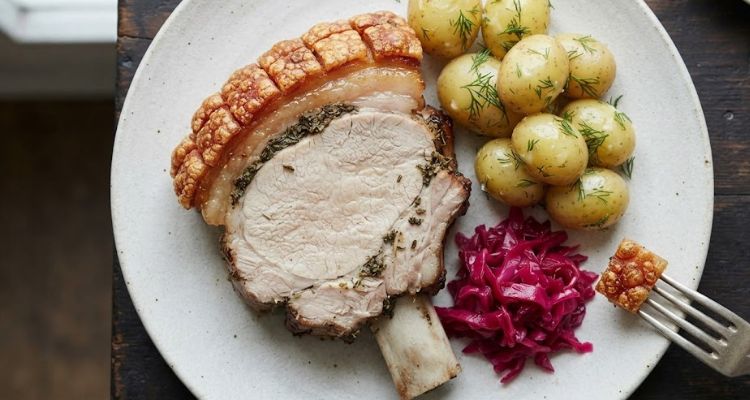
Nigella is firm on one point: no gravy. She finds this roast doesn’t need it and isn’t suited to it, preferring a soft cream sauce alongside, the kind from a fennel gratin or a potato Jansson’s temptation. On the table she likes pickled red cabbage, a Scandi cucumber salad and buttered potatoes with dill.
A simple sharp condiment does a lot here. Her quick favourite is equal parts redcurrant jelly and wholegrain mustard stirred together, which cuts the richness of the fat. If you want a showstopping sweet to follow a savoury feast like this, her prodigious pavlova keeps the winter-fruit theme going.
Can I change the flavourings from dill and juniper?
Yes, and Nigella actively encourages it. The dill, garlic and juniper keep the dish in Nordic territory, but she points out the cut itself travels far beyond Scandinavia. She suggests sage, shallots and English mustard powder, or cumin, coriander, chilli and ginger, or miso, soy and garlic.
Two more of her ideas: thyme, lemon and Dijon, or a red massage of Korean gochujang. The paste-in-the-troughs method stays identical whichever route you take, so treat the seasoning as a template. It’s the same spirit of reinvention behind her steak with anchovy elixir, another Cook, Eat, Repeat savoury built on a bold rub.