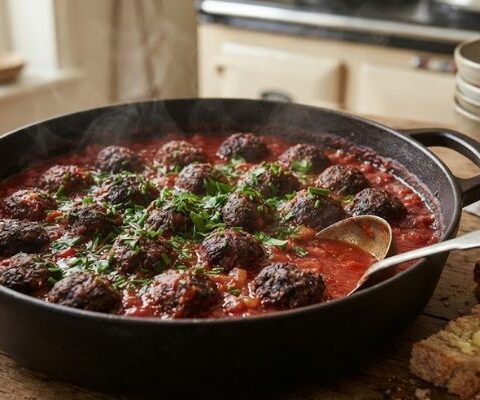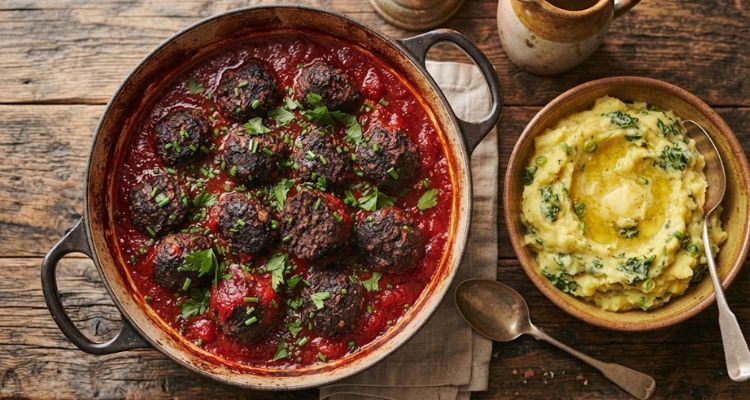
Nigella Lawson’s black pudding meatballs are beef and black pudding meatballs, herby and lightly spiced, simmered in a rich tomato sauce. It’s a comforting, big-batch dish that serves 4 to 6, from her book Cook, Eat, Repeat.
She put them in the book’s “Loving Defence of Brown Food” chapter, and while she thought they’d be a niche choice, she’s been overwhelmed by how many people have made and loved them. She adores them too much to leave out, calling them an instant sparker of joy she’s always glad to have in the freezer.
The clever part is the black pudding. Crumbled into the beef, it melts through the meatballs as they cook, adding a deep, savoury, faintly spiced richness that ordinary beef meatballs never have, all mellowed by the cheery tomato sauce around them.

Nigella Lawson Black Pudding Meatballs
Course: Dinner, LunchCuisine: BritishDifficulty: Easy4-6
servings20
minutes45
minutes445
kcal12
hours35
minutesNigella’s big-batch comfort dish from Cook, Eat, Repeat: about 40 beef-and-black-pudding meatballs, herby and lightly spiced, simmered in a rich tomato sauce. Serves four to six.
Ingredients
- For the tomato sauce:
2 onions (approx. 300g, roughly chopped)
45g beef dripping or 3 tablespoons olive oil
2 fat cloves of garlic
3 x 15ml tablespoons flat-leaf parsley (finely chopped)
1 teaspoon dried thyme
2 x 400g tins of chopped tomatoes
1 x 15ml tablespoon tomato purée
2 teaspoons Worcestershire sauce (gluten-free if necessary)
2 teaspoons Maldon sea salt flakes (or 1 teaspoon fine sea salt)
- For the meatballs:
500g minced beef (not low fat)
250g black pudding (gluten-free if necessary)
2 fat cloves of garlic
3 x 15ml tablespoons finely chopped parsley (plus more to serve)
2 x 15ml tablespoons finely chopped chives (plus more to serve)
1 teaspoon dried thyme
2 teaspoons Maldon sea salt flakes (or 1 teaspoon fine sea salt)
a very good grinding of pepper
¼ teaspoon dried chilli flakes
2 x 15ml tablespoons porridge oats (not jumbo, gluten-free if necessary)
2 large eggs (at room temperature)
Directions
- Take the chill off:Take the mince and black pudding out of the fridge so they lose their chill while you make the sauce. Pour 400ml of cold water into a jug and keep it by the stove.
- Start the sauce:Roughly chop the onions. Melt the dripping or warm the oil in a large heavy casserole (about 26cm) and cook the onions over medium heat, stirring now and then, for about 15 minutes, until softening and golden in parts.
- Build the sauce:Stir in the dried thyme and chopped parsley, and grate in the garlic. Add the tomatoes, swilling the tins out with the jug of water. Stir in the tomato purée, Worcestershire sauce and salt, bring to the boil, then simmer for 10 minutes.
- Mix the meatballs:Loosen the mince into a large bowl and crumble in the black pudding by hand. Grate in the garlic, add the chopped parsley and chives, the thyme, salt, pepper and chilli flakes, then the oats and eggs. Mix well by hand.
- Roll:Tear off walnut-sized lumps and roll into meatballs, about 40, placing them on a large tray or board as you go.
- Simmer:Ease the meatballs into the sauce in concentric circles, so they’re covered, and bring to a bubble. Clamp on the lid, turn down, and simmer robustly for 15 minutes.
- Finish:Take off the lid, stir very gently, then simmer uncovered for another 15 minutes, until the meatballs are cooked and the sauce is intense. Check the seasoning and rest off the heat for 5 to 10 minutes. Scatter with chives and parsley and serve.
Notes
- (make ahead): Make the sauce up to 3 days ahead, covered and refrigerated (or frozen, below). Form the meatballs up to 1 day ahead using mince and black pudding straight from the fridge, and keep them on trays, loosely covered, in the fridge. Take them out 1 hour before cooking, reheat the sauce until just boiling, reduce to a simmer and add the meatballs.
- (store): Refrigerate leftovers, covered, for up to 3 days, and reheat gently in a saucepan until piping hot.
- (freeze): Freeze cooked meatballs in their sauce for up to 3 months; defrost overnight in the fridge and reheat as above. The sauce on its own also freezes for up to 3 months, defrosted overnight in the fridge.
- (serving): Nigella loves them with her Brown Butter Colcannon, but when eating alone she likes them best with good bread and butter.
FAQs
What does the black pudding actually add?
It’s the whole point of the dish. Crumbled into the beef, the black pudding breaks down as the meatballs cook and lends them a deep, dark, savoury richness with a gentle warmth of spice, far more complex than a plain beef meatball. It also keeps them moist and tender.
Don’t be put off by the “dark mysteries of blood”, as Nigella puts it. Cooked through and bobbing in the cheery tomato sauce, the flavour is rich and comforting rather than strong or metallic. Use a good-quality black pudding, and a gluten-free one if you need the dish to be gluten-free.
Why oats and eggs in the meatballs?
The porridge oats and eggs are the binder. The eggs hold everything together, while the oats absorb some moisture and keep the meatballs light and tender rather than dense, doing the job breadcrumbs would in other recipes. Use ordinary porridge oats, not jumbo ones, which stay too coarse.
Room-temperature eggs mix in more evenly, which is why Nigella has you take everything out of the fridge early. Mix just until evenly combined, since overworking makes meatballs tough. For a gluten-free version, use gluten-free oats along with gluten-free black pudding and Worcestershire sauce.
Why cook the meatballs in the sauce rather than frying them first?
Poaching them straight in the simmering tomato sauce keeps them beautifully moist and lets them flavour the sauce as they cook, so it turns rich and intense. There’s no browning step and no extra pan, which makes it a genuinely simple one-pot dish.
Ease them in gently in concentric circles so they hold their shape, and make sure they’re covered by the sauce. The two-stage simmer, 15 minutes covered then 15 uncovered, cooks them through while reducing the sauce. It’s the same cook-in-the-sauce method behind Nigella’s meatballs with orzo, just with beef and black pudding here.
Why beef dripping, and can I use oil?
Beef dripping gives the sauce a deeper, meatier, more savoury base as the onions cook in it, which suits the richness of the meatballs. It’s a traditional touch that adds real depth. If you’d rather, 3 tablespoons of olive oil works perfectly well in its place.
Either way, take your time softening the onions, about 15 minutes, or longer on a low heat after a 5-minute start, so they turn sweet and golden. That slow-cooked onion base is what gives the finished sauce its body, so don’t rush it.
What do I serve them with?
Nigella’s top pairing is her Brown Butter Colcannon, the buttery mashed potato and cabbage soaking up the intense sauce beautifully. When she eats them alone, she simply has them with good bread and butter to mop the bowl, which is hard to beat.
They also work spooned over pasta, rice or soft polenta. A sharp green salad cuts the richness if you want something fresh alongside. However you serve them, keep something starchy to catch the sauce. There are more comforting suppers on the Nigella Lawson recipes page.
Can I make a big batch and freeze them?
Absolutely, and it’s exactly how Nigella likes to cook them. The quantities make a big batch of around 40 meatballs on purpose, since she loves knowing there’s always a container or three in the freezer. Cooked meatballs freeze in their sauce for up to 3 months.
Defrost overnight in the fridge and reheat gently until piping hot. You can also get ahead by making the sauce up to 3 days early and shaping the meatballs a day ahead, then bringing them to room temperature before cooking. For another cosy make-ahead, Nigella’s fear-free fish stew reheats well too.