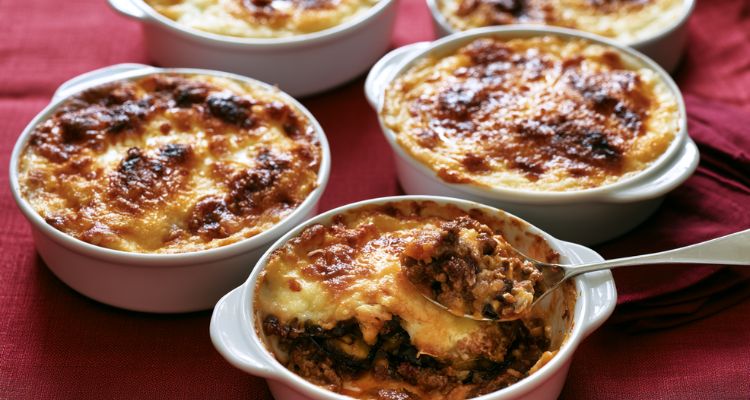
Hairy Bikers moussaka is a layered lamb and aubergine bake with a cornflour white sauce, spiced with cinnamon, mint and red wine. It serves 6 at 323 calories per serving and bakes in individual dishes for about 25 minutes.
This comes from The Hairy Dieters: Eat for Life (2013). The two biggest calorie savings are grilling the aubergines instead of frying them and making the white sauce with cornflour instead of a butter roux. Traditional moussaka uses enough oil to soak through half a kitchen roll, but this version uses just 1 tablespoon.
The cinnamon stick and dried mint are what give this a properly Greek flavour rather than a generic mince bake. Si and Dave cook both into the lamb sauce for 15 minutes, then remove the cinnamon before layering. That warm, herbal backbone is what separates a real moussaka from a lasagne with aubergines.

Hairy Bikers Moussaka
Course: DinnerCuisine: BritishDifficulty: Easy6
servings20
minutes45
minutes323
kcal1
hour10
minutesA low-calorie moussaka from The Hairy Dieters: Eat for Life (2013). Grilled aubergines layered with a spiced lamb and courgette sauce in individual ovenproof dishes, topped with a cornflour white sauce, nutmeg and Parmesan. Baked at 200°C until golden and bubbling.
Ingredients
500g lean minced lamb
1 medium onion, finely chopped
2 garlic cloves, crushed
1½ tsp dried oregano
1 tsp dried mint
2 bay leaves
1 cinnamon stick
2 tbsp plain flour
100ml red wine
400ml lamb stock
400g canned chopped tomatoes
2 tbsp tomato purée
2 medium courgettes, halved lengthways and sliced
2 medium aubergines (about 275g each), cut into 1cm rounds
1 tbsp olive oil
- For the white sauce:
500ml semi-skimmed milk
4 tbsp cornflour
2 bay leaves
½ tsp grated nutmeg
20g Parmesan
Directions
- Cook the lamb: Put the lamb, onion, garlic, oregano, mint, bay leaves and cinnamon stick in a large non-stick pan. Cook over a medium heat for 5 minutes, stirring to break up the meat. Stir in the flour, season, then add the wine, stock, tomatoes and tomato purée. Simmer for 10 minutes. Add the courgettes and cook for 5 minutes more until thick. Remove the bay leaves and cinnamon stick.
- Grill the aubergines: Preheat the grill to its hottest setting. Arrange the aubergine slices on a baking tray and brush both sides with oil. Grill for 5 minutes each side until softened and lightly browned.
- Make the white sauce: Preheat the oven to 200°C/Fan 180°C/Gas 6. Mix 4 tablespoons of milk with the cornflour until smooth. Heat the remaining milk with the bay leaves and half the nutmeg for 5 minutes. Remove the bay leaves, whisk in the cornflour mixture and cook for 3–4 minutes until thick. Season well.
- Layer and bake: Spoon a third of the meat sauce into 6 individual ovenproof dishes, add a layer of aubergines. Repeat twice, finishing with aubergines. Pour over the white sauce, sprinkle with the remaining nutmeg and Parmesan. Bake for 20–25 minutes until golden and bubbling.
FAQs
Why grill the aubergines instead of frying them?
Aubergines absorb oil like a sponge. Frying slices for a traditional moussaka can use 6–8 tablespoons of olive oil, adding hundreds of calories. Si and Dave brush them with just 1 tablespoon and grill them instead, which softens them without the fat.
The grilled slices still get lightly browned and softened, which gives flavour and structure to the layers. They hold their shape during assembly better than fried ones too, since they’re not waterlogged with oil. This single swap is the biggest calorie saving in the recipe. It’s the main reason a full moussaka comes in at just 323 calories per serving.
Why use cornflour for the white sauce?
A traditional béchamel uses butter and flour in a roux, which adds roughly 150–200 calories to the sauce. Si and Dave’s version uses cornflour mixed with semi-skimmed milk, which thickens to the same smooth consistency without any butter at all.
The bay leaves and nutmeg give the sauce its flavour, and the 20g of Parmesan on top adds richness where you taste it most. If you’ve made the Hairy Bikers mushroom pasta bake, that uses mascarpone instead of béchamel for a similar shortcut.
Why add cinnamon and mint to the lamb?
Cinnamon and dried mint are what make Greek moussaka taste different from Italian bolognese. The cinnamon adds a warm sweetness that works with lamb in a way it wouldn’t with beef. The mint lifts the heaviness of the mince and tomato.
Si and Dave cook the whole cinnamon stick directly in the sauce and remove it before layering, which gives warmth without any grittiness. The dried mint goes in at the start with the oregano and dissolves into the sauce completely. Together they give the filling an unmistakably Greek character that you’d recognise from a taverna, at zero extra calories.
Why make it in individual dishes?
Individual portions look more impressive and make serving easier since there’s no cutting through layers. Each person gets their own golden, bubbling moussaka straight from the oven.
It also controls portion size naturally, which matters for a diet recipe at 323 calories. A big shared dish tempts second helpings, while a single dish is one portion and done. If you don’t have individual dishes, a single large baking dish works fine for the whole family.
Can I use beef mince instead of lamb?
You can, but the flavour changes. Lamb has a stronger, more savoury taste that pairs naturally with the cinnamon and mint in a Greek context. Lean beef mince would give a milder result closer to a bolognese.
If you do swap, use extra-lean beef (5% fat or less) to keep the calorie count similar. The Hairy Bikers enchiladas use that same lean beef with good results, so the technique transfers well.
How do I store and reheat moussaka?
Cool completely, then cover and refrigerate for up to 3 days. Reheat individual dishes in the oven at 180°C for 15 minutes until piping hot through the centre. The white sauce may look set on top after chilling, but it loosens and bubbles again as it heats through.
It freezes for up to 2 months. Defrost overnight in the fridge before reheating. The aubergine layers hold up well after freezing, which isn’t always the case with vegetable-heavy bakes.