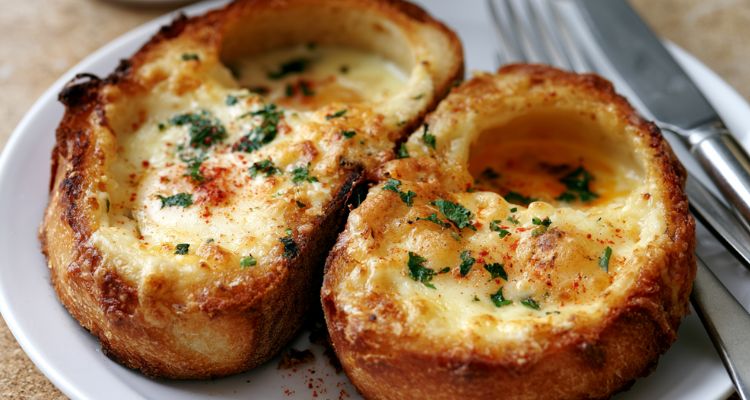
Hairy Bikers egg in a hole is a cheesy, spiced take on eggy bread with sourdough, Gruyère, cayenne and nutmeg, ready in under 20 minutes. Each slice gets an egg cracked into a hole in the centre, finished under a lid until the cheese melts. It serves 4.
This comes from Our Family Favourites (2024), and Si King calls it “a great favourite with all the King family, especially my eldest son, Alex.” It’s his take on eggy bread, with spice and cheese turning a simple breakfast into something worth sitting down for.
The cloche technique is what makes it work. Si covers the pan with a large saucepan lid so the trapped steam sets the egg white from above while the cheese melts on top. Two or three minutes under the lid and the whole thing comes together.

Hairy Bikers Egg in a Hole
Course: SidesCuisine: BritishDifficulty: Easy4
servings10
minutes10
minutes320
kcal20
minutesA King family breakfast from Our Family Favourites (2024). A cookie cutter punches a hole in each sourdough slice, the bread is fried twice for crispness, and the egg steams under a saucepan lid with Gruyère, cayenne and nutmeg on top.
Ingredients
4 slices of sourdough (or any robust bread)
2 tbsp olive oil
15g butter
4 eggs
2 tbsp finely chopped parsley
pinch of cayenne
a grating of nutmeg
75g Gruyère or any hard cheese, grated
salt and black pepper
Directions
- Cut the holes: Take the slices of sourdough and, using a 6–7cm cookie cutter, cut rounds in the middle of each. Keep the round centres for croutons, breadcrumbs, or cut them in half to use as soldiers for boiled eggs.
- First fry: Heat a large frying pan and add a tablespoon of the olive oil. When hot, add the slices of bread and fry on one side only.
- Second fry: Remove the bread, then add the remaining olive oil and the butter. When the butter has foamed up, put the bread back in the pan, fried side up. Depending on the size of your bread and pan, you may need to cook in batches.
- Add the eggs: Break the eggs one at a time into a ramekin and carefully drop one into each hole. Season with salt and pepper. Sprinkle with half the parsley and some cayenne and nutmeg, then add the cheese.
- Steam and serve: Put a cloche over the pan (a large saucepan lid works well) and cook over a low-medium heat for 2–3 minutes until the egg whites are set and the cheese has melted. You can flip the slices for 30 seconds to brown the cheese and crisp the edges, or serve as they are. Garnish with the remaining parsley and a little more nutmeg and cayenne if you like.
Notes
- Calories: Sourdough 4 slices ~120g (~312) + olive oil 30ml (~240) + butter 15g (~107) + eggs ×4 (~312) + Gruyère 75g (~300) + parsley/spices (~10) = ~1,281 kcal total ÷ 4 servings = ~320 kcal per serving. No calories listed on the official site.
FAQs
Why fry the bread on one side only first?
Si fries each slice on one side, removes it, adds fresh oil and butter, then puts it back fried-side up. This means the uncooked side now sits in foaming butter where it soaks up flavour while the egg cooks in the hole above. The buttery base is also what stops the egg sticking to the bread.
If you fried both sides first, the bread would be too crisp to absorb any butter and the egg would sit on a dry surface. The single-side fry also means one face stays softer, which gives a contrast between the crispy top and the buttery base.
What bread works best?
Si says sourdough or any sturdy bread, and the sturdiness matters. You need a slice thick enough to hold a raw egg without it running straight through. Thin sandwich bread collapses the moment you press a cutter into it.
Sourdough is ideal because it’s dense, holds its shape and has enough chew to stand up to frying. A good bloomer or thick farmhouse white also works well. Avoid anything pre-sliced and thin, because the egg needs a bread frame with some height to contain it.
Why crack the egg into a ramekin first?
Si doesn’t crack directly into the hole, and for good reason. A ramekin lets you check for shell fragments and control exactly where the egg lands. The yolk sits in the centre of the hole rather than sliding off to one side.
It also stops you breaking the yolk on the edge of the bread. A runny yolk is the whole point of this dish, so losing it to a clumsy crack would ruin the moment. I keep a ramekin next to the hob whenever I fry eggs now.
What cheese can I use instead of Gruyère?
Si says “Gruyère or any hard cheese,” so you have options. Cheddar is the most obvious swap and melts well under the lid. Emmental gives a milder, stretchier melt. Comté is the closest to Gruyère in flavour.
Avoid anything too crumbly like Lancashire or Wensleydale, since it won’t melt into a smooth layer. The cheese needs to go glossy under the steam, not sit in dry clumps. About 75g for 4 slices means each one gets a decent but not overwhelming covering.
Should I flip it at the end?
Si gives you the choice. Flipping for 30 seconds browns the cheese and gives “crisp bits around the edges,” which adds a crunch that’s hard to resist. Leaving it unflipped keeps the yolk more reliably runny.
I flip mine because I like the golden cheese crust on top. The trick is speed: 30 seconds maximum, because any longer sets the yolk fully. If you’re cooking for people who want them runny, serve theirs unflipped and flip your own.
Can I cook these for more than 4 people?
Si notes you may need to cook in batches depending on your pan size. A standard 28cm frying pan fits 2 slices comfortably, so 4 servings takes 2 rounds. For 8 people, plan for 4 rounds.
Keep finished slices warm on a baking tray in a low oven (120°C) while you cook the rest. If you’ve tried the Hairy Bikers sweetcorn fritters, you’ll know the batch-cooking rhythm. The main thing is not to stack them, or the steam softens the crispy base.