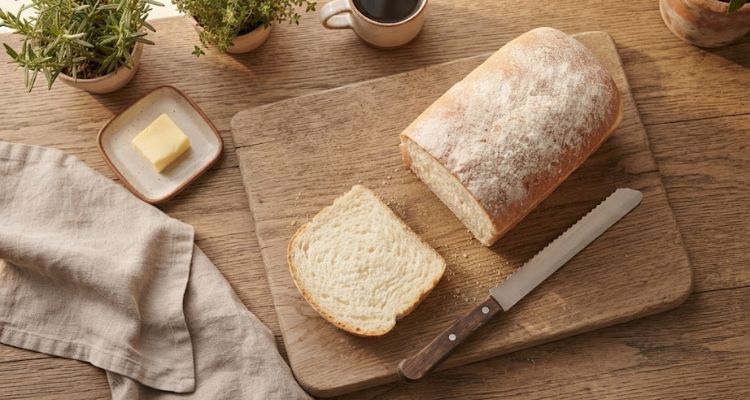
Nigella Lawson’s old-fashioned sandwich loaf is a soft, tender-crumbed white tin loaf made with strong bread flour and spoilt milk, needing only three 10-second knocks of kneading. It makes one loaf, from her book Cook, Eat, Repeat.
She reaches for it when she wants a slice of old-school, tender-crumbed bread rather than her usual crackle-crusted no-knead loaf. It’s perfect for sandwiches, whether bacon, sausage, egg or fish finger, the bread she uses for her fried chicken sandwich, and it makes wonderful toast.
The clever, thrifty touch is spoilt (soured) milk. Its fat and acid weaken the gluten to give the loaf its signature soft, fine crumb, and it’s a brilliant way to use up milk that’s turned rather than throwing it away. Nigella credits baker Dan Lepard’s Sour Cream Sandwich Bread as the original.

Nigella Lawson Old-Fashioned Sandwich Loaf
Course: SidesCuisine: BritishDifficulty: Easy12
servings20
minutes45
minutes300
kcal3
hours20
minutesNigella’s soft white tin loaf from Cook, Eat, Repeat, reworked from Dan Lepard: strong flour and spoilt milk brought together with three 10-second kneads, for a tender crumb ideal for sandwiches and toast. Makes one loaf.
Ingredients
500g strong white bread flour, plus more for dusting
2½ teaspoons (7g) or 1 x 7g sachet fast-action dried yeast
2 teaspoons (8g) caster sugar
2 teaspoons (12g) fine sea salt
125ml spoilt milk (or sour cream), straight from the fridge
3 x 15ml tablespoons (45g) soft unsalted butter (omit if using sour cream), plus more for greasing
vegetable oil, for kneading
Directions
- Mix the dry:You’ll need a 2lb/900g loaf tin (about 24 x 12 x 8cm). Mix the flour, yeast, sugar and salt in a large bowl.
- Build the wet:Pour the spoilt milk (or sour cream) into a jug, add 150ml cold water (to the 275ml mark), then 100ml boiling water (to 375ml). Stir in the soft butter; it won’t melt fully, which is fine.
- Combine:Pour the wet into the dry, stirring (hands are ideal) until almost all the flour is absorbed, about a minute. Form a rough ball, cover the bowl, and leave 10 minutes.
- Knead in bursts:Lightly oil the counter. Knead the dough for 10 seconds, re-form into a ball, return to the bowl and cover. Repeat twice more at 10-minute intervals. After the third 10-second knead, ball it up, cover, and leave to rise for 1 hour.
- Shape:Line the base of the tin and lightly grease the sides. Pat the risen dough out on the oiled surface into a soft 2cm-thick “mattress”, one edge about 4cm shorter than the tin’s length. Roll it tightly into a scroll from that edge and sit it seam side down in the tin, pressing the ends to fit.
- Second rise:Leave to rise for 1 to 1½ hours, until peeking just above the tin. Turn the oven on as it nears.
- Bake:Heat the oven to 200°C/180°C fan/400°F. Dust the top with flour and bake for 45 minutes, until risen with a rounded, deep biscuity-gold top. Turn out of the tin straight away and cool on a wire rack before slicing.
Notes
- (make it vegan): Replace the spoilt milk with plant-based yoghurt and the butter with vegetable fat, and reduce the salt and sugar to 1 teaspoon each.
- (sour cream version): If using sour cream instead of spoilt milk, omit the butter, as quantities are given for either version.
- (store): Keep in a bread bin to stay fresh longest, or wrapped in a clean tea towel or an airtight container in a cool place for 4 to 5 days.
- (freeze): Freeze the loaf or slices in freezer bags with the air pressed out, for up to 3 months. Defrost at room temperature, layering slices with parchment if freezing individually. Slices can be toasted from frozen.
FAQs
What is “spoilt milk”, and why use it?
Spoilt milk is simply milk that’s turned sour from being open too long, and rather than pouring it away, Nigella puts it to work. Its fat and acid gently weaken the gluten in the flour, which is what gives this loaf its lovely soft, fine, tender crumb rather than a chewy, open one.
It’s a thrifty, old-fashioned trick, a bit like the soured milk in traditional Irish soda bread. If you don’t have spoilt milk, sour cream works (omit the butter in that case), or buttermilk, using the same 125ml plus the butter. Fresh milk with a squeeze of lemon left to curdle also stands in.
Do I really only knead it three times for 10 seconds?
Yes, and that’s the beauty of it. Instead of a long, tiring knead, you give the dough three short 10-second kneads at 10-minute intervals, resting in between. During those rests the gluten develops on its own, so the brief kneads are all it needs to come together into a smooth, strong dough.
It’s Nigella’s most “stringent demand”, said with a wink, because it’s genuinely easy. The oiled surface, rather than a floured one, keeps the soft dough from sticking without adding extra flour. Don’t be tempted to knead it hard or long, since this gentle method is what keeps the crumb tender.
Why roll the dough into a scroll before baking?
Patting the risen dough into a flat “mattress” and rolling it tightly into a scroll, like a swiss roll, before dropping it seam side down into the tin gives you an even, well-structured loaf with a good rise and a neat, rounded top. The tension from rolling helps it climb rather than spread.
Sit it seam side down so it doesn’t unravel or split awkwardly as it proves and bakes. The scroll can lengthen as you roll, so gently press the ends to fit the tin. Then let it rise until it’s just peeking above the rim, which is your cue that it’s ready to bake.
How do I know it’s baked, and how do I get a good crust?
Nigella is reassuring here: after 45 minutes at 200°C it’ll be risen with a rounded, deep biscuity-gold top, and unless your oven is misfiring, it’s done. Dusting the top with flour before baking gives it that soft, rustic, floury finish rather than a hard shiny crust.
Turn it out of the tin straight away with oven gloves and cool it on a wire rack, which stops the base going soggy from trapped steam. And do resist slicing into it hot, however tempting, as the crumb needs to set as it cools or it’ll tear and gum up.
What do I use it for?
This is a proper all-rounder. It’s built for sandwiches, and Nigella name-checks bacon, sausage, egg and fish finger, using it for her fried chicken sandwich when a burger bun won’t do. Its tender crumb makes it the ideal bread for her fish finger bhorta too.
It also makes wonderful toast, and it’s the exact loaf Nigella recommends for her rum-spiked French toast, where a good white sandwich loaf is essential. So it’s worth baking a loaf specifically to turn stale slices into that treat. There’s more on the Nigella Lawson recipes page.
Can I make it vegan, and how do I store it?
Yes, easily. Nigella gives the swaps herself: use plant-based yoghurt in place of the spoilt milk and vegetable fat instead of butter, and reduce both the salt and sugar to 1 teaspoon each. The three-knead method stays exactly the same.
To keep it fresh, a bread bin is best, or wrap it in a clean tea towel, and it’ll keep 4 to 5 days in a cool place. It also freezes well for up to 3 months, whole or sliced, in freezer bags with the air pressed out. Handily, slices can be toasted straight from frozen.