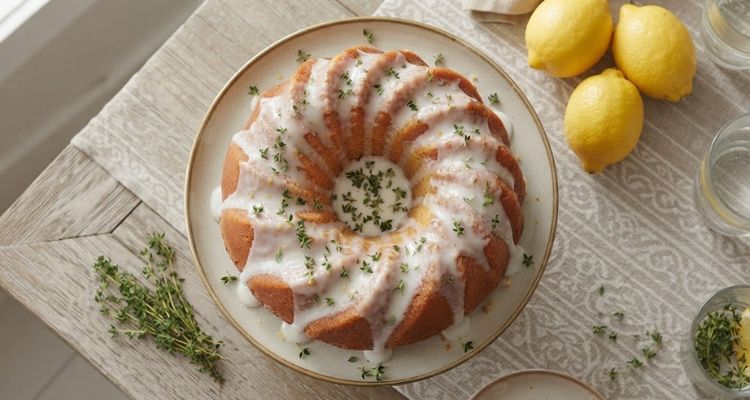
Nigella Lawson’s thyme and lemon bundt cake is a tender, buttermilk-rich lemon cake with fresh thyme beaten through the batter, finished with a sherbetty lemon glaze and a scatter of thyme. It cuts into 10 to 14 slices, from her book Simply Nigella.
She loves thyme and sprinkles it wantonly in her cooking, but wanted a cake that relied on it as a leading ingredient, not just a decorative flourish. Don’t be alarmed by the amount in the batter, she says: it doesn’t overwhelm, it charms.
Her firm warning is about the funnel. Even when the cake looks bronzed and ready, make sure it’s cooked through around the funnel, or it’ll be the devil to unmould and disappointingly undercooked inside, however brown the surface.

Nigella Lawson Lemon Bundt Cake
Course: DessertCuisine: BritishDifficulty: Easy10-14
servings20
minutes1
hour20
minutes320
kcal1
hour45
minutesNigella’s thyme and lemon bundt from Simply Nigella: a tender, buttermilk lemon cake with fresh thyme beaten through, finished with a sherbetty lemon glaze and scattered thyme. Cuts into 10 to 14.
Ingredients
450g plain flour
¾ teaspoon baking powder
¾ teaspoon bicarbonate of soda
200g soft unsalted butter
2 unwaxed lemons
small bunch fresh thyme
250g caster sugar
3 large eggs
250ml buttermilk (see note)
120g icing sugar
cooking spray (or sunflower oil and plain flour) for greasing
Directions
- Prep the tin: Preheat the oven to 170°C/325°F/gas mark 3, slipping in a baking sheet. You’ll need a 10-cup (2.5 litre) bundt tin or 20cm square tin. Spray or brush with an oil-and-flour paste into every crevice. Leave upside down over paper (keep the paper for icing later).
- Mix the dry: Fork together the flour, baking powder and bicarbonate of soda.
- Cream: Beat the butter with the grated zest of both lemons until creamy. Strip 4 tablespoons of thyme leaves from the sprigs and add with the caster sugar, beating to a light, fluffy mixture.
- Combine: Beat in the eggs one by one. After the last, slow down and add a third of the flour, then a third of the buttermilk, and so on until both are used up. Beat in the juice of 1 lemon.
- Bake: Scrape into the tin (don’t worry if it looks like too much batter, it settles) and bake on the baking sheet for 1¼ hours, checking from 1 hour, until a tester comes out clean and it’s cooked through around the funnel.
- Cool: Rest in the tin on a rack for 15 minutes, then carefully unmould and cool completely.
- Glaze: Slip the paper under the rack. Sieve the icing sugar and beat in the juice of the remaining lemon (about 2½ to 3 tablespoons) to a glaze thin enough to run but thick enough to glue the thyme. Pour over the cooled cake and immediately scatter with thyme leaves and the odd sprig.
Notes
- (don’t fear the thyme): The amount in the batter looks a lot but doesn’t overwhelm; it charms, giving a subtle, fragrant, herby lift against the lemon.
- (cook it through the funnel): Even when bronzed on top, check the cake is cooked right through around the central funnel, or it’ll be undercooked inside and hard to unmoul
- (buttermilk): No buttermilk? Use runny plain yoghurt, or make your own by stirring 1 tablespoon of lemon juice (or white wine/cider vinegar) into 250ml semi-skimmed milk and leaving 20 minutes.
- (no bundt tin): Use a 20cm square tin (about 5.5cm deep); it makes a high cake and takes 1 hour to 1 hour 20 minutes. Check it’s cooked through the centre.
- (store): Keep in an airtight container in a cool place for up to 5 days.
- (freeze): Freeze un-iced for up to 3 months, double-wrapped in cling film and foil. Defrost on a wire rack for about 5 hours.
FAQs
Thyme in a cake? Does it actually work?
Yes, beautifully, and it’s the whole point of the recipe. Nigella wanted thyme as a leading flavour rather than a garnish, inspired by having already made a rosemary loaf cake. In the batter, the thyme gives a subtle, fragrant, savoury-herby lift that plays against the sharp lemon without tasting “herby” in an odd way.
She reassures you not to be alarmed by the 4 tablespoons of thyme leaves it calls for: “it doesn’t overwhelm, it charms”. Beating the leaves with the sugar and butter releases their fragrance through the cake. If you’d genuinely rather not, you can leave it out for a classic lemon bundt, but it’s worth trying as is.
Why buttermilk, and what can I use instead?
Buttermilk makes the cake exceptionally light, moist and tender, as its acidity reacts with the bicarbonate of soda for a good rise and a soft, fine crumb, and its slight tang complements the lemon. It’s the secret to the cake’s texture.
If you don’t have buttermilk, Nigella gives two easy swaps: runny plain yoghurt in its place, or, her fallback, make your own by stirring 1 tablespoon of lemon juice (handy here) into 250ml semi-skimmed milk and leaving it for 20 minutes until slightly thickened. White wine or cider vinegar works instead of the lemon juice. Stir before using.
Why is it so important to cook it through around the funnel?
This is Nigella’s key warning, and it’s specific to bundt tins. The cake browns on the outside long before the thick ring of batter around the central funnel is cooked through, so a cake that looks perfectly bronzed can still be raw in the middle. An undercooked centre also makes it stick and tear when you try to unmould it.
So don’t rely on the surface colour: test with a cake tester pushed into the thickest part near the funnel, and it should come out clean. Start checking at 1 hour but be prepared for up to 1¼ hours (or more in a square tin). Better to give it a few extra minutes than to cut into a disappointingly wet middle.
How do I get it out of the bundt tin cleanly?
Thorough greasing is everything: spray or brush the oil-and-flour paste into every crevice of the intricate tin, and leave it upside down first to drain excess. Then, crucially, make sure the cake is fully baked (see above), as an underdone cake sticks.
Let it rest in the tin on a rack for 15 minutes, no longer, before turning out, so it firms up enough to hold its shape but is still warm enough to release. Nigella calls the unmoulding “that moment of breathless tension”, but with good greasing and a properly baked cake it should drop out cleanly. The dramatic reveal is half the fun, like her pumpkin bundt cake.
How do I get the glaze right?
The “sherbetty” lemon glaze should be, in Nigella’s words, thin enough to run down the cake but thick enough to act as a tangy glue for the thyme leaves you scatter on top. Sieve the icing sugar, then beat in the lemon juice gradually, about 2½ to 3 tablespoons, until you hit that pourable-but-not-watery consistency.
Pour it over the completely cooled cake (warm cake makes it run straight off) and immediately scatter with fresh thyme leaves and a sprig or two before it sets, so they stick. Nigella strews with abandon, but how much is up to you. It’s a sharp, lemony glaze that balances the sweet cake. There’s more on the Nigella Lawson recipes page.
Can I make it ahead, store or freeze it?
Yes, it keeps well. Thanks to the buttermilk it stays moist stored in an airtight container in a cool place for up to 5 days, and like many cakes it’s arguably even better a day after baking once the flavours settle.
It also freezes well, un-iced, for up to 3 months: wrap the cooled cake in a double layer of cling film and a layer of foil, then defrost on a wire rack at room temperature for about 5 hours before glazing and serving. So you can bake it well ahead and finish it with the fresh glaze and thyme on the day. Glaze only once fully defrosted.