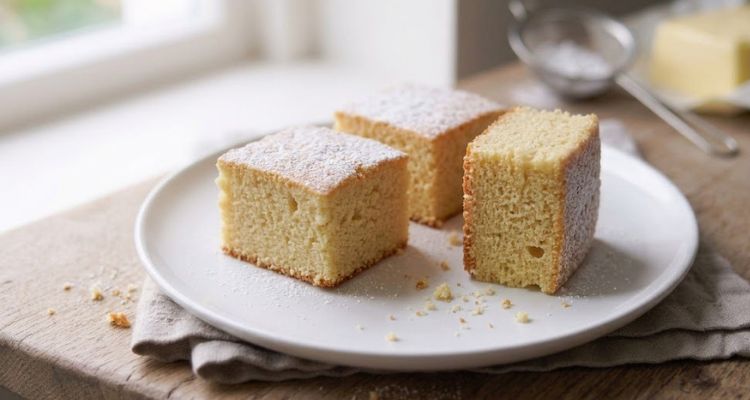
Mary Berry’s vanilla traybake is an all-in-one sponge made with butter, caster sugar, self-raising flour, 4 large eggs and milk. It bakes at 180°C/Fan 160°C/Gas 4 for 35 to 40 minutes in a 30 x 23cm tin. It cuts into 21 pieces.
Berry calls it the Basic All-in-one Sponge Traybake, and says it’s the simplest of cakes to make. She prints it in Ultimate Cake Book (2003) and again in Baking Bible (2010). The ½ teaspoon of vanilla is hers as well, taken from her marble cake.
The method is one line long. Measure everything into a large bowl and beat until well blended, which the 2003 edition times at about 2 minutes. There’s no creaming stage and nothing to rub in.
Mary Berry Vanilla Traybake
Course: DessertCuisine: BritishDifficulty: Easy4
servings30
minutes40
minutes300
kcalBerry’s plainest cake, from Baking Bible (2010). One bowl, one tin, and nothing to turn out afterwards. The vanilla is the measure she uses for this same batter in her marble cake, and it’s the one addition we’ve made.
Ingredients
225 g (8 oz) softened butter
225 g (8 oz) caster sugar
275 g (10 oz) self-raising flour
2 level teaspoons baking powder
4 large eggs
4 tablespoons milk
½ teaspoon vanilla extract
a little sifted icing sugar, to finish (optional)
Directions
- Preheat:Pre-heat the oven to 180°C/Fan 160°C/Gas 4. Grease a 30 x 23 cm (12 x 9 in) traybake or roasting tin then line the base with baking parchment.
- Mix:Measure all the ingredients into a large bowl and beat until well blended. Turn the mixture into the prepared tin and level the top.
- Bake:Bake in the pre-heated oven for about 35-40 minutes or until the cake has shrunk from the sides of the tin and springs back when pressed in the centre with your fingertips.
- Cool:Leave to cool in the tin, then cut into 21 pieces and peel off the baking parchment. Sieve over a little icing sugar to finish, if you like.
FAQs
Does Berry’s traybake actually contain vanilla?
No, and it’s worth being straight about that, because most pages using this keyword aren’t. Her recipe is called the Basic All-in-one Sponge Traybake. The ingredients run to butter, caster sugar, self-raising flour, baking powder, eggs and milk, and nothing else.
The vanilla comes from a few pages away in the same book. Her Chocolate Chip and Vanilla Marble Cake uses that identical batter in the identical tin, with ½ teaspoon of vanilla extract stirred through. Her marble version also drops the milk to 2 tablespoons, and we’ve kept the traybake’s 4.
Butter or soft margarine?
She changed her mind between books, and everything else stayed the same. Ultimate Cake Book (2003) asks for 8 oz of soft margarine. Baking Bible (2010) asks for 225g of softened butter.
The sugar, flour, baking powder, eggs and milk are identical in both, as are the tin, the temperature and the 35 to 40 minutes. Since she published each in turn, both clearly work. Which you prefer is a flavour question rather than a structural one, and that’s my read rather than a comparison she makes.
How do I make a bigger one for a crowd?
She gives a large version, and here the two books genuinely disagree. Both move up to a 29 x 36cm (11½ x 14½ in) tin, with 350g each of fat and caster sugar. Both take 450g self-raising flour, 6 eggs and 6 tablespoons of milk, baked for 40 to 45 minutes.
The difference is the raising agent and the yield. The 2003 book calls for 3 teaspoons of baking powder and cuts into 32 pieces. The 2010 book calls for 2 teaspoons and cuts into 36. I’d follow the 2010 figures as the later word, and the standard tin is the same one she uses for her spiced Dorset apple traybake.
Why leave it in the tin to cool?
Because with a traybake there’s no reason not to, and Berry says so in her introduction to the chapter. Once it’s cooked, there’s no need to turn the cake out onto a wire rack, you just ice it and cut it into squares.
That’s the whole appeal of the format in her hands. She describes traybakes as economical in time and energy, needing just a few utensils, which makes them ideal for feeding large numbers. One bowl, one tin, and no palette knife under a warm sponge hoping it doesn’t crack.
What can I put on top, or in the middle?
Her own finish is the plainest possible. Sieve over a little sifted icing sugar when the cake is cold, and she marks even that optional. If you want a proper icing, the same book shows what she does with this base: her Iced Lemon Traybake mixes 3 tablespoons of lemon juice into 225g of sifted icing sugar and spreads it over the cooled cake.
There’s also a trick in her chapter introduction that people miss. She points out you can make a layered cake from traybakes, sandwiching two together with a filling of your choice, such as jam or butter cream. Her lemon curd fits that description too, though it’s my suggestion rather than one of her named examples.
How long does it keep?
Berry gives no storage note with this recipe, so I’m borrowing and saying so. For the drizzle traybakes in Absolute Favourites (2015), which use the same all-in-one base with lemon added, she says they keep in an airtight container for 3 to 4 days and freeze for up to 1 month.
I’d expect a plain sponge to dry out faster than a drizzle, since a drizzle has a sugar crust sitting on top of it, though that’s my expectation and not something she states. What I would do either way is sieve the icing sugar over just before serving rather than on baking day. It sinks into the surface and disappears if you do it too early.