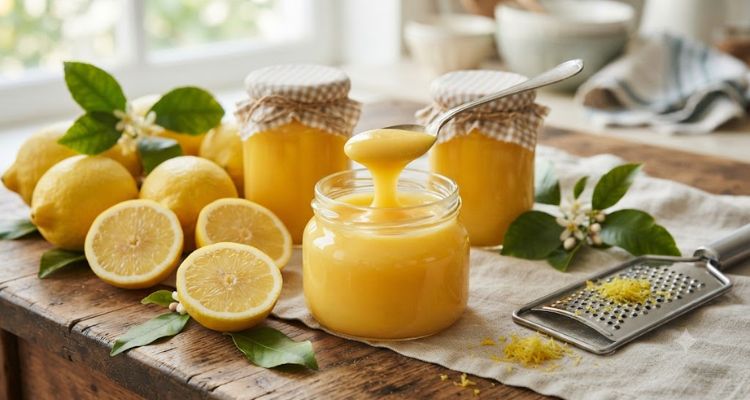
Mary Berry’s lemon curd is a smooth, glossy, sharp-sweet spread made from just lemons, sugar, butter and eggs, cooked gently over simmering water. It’s bright and tangy with a silky, buttery finish, nothing like the shop-bought stuff. It takes about 20 minutes at the stove and fills a couple of jars.
Her recipe on BBC Food uses the classic bain-marie method: a heatproof bowl set over a pan of gently simmering water, so the eggs never get direct heat. She melts the sugar and butter with the lemon first, then whisks in whole eggs plus an extra yolk for a richer set. There’s no flour or cornflour, just the eggs doing the thickening.
The one thing that makes or breaks it is keeping the heat gentle. Berry warns the water shouldn’t touch the bowl, and the curd cooks slowly for 10 to 13 minutes. Rush it over a hard boil and the eggs scramble into sweet lemony scrambled egg, which no amount of whisking undoes.

Mary Berry Lemon Curd Recipe
Course: DessertCuisine: BritishDifficulty: Easy2
servings10
minutes15
minutes40
kcal25
minutesFrom Mary Berry’s BBC Food recipe. A traditional bain-marie lemon curd thickened with eggs and an extra yolk, cooked low and slow until it coats the back of a spoon.
Ingredients
finely grated zest and juice of 4 lemons
200g caster sugar
100g unsalted butter, cut into cubes
3 large eggs, plus 1 large egg yolk
Directions
- Set up the bain-marie: Put the lemon zest and juice, the sugar and the butter into a heatproof bowl. Sit the bowl over a pan of gently simmering water, making sure the water is not touching the bottom of the bowl.
- Melt: Stir the mixture every now and again until all the butter has melted.
- Add the eggs: Lightly whisk the eggs and egg yolk together, then stir them into the lemon mixture. Whisk until everything is well combined.
- Cook gently: Leave to cook for 10-13 minutes, stirring every now and again, until the mixture is creamy and thick enough to coat the back of a spoon.
- Cool and pot: Take the curd off the heat and set aside to cool, stirring occasionally as it cools. Once cooled, spoon into sterilised jars and seal. Keep in the fridge until ready to use.
FAQs
Why cook lemon curd over simmering water instead of direct heat?
The bowl over water, a bain-marie, spreads a gentle, indirect heat that cooks the eggs slowly without scrambling them. Put the pan straight on the hob and the base gets far too hot, so the eggs seize before the curd thickens. Keep the water at a lazy simmer, not a rolling boil, and make sure it never touches the bowl.
Why does Berry add an extra egg yolk?
The extra yolk enriches the curd and helps it set to that thick, spoonable texture without any flour or cornflour. Yolks are where the setting power and the richness live, so one more gives a glossier, more luxurious finish. Whole eggs alone would still work, just with a slightly softer, less silky set.
How do I know when the lemon curd is ready?
It’s done when it’s thick enough to coat the back of a spoon and holds a light trail, usually after 10 to 13 minutes. Remember it thickens further as it cools and again in the jar, so don’t chase a stiff set in the pan. If it looks thin while hot, that’s normal; pull it once it coats the spoon.
Why use unsalted butter and unwaxed lemons?
Unsalted butter lets the sharp lemon flavour lead, rather than a salty note creeping in. Unwaxed lemons matter because you’re using the zest, and the wax coating on treated lemons can carry a slightly bitter, chemical taste. Give the lemons a good scrub either way before you grate them.
How long does homemade lemon curd keep?
Sealed in sterilised jars in the fridge, it keeps for about two weeks, which is shorter than jam because of the eggs and butter. It isn’t a long-life preserve, so make it in small batches like this rather than a big cauldron. For longer storage you can freeze it for up to a year and thaw it in the fridge.
What can I do with a jar of lemon curd?
It’s classic on warm scones or toast, but it also makes a quick filling for a Victoria sponge or a swirl through her vanilla cheesecake. Fold a spoonful through whipped cream for an instant pudding, or use it to fill tarts and meringues. A little stirred into natural yoghurt makes a fast lemon fool.