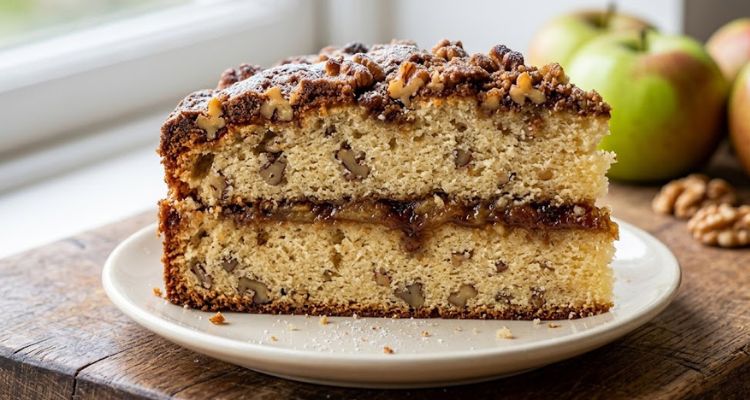
Mary Berry’s apple and walnut cake is a deep round cake with 100g of chopped walnuts and 100g of sultanas in the batter. A layer of 400g grated cooking apples runs through the middle. It bakes at 180°C/Fan 160°C/Gas 4 for 1¼ to 1½ hours.
Berry’s own title is Apple and Cinnamon Cake, in Baking Bible (2010) and Ultimate Cake Book (2003). Her headnote calls it the sort of cake you’d find in a first-class coffee shop or tearoom. She suggests selling it in wedges at school fêtes, warmed, with clotted cream.
The apple never goes into the batter. Half the mixture goes into the tin, then the grated apple and cinnamon spread across in an even layer, then the rest on top. It bakes as three distinct layers.
Mary Berry Apple and Walnut Cake
Course: Mary BerryCuisine: BritishDifficulty: Easy8
servings20
minutes1
hour495
kcalThe deep round cake from Baking Bible (2010), where walnuts go in twice: chopped through the batter, then scattered over the top with muscovado before it bakes. Nearly a pound of grated apple sits hidden in the middle.
Ingredients
225 g (8 oz) softened butter
225 g (8 oz) light muscovado sugar
3 large eggs
100 g (4 oz) chopped walnuts
100 g (4 oz) sultanas
225 g (8 oz) self-raising flour
2 level teaspoons baking powder
400 g (14 oz) cooking apples, peeled, cored and grated
1 level teaspoon ground cinnamon
- To finish:
light muscovado sugar, for sprinkling
extra chopped walnuts, for sprinkling
icing sugar, for dusting
Directions
- Preheat:Pre-heat the oven to 180°C/Fan 160°C/Gas 4. Grease a 23 cm (9 in) deep round cake tin then line the base with baking parchment.
- Mix:Measure the butter, sugar, eggs, chopped walnuts, sultanas, flour and baking powder into a large bowl and beat for about 2 minutes until thoroughly blended.
- Layer:Spoon half the mixture into the prepared tin then spread the grated apple and ground cinnamon in an even layer on top. Spoon the remaining cake mixture on top, level the surface then sprinkle generously with light muscovado sugar and walnuts.
- Bake:Bake in the pre-heated oven for about 1¼-1½ hours or until the cake is well risen and golden brown. Leave to cool in the tin for a few minutes then turn out, peel off the parchment and finish cooling on a wire rack. Dust with icing sugar to serve.
FAQs
Berry calls this an apple and cinnamon cake, so why the walnuts?
Because they’re in it twice, and nothing else in her apple recipes does that. The batter takes 100g of chopped walnuts beaten in with the sultanas. More chopped walnuts then go over the top with the muscovado sugar before it bakes.
Her title puts the cinnamon first, which is fair, since a level teaspoon goes through the apple layer. But if you want an apple cake with nuts in it, this is the one she wrote. Her other walnut bakes pair the nut with coffee rather than fruit, in a traybake, a butterfly cake and a praline-topped sandwich cake.
Why layer the apple instead of mixing it in?
She doesn’t explain, so here’s my read. Four hundred grams of grated apple stirred through would make the batter far too wet, and the fruit would disappear into it. Layering keeps a distinct seam running through the middle instead.
She takes the same approach in her spiced Dorset apple traybake, where sliced apples go between and on top of the batter rather than into it. There she adds a note worth carrying across. Spread the second half of the mixture gently with a palette knife, so the fruit underneath isn’t disturbed.
Butter or soft margarine?
She changed it between editions, and this is the second recipe where she’s done exactly that. Ultimate Cake Book (2003) asks for 8 oz of soft margarine and 3 extra large eggs. Baking Bible (2010) asks for 225g of softened butter and 3 large eggs.
Nothing else moves. Same 400g of apples, same 100g each of walnuts and sultanas, same tin, same temperature, same 1¼ to 1½ hours. Her Basic All-in-one Sponge Traybake made the identical switch across those same two books, which points to a house style change rather than a decision about this cake.
How do I know when it’s done, given the long bake?
Well risen and golden brown is her test, after 1¼ to 1½ hours. That’s a wide window. A deep 23cm tin with a wet layer of apple through the middle is also the sort of cake that colours on top well before the centre has set.
A skewer into the middle is the safer check, though it will come out damp if it passes through the apple seam rather than the sponge. Berry doesn’t mention a skewer for this cake, so treat that as my suggestion rather than her instruction. If the top is browning too fast, a loose sheet of foil over it is the standard fix.
What kind of apples should I use?
Cooking apples, peeled, cored and grated, 400g of them. In a British kitchen that means Bramleys. My reasoning for sticking to them is the sugar: there’s 225g of muscovado in the batter plus more on top, and a sharp apple is what keeps it from cloying.
Berry treats other apples differently elsewhere, which is the useful signal. In her gluten-free apple and coconut cake the apples are diced rather than grated, then cooked with lemon zest and juice for 4 to 5 minutes and simmered, covered, for about 15 more until soft. They go in cold, and she warns to keep the pieces small so they don’t sink.
How does this differ from her apple and cinnamon loaf cake?
They’re built differently, despite the similar names. Her apple and cinnamon loaf cake, from Mary Berry Cooks (2014), is a rubbed-in mixture using just 75g of butter to 200g of flour. Diced dessert apples are stirred through, slices go on top, and it makes two small loaves in 40 to 45 minutes.
This one is an all-in-one with three times the butter, in a single deep round tin, and the loaf has no walnuts or sultanas in it at all. The loaf also carries a keeping note this cake doesn’t: 3 to 4 days in a cake tin, or up to 3 months frozen. Berry gives no storage advice for the apple and cinnamon cake in either book.