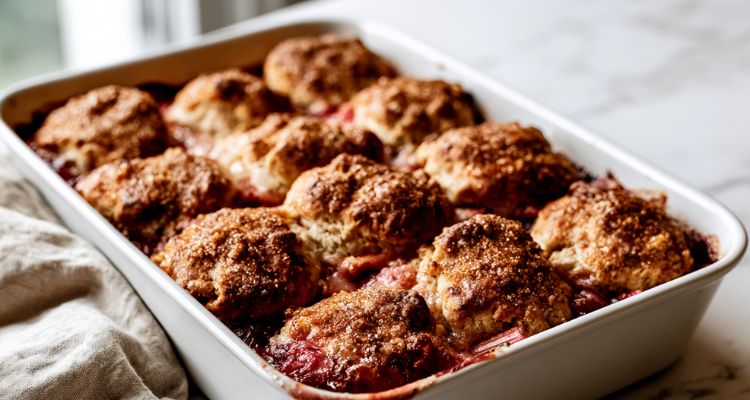
Mary Berry’s rhubarb and orange cobbler is a baked pudding of early rhubarb with orange juice under a scone topping sprinkled with demerara sugar. It bakes at 180°C (160°C fan/Gas 4) for 30 to 40 minutes and serves 6.
Berry’s headnote in Mary Berry Cooks (2014) says her topping is “rolled out fairly thinly” for a lighter finish than a traditional cobbler. She splits the orange zest between the fruit and the scone dough, so the citrus runs through the whole dish.
The detail that sets this cobbler apart is the raw rhubarb. Berry doesn’t pre-cook it on the hob. She arranges it straight in the dish with sugar and orange juice, then bakes everything together so the rhubarb softens slowly under the scone lid.
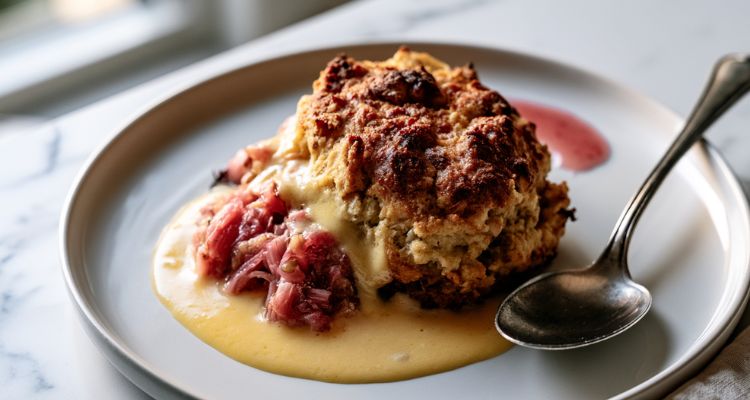
Mary Berry Rhubarb and Orange Cobbler
Course: DessertCuisine: BritishDifficulty: Easy6
servings15
minutes40
minutes345
kcalFrom Mary Berry Cooks (2014), a gentler cobbler baked at a lower temperature than Berry’s apple versions, with orange zest threaded through both the fruit and the scone dough.
Ingredients
- For the rhubarb filling:
800g (1lb 12oz) early rhubarb, trimmed and cut into 5cm (2in) lengths
150g (5oz) caster sugar
grated zest and juice of 2 oranges
cream or custard, to serve
- For the scone cobbler:
150g (5oz) self-raising flour
½ teaspoon baking powder
75g (3oz) caster sugar
50g (2oz) softened butter
75ml (2½fl oz) milk
about 2 tablespoons demerara sugar
Directions
- Preheat the oven to 180°C/160°C fan/Gas 4. You’ll need a 1.5-litre (3-pint) baking dish and a 5cm (2in) pastry cutter.
- Arrange the rhubarb in the baking dish. Add the caster sugar, half the orange zest and all the orange juice.
- Measure the flour, baking powder and caster sugar into a mixing bowl. Add the butter and rub it into the flour until the mixture resembles breadcrumbs. Stir in the milk and remaining orange zest and mix to a soft dough.
- Turn the dough onto a lightly floured work surface and pat out until about 1cm (½in) thick. Cut into circles using the cutter.
- Arrange the scones on top of the rhubarb in a circle around the edge of the dish. Sprinkle with the demerara sugar.
- Bake for 30 to 40 minutes until the rhubarb is tender when tested with the point of a knife and the cobbler is golden brown. Serve hot with cream or custard.
FAQs
Why does Berry use early rhubarb for this cobbler?
Early forced rhubarb has thinner, more tender stems with a delicate pink colour. Berry notes elsewhere in the same book that forced rhubarb “just needs brief simmering” compared to thicker outdoor stems. In a cobbler baked at her lower temperature of 180°C, tender rhubarb softens perfectly in 30 to 40 minutes.
Outdoor rhubarb from later in the season has tougher, greener stalks that take longer to cook through. If you’re using thicker stems, cut them into shorter 3cm lengths and add an extra 5 to 10 minutes of baking time. Check the rhubarb with a knife tip as Berry instructs.
Can I use other fruit instead of rhubarb?
Berry answers this herself in her Wise Words note beneath the recipe. She says to “make this cobbler with any seasonal fruits; try apples and blackberries, plums or summer berries.” Her apple and blackberry cobbler from Foolproof Cooking (2016) uses the same scone principle with a slightly different method.
If you swap the fruit, adjust the sugar to match its sharpness. Rhubarb needs 150g of caster sugar because it’s very tart. Sweet summer berries would need half that amount. Keep the orange zest in the scone dough regardless, because it lifts any fruit filling.
Why is the oven temperature lower than Berry’s other cobblers?
Berry bakes this at 180°C/160°C fan/Gas 4, compared to 200°C for her apple cobbler in Foolproof Cooking and 220°C for the Complete Cookbook version. The lower heat suits rhubarb, which releases a lot of liquid as it cooks and needs time to reduce down rather than boil over.
A hotter oven would brown the scones before the rhubarb underneath had softened properly. Berry’s thinner scone topping (patted to just 1cm thick) also cooks faster than a chunky round, so it doesn’t need aggressive heat. The demerara sugar on top caramelises gently at this temperature instead of burning.
Why does Berry split the orange zest between filling and topping?
Half goes into the dish with the rhubarb and orange juice, half goes into the scone dough. This means the citrus flavour comes from two directions at once. The zest in the filling infuses the juice as it bakes; the zest in the topping releases its oils into the scone as it rises.
Most cobbler recipes keep the fruit and topping completely separate in flavour. Berry connects them through the shared orange, which makes the finished dish taste more unified. It’s a small step that takes no extra effort, and it’s the kind of detail she’s known for across her baking books.
What size baking dish should I use?
Berry specifies a 1.5-litre (3-pint) baking dish. This matters because the 800g of rhubarb needs to sit in a fairly even layer with room for the scone circles on top. Too deep and the rhubarb steams instead of baking; too shallow and the juice overflows.
An oval or rectangular dish around 25cm by 18cm works well. Berry arranges the scone circles “in a circle around the edge of the dish.” This leaves the centre open for the rhubarb juice to bubble up. The chicken cobbler version follows the same approach: scones around the edge, filling visible in the middle.
How do I tell when the rhubarb is cooked through?
Berry’s instruction is precise. She says to bake until the rhubarb “is tender when tested with the point of a knife.” Push a small sharp knife into the thickest piece of rhubarb through a gap between the scones. It should slide in with no resistance at all.
The visual clue is the juice. When the rhubarb is ready, you’ll see thick, pink-orange syrup bubbling around the scone rounds. If the juice still looks thin and watery, the fruit needs more time. Berry’s iced fairy cakes teach a similar lesson about doneness: look at what’s happening, not just the clock.