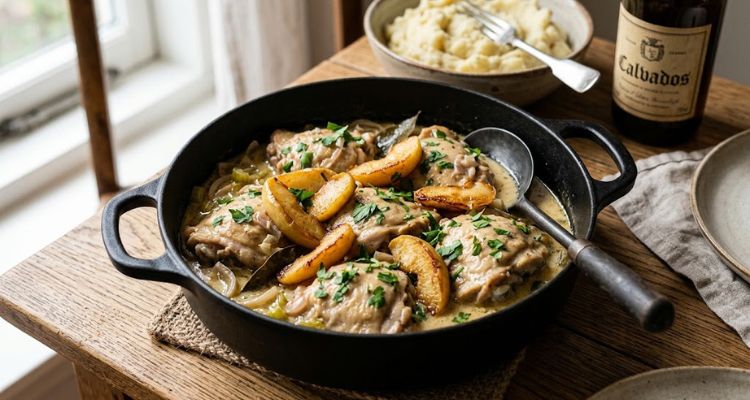
Mary Berry’s Normandy chicken braises six chicken thighs with banana shallots, celery and 150ml of Calvados, finished with crème fraîche. Eating apples are fried separately in butter and muscovado sugar. It cooks at 160°C/140°C fan/Gas 3 for about 40 minutes and serves 6.
Berry’s note in Classic (2018) explains the name in seven words: Normande implies apple. She calls it a mild and creamy apple-flavoured dish, which is a fair description of what Calvados and crème fraîche do to a braise.
The apples never go into the sauce. They’re fried at the last minute over a high heat until golden, then spooned on top. That’s what keeps them in wedges rather than collapsing into purée.

Mary Berry Normandy Chicken
Course: DinnerCuisine: BritishDifficulty: Easy6
servings20
minutes1
hour570
kcalFrom Classic (2018), the book of her BBC series. A brown-and-braise casserole that goes in the oven low, plus a two-minute apple garnish fried at the end. It can be made a day ahead, which is why it works for having people over.
Ingredients
6 chicken thighs on the bone, skin removed
2 tbsp oil
30 g (1 oz) butter
400 g (14 oz) banana shallots, sliced
5 celery sticks, sliced
2 garlic cloves, crushed
150 ml (5 fl oz) Calvados or brandy
30 g (1 oz) plain flour
200 ml (7 fl oz) chicken stock
3 eating apples, peeled, cored and sliced into wedges 1-2 cm (½-¾ in) thick
1 tsp muscovado sugar
200 ml (7 fl oz) full-fat crème fraîche
salt and freshly ground black pepper
1 tbsp chopped parsley, to serve
Directions
- Preheat:Preheat the oven to 160°C/140°C fan/Gas 3.
- Brown the chicken:Season the chicken thighs with salt and pepper. Heat the oil and half the butter in a deep ovenproof saucepan or flameproof and ovenproof casserole dish. When the butter has melted, brown the chicken on all sides over a high heat for 4-5 minutes until golden. You may need to do this in batches. Remove from the pan and set aside.
- Soften the vegetables:Add the shallots and celery to the pan and fry over a high heat for 4-5 minutes. Add the garlic and fry for a further 1-2 minutes. Pour in the Calvados or brandy and boil for a few seconds.
- Make the sauce:Measure the flour into a bowl, add 3 tablespoons of the stock and blend until smooth. Gradually blend in the rest of the stock, then add to the pan, bring to the boil, stirring, and cook until smooth and thickened.
- Braise:Return the chicken pieces to the pan and season with salt and pepper. Cover with a lid, bring back up to the boil and transfer to the oven to cook for about 40 minutes or until tender.
- Fry the apples:When ready to serve, fry the apple in the remaining butter, sprinkle over the sugar and fry over a high heat for 4-5 minutes until golden.
- Finish:Stir the crème fraîche into the pan with the chicken, check the seasoning and serve with a sprinkling of parsley and a spoonful of golden apple slices on the top.
FAQs
Can I use chicken breasts instead of thighs?
Yes, and it’s her own suggestion rather than a substitution we’re proposing. Her Classic Tip on this recipe says you can use six skinless chicken breasts if you prefer.
She doesn’t adjust the timing for them, which is worth thinking about. Breasts are leaner than thighs and will be done sooner, so I’d start checking at around 25 minutes rather than waiting for the full 40. That timing suggestion is mine, not hers.
Do I have to use Calvados?
She gives brandy as an equal alternative in the ingredients list itself, so no. Calvados is apple brandy from Normandy, which is why it belongs in a dish whose name means apple, but 150ml is a lot to buy for one recipe.
What you shouldn’t do is skip the spirit entirely and add more stock. It goes into a hot pan and boils for a few seconds, which drives off the alcohol and leaves the flavour behind. Take it out and you lose the backbone of the sauce, which is my judgement rather than a warning she gives.
Why fry the apples separately?
Because apples cooked in a braising liquid for 40 minutes disappear. Hers are sliced into wedges 1 to 2cm thick, fried in butter over a high heat for 4 to 5 minutes with a teaspoon of muscovado sugar, and spooned on at the very end.
The sugar is doing more than sweetening. It helps the cut faces caramelise in the pan, which gives you the golden colour she asks for against a pale, creamy sauce. She uses eating apples rather than cookers here, and that’s consistent: her cooking apples go into things that want them to collapse, like her apple and walnut cake, where the fruit is grated into a layer.
Can I make it in advance?
This is where the recipe earns its place at a dinner party. Berry says it can be made up to a day ahead, then you add the crème fraîche and fry the apples to serve. So the long part is done before anyone arrives.
For the freezer she’s equally specific: it freezes well without the crème fraîche and apples. That means braising, cooling and freezing the chicken and sauce, then finishing it fresh. Dairy splits on reheating and fried apple goes soft, so both are deliberately held back.
How is this different from her other Normande chicken?
Same name, same region, entirely different cooking. Her Chicken thighs Normande in the Complete Cookbook (2024) puts leeks, bacon and garlic in a roasting tin with 350ml of strong dry cider, sits eight chicken thighs on top, skin on, and roasts them at 190°C/170°C fan/Gas 5 for 20 to 25 minutes.
The juices are then reduced by half on the hob and finished with crème fraîche, which is the one thing the two recipes share. That version has no apples in it at all, no brandy and no browning stage, and it serves 4 rather than 6. It’s a weeknight supper where this one is a make-ahead casserole.
What should I serve with it?
Something to catch the sauce, since there’s 200ml of crème fraîche stirred through it plus the braising liquid. Mashed potato is the obvious partner, and Berry pairs her own Normandy-style pheasant with a celeriac and potato gratin in Cook Up a Feast, noting that celeriac’s mild celery flavour goes particularly well with potatoes.
That’s a sensible steer here too, given there are already five sticks of celery in the pan. Keep the green vegetable plain, because the sauce is doing the work. Both suggestions are mine rather than hers, since she gives no serving note for this recipe.