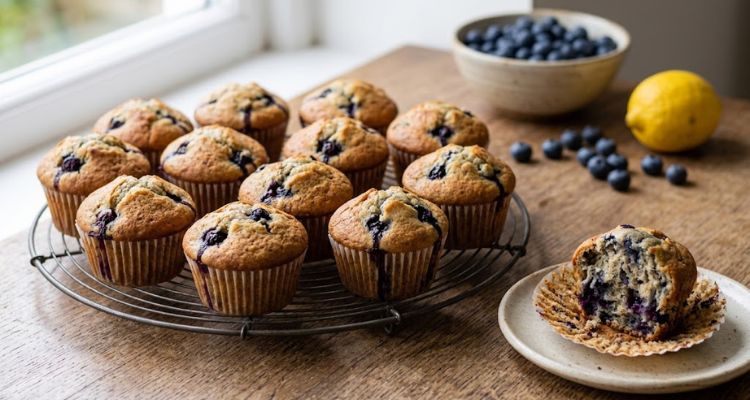
Mary Berry’s lemon and blueberry muffins take 250g self-raising flour, 175g blueberries and the grated rind of a whole lemon. The butter is rubbed into the flour rather than melted. They bake at 200°C/Fan 180°C/Gas 6 for 20 to 25 minutes.
She calls them simply Blueberry Muffins in Baking Bible (2010), though the lemon is in every version she’s published. Her Cookery Course headnote explains why: they aren’t over sweet, and the lemon gives them a pleasingly tangy flavour.
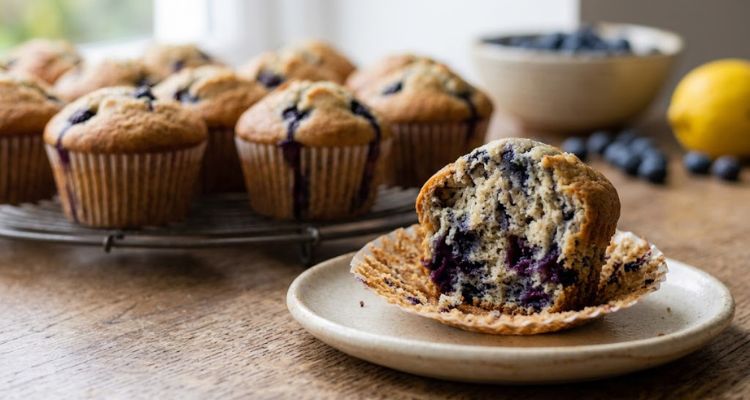
One line in her method decides whether they work. After the milk and eggs go in, mix quickly to blend, because the mixture should have a lumpy consistency. A smooth batter means tough muffins.
Mary Berry Lemon and Blueberry Muffins
Course: DessertCuisine: BritishDifficulty: Easy12
servings10
minutes20
minutes200
kcalFrom Baking Bible (2010), where the fat is rubbed into the flour like a scone rather than melted like most muffin recipes. The rind of a whole lemon against just 75g of sugar, which is why these suit breakfast rather than the tea trolley.
Ingredients
250 g (9 oz) self-raising flour
1 level teaspoon baking powder
50 g (2 oz) softened butter
75 g (3 oz) caster sugar
175 g (6 oz) blueberries
grated rind of 1 lemon
2 large eggs
250 ml (9 fl oz) milk
Directions
- Preheat:Pre-heat the oven to 200°C/Fan 180°C/Gas 6. Place muffin cases in a 12-hole muffin tin.
- Rub in:Measure the flour and baking powder into a large bowl. Rub in the butter with the fingertips until the mixture resembles fine breadcrumbs. Stir in the sugar, blueberries and the grated lemon rind.
- Mix:Mix together the eggs and milk, then pour the mixture all in one go into the dry ingredients. Mix quickly to blend. The mixture should have a lumpy consistency. Spoon the mixture into the prepared tins or paper cases, filling almost to the top.
- Bake:Bake in the pre-heated oven for about 20-25 minutes until well risen, golden and firm to the touch. Leave to cool for a few minutes in the tray, then lift out the paper cases and cool the muffins for a few minutes on a wire rack. Serve warm.
FAQs
Berry calls these blueberry muffins, so where’s the lemon?
In the ingredients, in all three versions she’s published, and it’s doing more work than the name suggests. The grated rind of a whole lemon goes in against just 75g of caster sugar, which is a small amount of sugar for 12 muffins.
Her Cookery Course headnote is the clearest on the point. She describes them as not over sweet, with the lemon giving a pleasingly tangy flavour, and suggests them for breakfast. That’s the whole design: these are a breakfast bake rather than a dessert, and the lemon is what keeps them on that side of the line.
How lumpy should the batter look?
Genuinely lumpy, and she says so twice in different books. Here the instruction is to mix quickly to blend, because the mixture should have a lumpy consistency. In her Cookery Course version she puts a number on it: fold very roughly, no more than 20 strokes, and the mixture should still look lumpy and uneven.
Twenty strokes is far fewer than instinct suggests. If your batter looks smooth and pourable, the gluten has developed and the muffins will bake up chewy rather than short and crumbly. The same warning appears across her muffin recipes, including the raspberry and apple ones we used for her rhubarb muffins, where she says to stir the fruit in three or four times only.
Why rub the butter in instead of melting it?
Because this version is built like a scone rather than a classic American muffin, and she says as much in the 2003 edition. She describes the American muffin as a cross between a scone and a fairy cake, but bigger.
Her Cookery Course recipe takes the other route entirely, with 100g of melted butter stirred into the wet ingredients. That one also uses more flour, more blueberries and a teaspoon of vanilla. They’re two different recipes rather than two printings of one, so follow whichever you’re making rather than mixing the methods.
How full should I fill the cases?
Almost to the top, which contradicts the usual advice and needs the right tin. The 2003 edition explains why: the mixture rises well above ordinary fairy cake paper cases, so if that’s what you’re using, grease the deep muffin tins first. With proper muffin paper cases you don’t need to grease at all.
Her Cookery Course version says three-quarters full instead, and bakes for 25 to 30 minutes rather than 20 to 25. Match the fill level to the recipe you’re following, because a fuller case in a hotter, shorter bake behaves differently from a three-quarter case with five more minutes.
Butter or soft margarine?
This is the fourth recipe where her answer changed between the same two books. Ultimate Cake Book (2003) rubs in 2 oz of soft margarine. Baking Bible (2010) rubs in 50g of softened butter.
Everything else is untouched: the same 250g of flour, 175g of blueberries, one lemon, 250ml of milk and the same 20 to 25 minutes at 200°C. The only other change is the eggs, from extra large in 2003 to large in 2010. Her Basic All-in-one Sponge Traybake, her Apple and Cinnamon Cake and her Iced Chocolate Traybake all made the identical margarine-to-butter switch across those two editions.
How long do they keep?
Not long, and Berry’s instruction in every version is to serve them warm. Her Cookery Course note is the only one that gives a figure: they’ll keep in an airtight container for up to 2 days, though they’re best served while still warm.
That’s a different answer from her other muffins, worth knowing if you’re planning ahead. Her raspberry and apple muffins in Cooks the Perfect are also best eaten fresh but keep up to two days, and her Mary Berry Everyday muffins freeze well. She gives no freezing note for these ones at all.