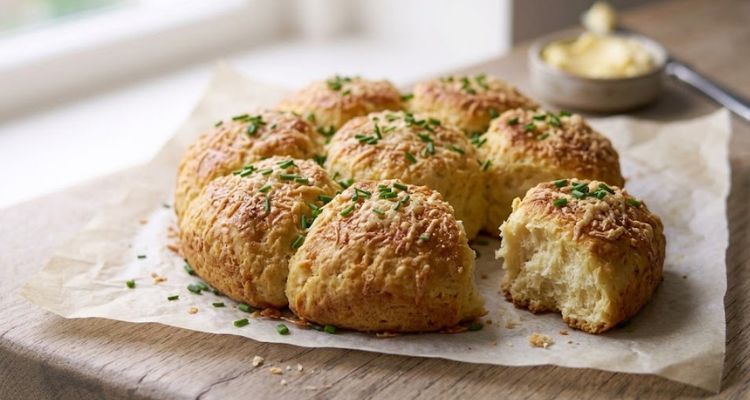
Mary Berry’s cheese and chive scones are made with mature Cheddar, Parmesan, garlic and 6 tablespoons of snipped chives in a mustard-spiked scone dough. They bake at 220°C/200°C fan/Gas 7 for 25 minutes. One batch serves 10 to 12.
She calls them Cheese and Garlic Tear-and-Share Scones in Foolproof Cooking (2016), though the chives are right there in the ingredients. Her note is that they’d be lovely for lunch with soup, and that a scone dough beats a yeast dough for speed.
The shaping is what makes them tear-and-share. The dough divides into 22 equal balls, arranged on the baking sheet so they form a round with all the balls just touching. They rise into each other as they bake.

Mary Berry Cheese and Chive Scones
Course: SidesCuisine: BritishDifficulty: Easy22
servings20
minutes25
minutes265
kcalFrom Foolproof Cooking (2016), a savoury scone dough turned into one sharing round rather than cut with a cutter. Two cheeses, garlic and a generous six tablespoons of chives, on the table in well under an hour.
Ingredients
450 g (1 lb) self-raising flour, plus extra for dusting
2 tsp baking powder
2 tsp mustard powder
1 tsp salt
100 g (4 oz) butter, cubed
50 g (2 oz) Parmesan cheese, finely grated, plus extra for sprinkling
100 g (4 oz) mature Cheddar cheese, grated
1 garlic clove, crushed
6 tbsp finely snipped chives
2 eggs
about 150 ml (5 fl oz) milk (see FAQ on the liquid)
Directions
- Preheat:Heat the oven to 220°C/200°C fan/Gas 7 and line a baking sheet with baking paper.
- Rub in:Measure the flour and baking powder into a large bowl with the mustard, salt and butter. Rub the butter in with your fingertips until the mixture resembles fine breadcrumbs, then add both cheeses with the garlic and chives.
- Make the dough:Beat the eggs in a jug and add enough milk to make up to 300ml (10 fl oz) of liquid. Add this gradually to the bowl and mix to a dough. Tip onto a lightly floured surface, knead until smooth, then divide into 22 equal-sized balls.
- Shape:Arrange the balls on the baking sheet to form a round, with all the balls just touching. Brush with any leftover liquid from the jug and sprinkle with the extra Parmesan.
- Bake:Bake for 25 minutes until well risen and golden on top and underneath. Serve warm with butter.
FAQs
Berry calls these cheese and garlic scones, so where do the chives come in?
They’re in the recipe, just not in the title. The ingredients list carries 6 tablespoons of finely snipped chives, which go into the bowl at the same time as the Cheddar, Parmesan and crushed garlic.
Six tablespoons is a lot of chives for 450g of flour, and it’s why these read as cheese and chive scones to anyone eating them. If you’re searching for that combination in Berry’s books, this is the recipe, and it’s the only one of hers that has both.
How sticky should the dough be?
Stickier than you think, and this is the best line she writes about scones anywhere. Her Foolproof Tip on this recipe says a scone dough should be fairly sticky rather than dry. If it’s on the wet side, she says, it gives a better rise and the resulting scones are very moist.
That runs against the instinct to add flour until the dough stops clinging to your hands. Resist it. The flour you add at the kneading stage is the difference between a scone that climbs and one that sits there, and Berry would rather you had a slightly awkward dough than a dry one.
The milk quantity doesn’t seem to add up. How much do I actually need?
Good catch, and it’s worth explaining rather than papering over. The ingredients list says about 150ml of milk, but the method tells you to beat 2 eggs in a jug and add enough milk to make 300ml of liquid in total. Two eggs come to roughly 100ml, so reaching 300ml needs nearer 200ml of milk.
Go by the jug, not the list. The 300ml total is the instruction that matters, and the word “about” in the ingredients is doing the work. Her Sultana Scones in Mary Berry Everyday (2017) use exactly the same jug method with the same 300ml target, so it’s her standard approach rather than a one-off.
Can I make individual scones instead of a sharing round?
Yes, and she gives you two other routes. Her Cheese Scone Round in Baking Bible (2010) uses 225g self-raising flour, 150g mature Cheddar, mustard powder and a quarter teaspoon of cayenne, rolled to a 15cm circle, marked into 6 wedges and baked for about 15 minutes at the same 220°C.
There’s also a cheese variation on her sweet scones in Baking with Mary Berry (2015). You omit the sugar and add 125g grated aged Cheddar with half a teaspoon of mustard powder, then roll into a 15cm round and cut into wedges. Note that both alternatives are wedges rather than cutter scones, and neither contains chives.
Why mustard powder in a cheese scone?
Because she uses it every time she puts cheese in a scone, which tells you she considers it part of the formula rather than a flourish. This recipe takes 2 teaspoons for 450g of flour; the Baking Bible round takes half a teaspoon for 225g, so roughly the same strength.
That round goes further and adds a quarter teaspoon of cayenne pepper as well. Berry doesn’t explain the reasoning in either book. What I’d say from cooking with both is that neither makes the scones taste of mustard or chilli, they just stop the cheese tasting flat, but that’s my observation and not hers.
Can I make them ahead or freeze them?
Both, and she’s specific. They can be made up to a day ahead, and they freeze well cooked, so this is a reasonable thing to have in the freezer before people arrive.
Serve them warm with butter, which is her instruction. Her own suggestion for what to put beside them is soup, and her leek and potato soup is the obvious partner from her own books. They’d hold up next to something cold too, like her smoked salmon starter, though that pairing is mine rather than hers.