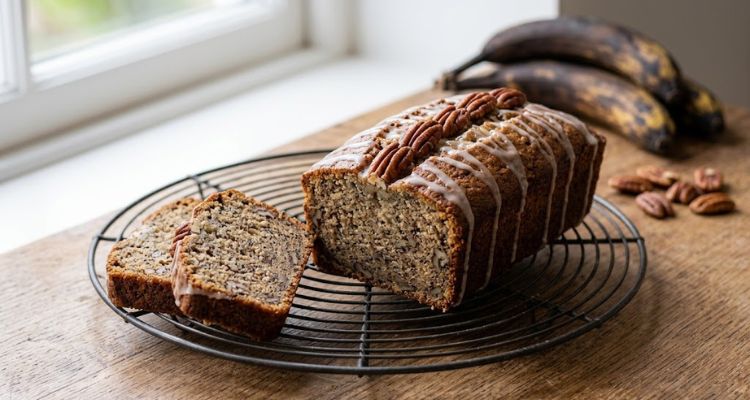
Mary Berry’s banana loaf is made with 200g of mashed ripe banana, light muscovado sugar, self-raising flour and chopped pecans. It bakes in a 900g loaf tin at 180°C/fan 160°C/Gas 4 for about an hour. A honey icing goes on once it’s cold.
Berry weighs her bananas, and that’s the detail worth taking away. In Cooks the Perfect (2014) she says to check you have about 200g of mashed banana. Too little gives a loaf that lacks flavour, too much and the cake may turn out heavy.
She also solves the problem of nobody’s loaf tin matching anyone else’s. What matters is capacity, 1.2 litres, rather than the exact dimensions. Different proportions bake at different speeds, so the time shifts.

Mary Berry Banana Loaf Recipe
Course: DessertCuisine: BritishDifficulty: Easy12
servings15
minutes1
hour287
kcalThe version from Cooks the Perfect (2014), the book where she stops to explain her reasoning. Pecans through the batter, more on top, and a honey icing that takes 25g of icing sugar and two teaspoons of honey.
Ingredients
115 g (4 oz) butter (room temperature) or baking spread (at least 70% fat), plus extra for greasing
2 very ripe bananas, about 200 g (7 oz) total peeled weight
150 g (5½ oz) light muscovado sugar
2 large eggs
225 g (8 oz) self-raising flour
1 tsp baking powder
2 tbsp full-fat or semi-skimmed milk
75 g (2½ oz) pecans, chopped
- For the icing and decoration:
25 g (scant 1 oz) icing sugar
2 tsp clear honey
10-12 pecan halves, about 20 g (¾ oz)
Directions
- Preheat:Preheat the oven to 180°C (fan 160°C/350°F/Gas 4). Grease the loaf tin and line the base with baking parchment. You don’t need to line the sides.
- Mix:Mash the bananas. Put the butter, muscovado sugar, eggs, flour, baking powder and milk in a large bowl and beat with an electric hand whisk for 1 minute, or 2 minutes with a wooden spoon, until blended. Add the banana and beat for 30 seconds or until mixed in. Stir in the chopped pecans, spoon into the tin and level the top.
- Bake:Bake for about 1 hour or until well risen and golden brown. Check after 45 minutes, and if the top is browning too much, lay a piece of foil over it. To see if the loaf is done, insert a fine skewer in the middle: it should come out clean.
- Cool and ice:Leave to cool in the tin for a few minutes. Run a palette knife around the edge, turn out the loaf, peel off the lining paper and finish cooling on a wire rack. When it’s cold, sift the icing sugar into a bowl and stir in the honey and ½ teaspoon of cold water to make a runny icing.
- Decorate:Drizzle the icing over the cake and lay the pecan halves down the middle.
FAQs
How ripe should the bananas be, and how much do I need?
Very ripe, black skins included. Berry says the riper they are the better the flavour, and that you can keep very ripe bananas in the freezer until you’re ready to bake. In another of her books she suggests freezing them in their skins, which go black, then defrosting and peeling them for banana bread.
The weight is the part almost every other recipe skips. Mash with a fork until broken down and pulpy, then check you have about 200g. Too little results in a lack of flavour, too much and the cake may have a heavy texture. Two bananas usually gets you there, but two large ones can push past 300g, which is why she tells you to weigh rather than count.
My loaf tin isn’t the size she lists. Does it matter?
Less than you’d think, and she addresses it directly. She notes that 900g loaf tins vary and can be thinner, fatter or deeper than hers. Provided yours has the same 1.2 litre capacity, you’ll have the right amount of mixture.
What changes is the timing. If your tin is shallower but longer, the loaf may bake a bit more quickly. If it’s shorter and deeper, it may take longer. That’s why her method tells you to check at 45 minutes for a bake she times at about an hour, and to reach for foil if the top is running ahead of the middle.
How is this different from her Baking Bible banana loaf?
They’re separate recipes, not editions of one. The Baking Bible (2010) version is plainer: 100g butter, 175g caster sugar, no nuts, no icing, and everything goes into the bowl in one go including the mashed banana. It bakes for about the same hour in the same size tin.
This one uses muscovado rather than caster sugar, adds 75g of chopped pecans and finishes with honey icing. The method differs too: here the banana goes in after the rest is already blended, beaten for just 30 seconds. Her Baking Bible headnote makes a claim this version doesn’t: that the loaf is moist enough that it really doesn’t need buttering, and that it freezes very well.
Why is the banana added separately rather than all-in-one?
Berry doesn’t explain, so this is my read rather than hers. Everything else is beaten for a full minute with an electric whisk, and the banana then gets 30 seconds. Mashed banana is soft enough to disperse quickly, so the shorter time is probably about not overworking the flour once the wet fruit is in.
If you prefer the simpler route, her Baking Bible version puts every ingredient in together and beats for 2 minutes, so she clearly considers both acceptable. I’d follow the timings on whichever version you’re making rather than mixing the two methods.
Can I leave out the pecans or use something else?
The pecans are hers, so leaving them out changes her recipe rather than following it. That said, she treats nuts as swappable elsewhere: her apple and walnut cake uses walnuts through the batter and over the top in the same way.
The cleaner answer if you want a nut-free loaf is to make the Baking Bible version instead, which has no nuts in it at all and no icing to hold the decoration. That’s her recipe as written rather than an edit of this one.
What else does she do with bananas?
Quite a lot, and each one has a different job. Her Banana Cake with Cinnamon Cream Cheese Frosting in Mary Berry Cooks (2014) makes two small loaves, and her reasoning is that nobody wants to eat too much cake, so you freeze one for another time. The iced cakes freeze for up to 2 months, wrapped in greaseproof paper, without the banana chips on top.
She also puts banana where you might not expect it. Her Carrot and Banana Cake in Foolproof Cooking (2016) explains that she has always put banana in her carrot cake, because it gives a moist sponge and a slightly denser texture rather than a light, springy one. That’s a different approach from her classic carrot cake, which is worth knowing if you’ve made that one.