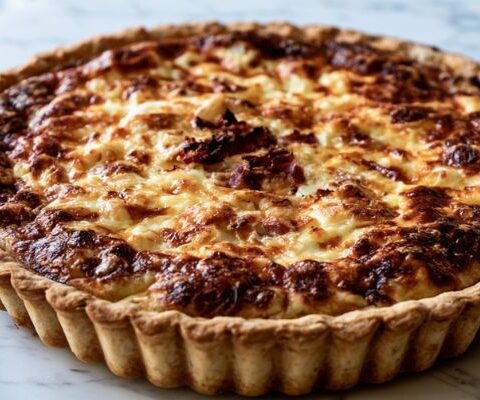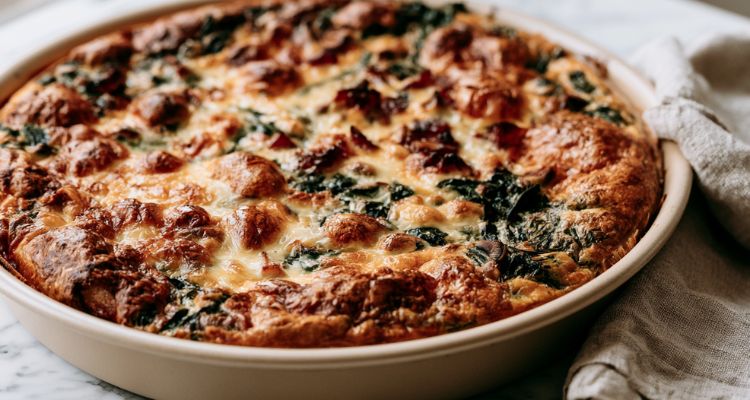
Mary Berry’s crustless quiche is a pastry-free bake made with eight eggs, double cream, crispy bacon, spinach and Gruyère. It bakes in a 20cm cake tin at 180°C (160°C fan/Gas 4) for 30 minutes and serves 4 to 6.
Berry calls this her “spinach frittata quiche” in Simple Comforts (2020). Her headnote explains: “we don’t always want pastry. This is a combination of the two.” It’s one of the few times Berry actively sidesteps her own pastry, which says something.
The step most people rush is squeezing the spinach dry after wilting. Berry fries it until “just wilted” then drains and squeezes out the liquid. Skip this and water pools at the base, giving you a soggy bottom with no pastry to blame.
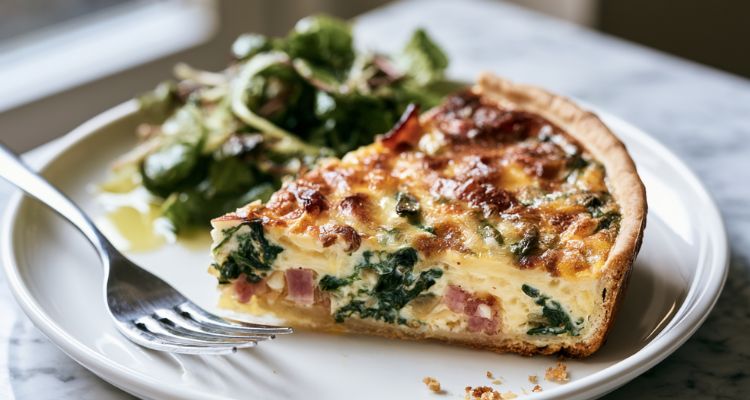
Mary Berry Crustless Quiche
Course: BreakfastCuisine: BritishDifficulty: Easy4-6
servings15
minutes30
minutes405
kcalFrom Simple Comforts (2020), Berry’s hybrid of a frittata and quiche that skips the pastry entirely. A four-ingredient filling baked in a lined cake tin, ready in under 45 minutes.
Ingredients
A knob of butter, for greasing
4 rashers of thick-cut smoked bacon, chopped
100g (4 oz) baby spinach
8 large eggs
150ml (5 fl oz) pouring double cream
175g (6 oz) Gruyère cheese, grated
Salt and freshly ground black pepper
Directions
- Prepare: You will need a fixed-base 20cm (8 in) cake tin with deep sides. Preheat the oven to 180°C/160°C fan/Gas 4 (350°F). Grease the sides of the tin thoroughly with butter and line the base with a disc of baking paper.
- Fry the bacon: Heat a frying pan over a high heat and fry the bacon until crisp. Remove with a slotted spoon and set aside.
- Wilt the spinach: Add the spinach to the same pan and fry until it has just wilted, then drain and squeeze out the liquid. Roughly chop and set aside.
- Mix the filling: Whisk the eggs and cream together in a large bowl. Add the bacon, spinach and cheese, then season well and pour into the prepared tin.
- Bake: Bake for 30 minutes until firm around the edges and just set in the middle.
- Turn out: Leave to cool slightly before turning out from the tin. You might need to run a palette knife round the edge before releasing the quiche from the tin. Turn out carefully on to a tea towel covering a plate, then reverse it on to another plate. Serve warm in wedges, with a dressed salad.
FAQs
Can I swap the Gruyère for another cheese?
Berry uses Gruyère because it melts smoothly and has a strong, tangy flavour that stands up without pastry around it. In her Spinach, Gruyère and Ham Quiche in Mary Berry Cooks (2014), she writes that “using a strong-flavoured tangy cheese really lifts this quiche.” Cheddar works but gives a denser, less stretchy texture.
Emmental is the closest swap, and Berry herself suggests it as an alternative in that 2014 recipe. Avoid soft cheeses like brie or mozzarella here because they release too much moisture during baking. The filling needs a cheese that melts without weeping.
How do I know when the quiche is set?
Berry says “firm around the edges and just set in the middle,” which means the centre should still have the slightest wobble when you gently shake the tin. It firms up as it cools. If you wait until the centre is completely solid in the oven, you’ll overcook it and the eggs will turn rubbery.
I found 30 minutes was spot on in my oven, but start checking at 25 minutes. The top should be lightly golden and puffed up. It sinks back slightly as it cools, which is normal for any egg-based bake without flour to hold the structure.
What makes this different from a regular frittata?
Berry’s headnote calls it “a combination of the two,” and the key difference is the cream. A traditional frittata uses just beaten eggs with no dairy. Berry adds 150ml of double cream, which creates the silky, custard-like texture you’d expect from a quiche lorraine filling. The egg-to-cream ratio here is looser than her pastry quiches.
Her Summer Frittata in Cook Up a Feast (2010) uses eight eggs with no cream at all, just potato and goat’s cheese. That one is firmer and denser. This crustless version sits right between the two styles, which is why Berry invented a hybrid name for it.
Why does Berry use a cake tin instead of a flan dish?
The deep sides of a cake tin give the quiche height, so each wedge has a thick, satisfying cross-section rather than a thin disc. Berry specifies a “fixed-base 20cm cake tin with deep sides” because a loose-bottomed tin would leak raw egg mixture before it sets.
She lines the base with baking paper and greases the sides with butter so the set quiche releases cleanly. The turn-out step at the end is the trickiest part: go slowly, use a palette knife round the edge, and flip on to a tea towel first to cushion it.
Can I add other vegetables to this recipe?
Berry keeps this version simple with just bacon, spinach and cheese, but her quiche fillings across other books show what works. In her Roasted Vegetable Quiche from Foolproof Cooking (2016), she roasts peppers, courgettes and onions before adding them. The key rule is the same: any vegetable must be cooked and drained first.
Raw vegetables release water as they bake and will ruin the set of the custard. I tested this with mushrooms once and the base was waterlogged. Fry or roast your vegetables, drain them well, then fold into the egg mixture. Keep the total filling volume similar to Berry’s original or the baking time will change.
How should I reheat leftover crustless quiche?
Berry says this can be served cold, and it’s genuinely good straight from the fridge since the Gruyère firms up and the flavour concentrates overnight. If you prefer it warm, 10 minutes at 160°C/140°C fan is enough to heat through without drying out the eggs.
Avoid the microwave if you can because it turns the edges rubbery while the centre stays cold. The oven gives even, gentle heat that keeps the custard texture intact. Cover loosely with foil to stop the top from browning further.