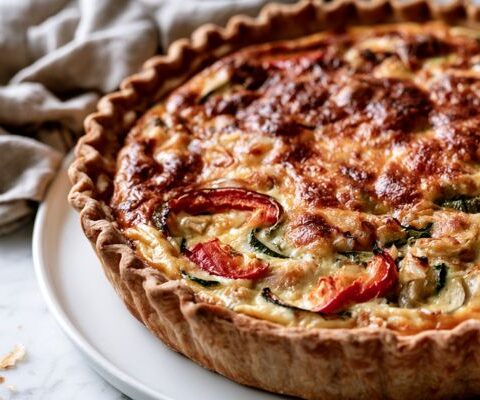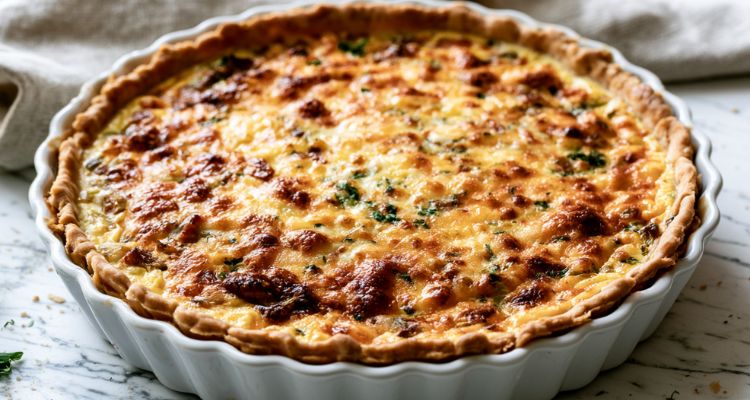
Mary Berry’s leek and bacon quiche is a large shortcrust tart with softened leeks, crispy streaky bacon, Dijon mustard, Gruyère and a rich six-egg custard. It bakes in a 28cm tin at 190°C (170°C fan/Gas 5) for 30-35 minutes and serves 8-12.
Berry’s headnote in Absolute Favourites (2015) calls this “a classic recipe but with a twist from the added leeks and layer of mustard.” The mustard layer sets this apart: she spreads Dijon over the blind-baked pastry base before adding anything else. It creates a flavour barrier between the crisp pastry and the wet filling.
The three-stage leek and bacon method is where Berry takes her time. She fries over high heat, covers and cooks gently for 10 minutes, then uncovers and fries again to “drive off any liquid and crisp up the bacon.” That final stage prevents soggy filling.

Mary Berry Leek and Bacon Quiche
Course: BreakfastCuisine: BritishDifficulty: Easy8-12
servings35
minutes1
hour10
minutes600
kcalFrom Absolute Favourites (2015), Berry’s largest quiche with a hidden Dijon mustard layer and a three-stage method for cooking the leeks and bacon that keeps the filling dry and the pastry crisp.
Ingredients
- For the pastry:
225g (8 oz) plain flour, plus extra for dusting
150g (5 oz) cold butter, cubed
1 egg, beaten
- For the filling:
A knob of butter
2 medium leeks, roughly chopped
350g (12 oz) unsmoked streaky bacon, snipped into small pieces
2 tbsp Dijon mustard
175g (6 oz) Gruyère cheese, grated
6 eggs
600ml (1 pint) double cream
2 heaped tbsp chopped parsley
Salt and freshly ground black pepper
Directions
- Make the pastry: Measure the flour and butter into a food processor and whizz until the mixture resembles breadcrumbs (or place in a mixing bowl and rub the butter into the flour with your fingertips). Add the egg and 1 tablespoon of water and mix again. Add more water if needed and mix into a smooth dough.
- Line the tin: You will need a 28cm (11 in) round, loose-bottomed tart tin or fluted ceramic flan dish and some baking beans. Lightly dust a work surface with flour and roll out the dough into a circle large enough to line the tart tin or dish and about 3mm (⅛ in) thick. Press into the base and sides of the tin and make a small lip around the top. Prick the base all over with a fork and place in the fridge to chill for 15 minutes.
- Blind-bake: Preheat the oven to 200°C/180°C fan/Gas 6 (400°F). Line the chilled pastry case with greaseproof paper and fill with baking beans. Bake in the oven for 15-20 minutes, then remove the beans and paper, lower the temperature to 160°C/140°C fan/Gas 3 (325°F) and return the pastry case to the oven to dry out for 5-10 minutes. Remove from the oven and set aside to cool. Increase the temperature to 190°C/170°C fan/Gas 5 (375°F).
- Cook the filling: Melt the butter in a frying pan, add the leeks and bacon and fry over a high heat for about 15 minutes. Lower the heat, cover with a lid and cook gently for about 10 minutes until softened. Remove the lid and fry over a high heat, stirring frequently to stop the cooked leeks from catching and burning, to drive off any liquid and crisp up the bacon. Leave to cool a little.
- Layer the mustard: Spread the mustard over the base of the cooked pastry case with the back of a spoon and then spoon in the bacon and leek mixture. Season with salt and pepper and add half the cheese.
- Make the custard: Crack the eggs into a large bowl and add the cream and parsley, then season with salt and pepper and whisk by hand to combine. Pour the mixture into the tart case and sprinkle over the remaining cheese.
- Bake: Bake in the oven for 30-35 minutes until golden brown and just set. Serve warm with a fresh salad.
FAQs
Why does Berry spread mustard on the pastry base?
The Dijon mustard layer does two things that aren’t obvious. It adds a sharp, peppery flavour that cuts through the richness of 600ml of cream and six eggs. It also creates a thin seal between the pastry and the wet filling, which helps keep the base crisp.
Berry doesn’t explain her reasoning in the recipe, but she positions the mustard as a “twist” on the classic. I’ve tested it with and without, and the mustard version tastes noticeably more interesting. Without it, the quiche is pleasant but flat. You don’t taste mustard directly, but you’d notice something was missing if it wasn’t there.
How do I stop the leeks making the quiche soggy?
Berry’s three-stage cooking process is designed exactly for this. She fries the leeks and bacon over high heat first, then covers and cooks gently to soften. Finally she removes the lid and fries over high heat again to “drive off any liquid and crisp up the bacon.”
Leeks hold a surprising amount of water, and if you skip the uncovered high-heat fry, that water ends up in your custard. I give the final stage at least 5 minutes, stirring frequently so the leeks caramelise slightly without burning. You’ll see the pan go from wet and steamy to dry and sizzling.
How does this compare to Berry’s Quiche Lorraine?
The Quiche Lorraine from Cook Up a Feast (2010) is smaller (20cm, serves 6) and uses Cheddar with crème fraîche and double cream. This leek version is bigger (28cm, serves 8-12) and uses all double cream with Gruyère, which gives a richer, more indulgent result.
The Lorraine also uses roughly chopped onion where this uses leeks, and the Lorraine has no mustard layer. Both use unsmoked bacon and parsley. If you’re feeding four to six, the Lorraine is the right size. For a party or buffet, this leek version is better because it scales to twelve servings.
What can I use instead of baking beans?
Berry’s own tip answers this directly. She says “you can use pasta, dried pulses, or uncooked rice from your store cupboard.” Dried chickpeas and lentils work well because they’re heavy enough to stop the pastry rising. Keep them in a jar marked “baking beans” after use since they can’t be cooked and eaten afterwards.
Ceramic baking beans from a kitchen shop are worth buying if you make quiche regularly. They conduct heat more evenly than dried pulses and you can reuse them forever. Whatever you use, fill the case generously right up the sides so the pastry keeps its shape.
How far ahead can I make this?
Berry says 1-2 days in the fridge once cooked. It also freezes, with the caveat to “defrost slowly in the fridge so the filling retains its texture.” Fast defrosting at room temperature makes the custard weep and the pastry go soft.
For entertaining, I make the pastry case the day before and store it at room temperature once blind-baked and cooled. On the day, I cook the filling, assemble and bake. This splits 1 hour 45 minutes of work into two manageable sessions. Berry’s crustless quiche from Simple Comforts is faster if you need a last-minute option since it skips the pastry entirely.