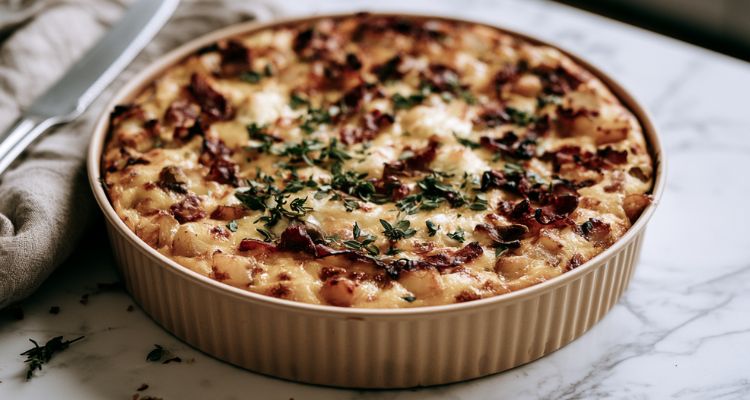
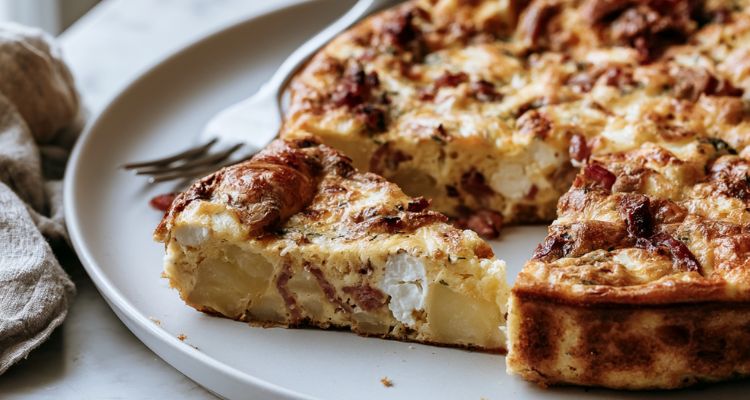
Mary Berry’s frittata is an oven-baked Italian-style omelette made with eight eggs, cubed potatoes, goat’s cheese, thyme and Black Forest ham. It bakes in a 20cm springform tin at 200°C (180°C fan/Gas 6) for 12-15 minutes and serves 6.
Berry introduces this in Cook Up a Feast (2010) as “a kind of Italian omelette, cooked in the oven rather than in a frying pan.” The oven method is the key difference: it cooks the egg from all sides at once. This gives a thicker, more even result that holds its shape when sliced cold for picnics.
The potato step matters more than it looks. Berry boils cubed potatoes with onion for 5-8 minutes, then drains and refreshes in cold water. The cold refresh stops them cooking further and going mushy. Overcooked potato crumbles into the egg instead of staying in distinct cubes.
Mary Berry Frittata
Course: BreakfastCuisine: BritishDifficulty: Easy6
servings15
minutes20
minutes235
kcalFrom Cook Up a Feast (2010), co-written with Lucy Young. An oven-baked frittata designed for picnics and summer lunches, with par-boiled potatoes and goat’s cheese baked in a springform tin.
Ingredients
350g (12 oz) potatoes, cut into 3cm (1¼ in) cubes
1 small onion, roughly chopped
Salt and freshly ground black pepper
8 large eggs
1 tsp freshly chopped thyme leaves
100g (3½ oz) roll goat’s cheese, cut into small cubes
75g (2½ oz) Black Forest ham, cut into thin strips
Directions
- Par-boil: Preheat the oven to 200°C/180°C fan/Gas 6 (400°F). Cook the potatoes and onion in boiling salted water for 5-8 minutes or until tender. Drain and refresh in cold water.
- Mix the eggs: Crack the eggs into a large mixing bowl, add the thyme, and season with salt and freshly ground black pepper. Whisk by hand until combined. Add the potatoes and onion and stir in the cheese.
- Assemble: Pour into the greased and base-lined springform tin and scatter over the strips of ham.
- Bake: Bake for 12-15 minutes or until slightly risen and just firm. To make slicing easier, leave to cool slightly before serving.
FAQs
Why does Berry bake this frittata in the oven instead of on the hob?
Most frittata recipes start on the hob and finish under the grill, which gives you an uneven cook: the bottom sets first and can toughen before the top firms up. Berry’s oven method cooks the egg from all sides at once, giving a more uniform texture throughout.
The springform tin also gives the frittata height. A frying pan frittata is thin and flat. Berry’s version is thick enough to slice into proper wedges that hold together for a picnic. Her Courgette Frittata in Cooking with Mary Berry (2016) uses the traditional hob-then-grill method, so you can compare the two approaches.
Can I use different cheese instead of goat’s cheese?
Berry picks goat’s cheese because it holds its shape in cubes rather than melting into the egg. It creates pockets of tangy cheese throughout each slice that you can see and taste individually. Feta works as a direct swap because it behaves the same way: crumbly, tangy and heat-resistant.
If you prefer a melting cheese, it changes the character of the dish entirely. Berry uses Gruyère in her crustless quiche from Simple Comforts (2020), which melts through the custard for a smooth, rich texture. That recipe adds cream too, so it’s a different dish altogether. For this frittata, a cheese that stays in cubes is the point.
Why does Berry par-boil the potatoes with the onion?
Cooking both together saves time and a pan, but the real reason is that the onion softens in the same 5-8 minutes the potato needs. Raw onion in a frittata that bakes for only 12-15 minutes would stay crunchy and sharp. Par-boiling mellows it.
The cold-water refresh after draining is equally important. It stops the carryover cooking that would turn the potato cubes soft and crumbly. Berry needs them firm enough to hold their shape when stirred into the egg and baked. I drain them in a colander, run cold water over for 30 seconds, then leave to steam dry for a minute before adding to the eggs.
How do I know when the frittata is done?
Berry says “slightly risen and just firm,” which means the top should puff up a little and feel set when you press it gently in the centre. If the centre still wobbles or your finger leaves a dent, give it another 2-3 minutes.
Unlike her quiche recipes, which use cream and set more gently, this frittata has no dairy so the eggs cook faster and more firmly. Overbaking makes it dry and bouncy. I pull mine at 13 minutes and let the residual heat finish it in the tin.
Is this suitable for a packed lunch or picnic?
Berry designed this specifically as picnic food. She says to serve it “warm or cold” and the 8-hour prepare-ahead window makes it perfect for morning preparation and afternoon eating. The springform tin release means you get clean, portable wedges.
Wrap individual wedges in greaseproof paper for easy transport. The potato and cheese hold up well at room temperature for several hours, unlike quiche with its cream custard that’s best kept chilled. Berry pairs it with “dressed salad and bread,” which travels well in separate containers.
What is Black Forest ham and can I use regular ham?
Black Forest ham is a German dry-cured ham with a mild, slightly smoky flavour. Berry uses it because it’s “one of the most reasonably priced cured hams” and it crisps slightly on top of the frittata during baking. She suggests Serrano or Parma ham as alternatives.
Regular sliced ham from the deli counter works too, though it won’t have the same depth of flavour. Cut it into thin strips as Berry specifies so it distributes evenly across the top. The ham goes on last, scattered over the surface, so it’s visible and slightly crispy on each wedge when served.