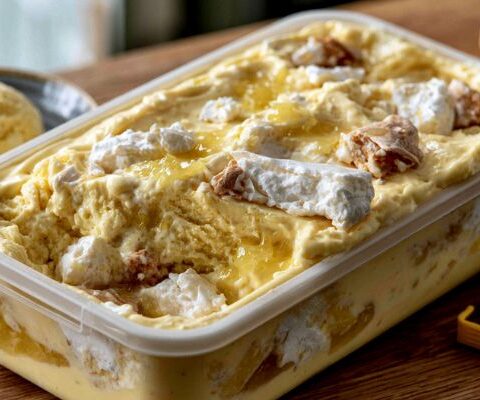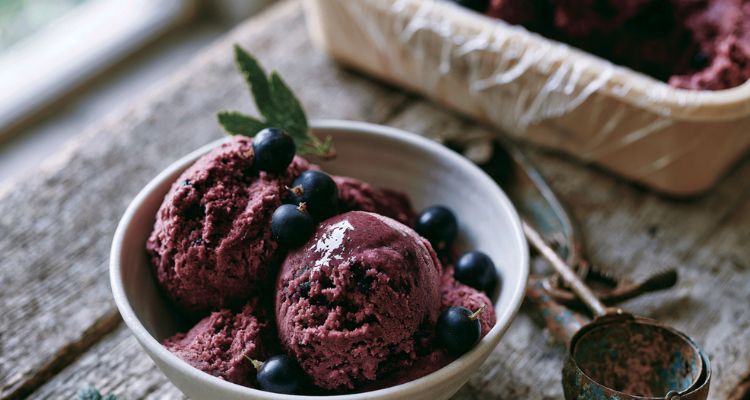
Delia Smith’s blackcurrant ice cream is fresh blackcurrant pulp folded into a sugar syrup and softly whipped double cream, then frozen in a polythene box. It serves 6 to 8, needs no ice cream maker, and takes about 6 hours to set.
Smith writes in Delia’s Complete Cookery Course that blackcurrants “make the very nicest ice cream.” That richness comes from sieving the raw fruit rather than cooking it. Cooking would dull the sharp, fresh tang that makes this flavour stand apart.
The one step most people skip is beating the mixture at the 3-hour mark. That single beat breaks up ice crystals and folds air back in. Without it, you’ll get a solid block of frozen fruit rather than a scoopable cream.
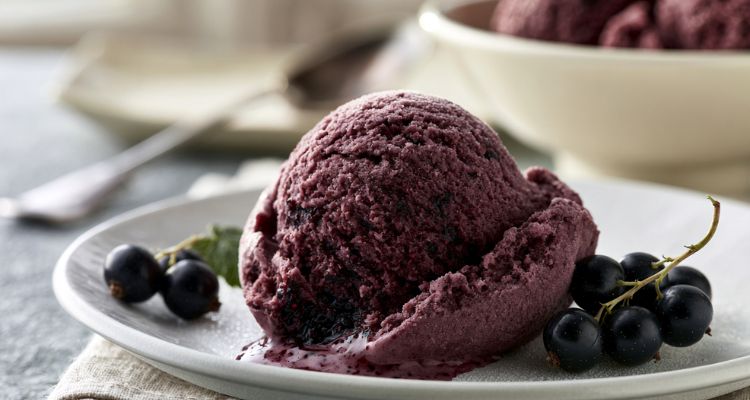
Delia Smith Blackcurrant Ice Cream
Course: DessertCuisine: BritishDifficulty: Easy6-8
servings20
minutes255
kcal6
hours40
minutesA three-ingredient no-churn ice cream from Delia’s Complete Cookery Course, made by sieving raw blackcurrants into a sugar syrup and folding in cream. Smith says loganberries or raspberries work with the same method.
Ingredients
450g (1 lb) fresh or frozen blackcurrants, defrosted if frozen
175g (6 oz) sugar
150ml (5 fl oz) water
275ml (10 fl oz) double cream
Directions
- Sieve the blackcurrants: Pile about 150g (5 oz) of blackcurrants at a time into a nylon sieve set over a mixing bowl. Mash with a wooden spoon until you’ve extracted all the pulp. Only stalks, pips and skins should remain in the sieve. Repeat until all the fruit is done.
- Make the syrup: Place the sugar and 150ml (5 fl oz) water in a saucepan over a medium heat. Stir until all the sugar crystals have dissolved, then bring to the boil and boil for exactly 3 minutes. Remove from the heat.
- Combine: Stir the hot syrup into the fruit pulp.
- Whip the cream: Whip the double cream until it just begins to thicken. Don’t overwhip: it should be floppy, not stiff.
- Fold and freeze: Fold the cream into the fruit mixture until thoroughly blended. Pour into a freezerproof polythene box with a lid. Freeze for about 3 hours until the mixture begins to set.
- Beat: Turn the half-frozen mixture out into a bowl and beat thoroughly. Return to the box and freeze for another 3 hours until fully set.
- Serve: Remove to the main part of the fridge about an hour before serving.
Notes
- Use a nylon sieve, not metal. Smith warns that a metal sieve can discolour the fruit.
- No need to remove the stalks before sieving. The sieve catches everything.
- Smith says to eat this ice cream within three weeks of making it.
FAQs
Why does Smith sieve the blackcurrants raw instead of cooking them?
Raw blackcurrants have a sharp, intense flavour that cooking softens. Sieving them uncooked captures that brightness and mixes it straight into the sugar syrup. The syrup takes the edge off the tartness without killing the fresh taste. The result is a cleaner, more concentrated blackcurrant hit than any cooked version can deliver.
Cooking would also break down the pectin in the fruit, which changes the texture of the final ice cream. The raw pulp gives a slightly thicker base that holds the cream in suspension better during freezing.
Why does the cream need to be floppy, not stiff?
Stiffly whipped cream traps too much air in rigid pockets. When you fold it into the fruit mixture, those pockets stay separate rather than blending evenly. You end up with streaks of white cream through purple fruit instead of a smooth, uniform colour.
Floppy cream folds in without resistance, creating a seamless blend. It also freezes to a softer consistency because there’s less trapped air to form large ice crystals. Stop whipping the moment the cream holds a gentle shape and slowly falls off the whisk.
Can I use frozen blackcurrants?
Smith says frozen blackcurrants work fine as long as you defrost them fully first. Frozen fruit actually sieves more easily because the cell walls break down during freezing, so the pulp comes through faster. You won’t notice any difference in the finished ice cream.
Drain off any excess liquid from the defrosted berries before sieving. That extra water would dilute the fruit pulp and weaken the flavour. If you’re making this outside summer, frozen is the practical choice and Smith clearly designed the recipe to handle it.
What other fruit can I use with this method?
Smith says loganberries and raspberries both work with the same recipe. Raspberries give a milder, sweeter result so you could reduce the sugar by about 25g if the berries are ripe. Loganberries sit between the two: tarter than raspberries, gentler than blackcurrants.
For a different Delia frozen dessert, her strawberry cheesecake ice cream uses a completely different technique with cream cheese and condensed milk. It’s richer and sweeter, so the two make a good contrast if you’re serving both at a summer table.
Why do I need to beat it halfway through freezing?
The beat at the 3-hour mark is what separates ice cream from a frozen block. As the mixture freezes from the outside in, large ice crystals form at the edges and work their way towards the centre. Beating smashes those crystals into smaller pieces and redistributes them evenly through the mixture.
Smaller ice crystals mean a smoother, creamier scoop when you serve it. Professional ice cream makers churn continuously to achieve this, but Smith’s single-beat method gets surprisingly close. Don’t skip it, even if the mixture looks fine at the 3-hour mark.
How far ahead can I make this?
Smith says to eat it within three weeks, which gives you plenty of lead time for a dinner party. The blackcurrant flavour actually intensifies slightly after a day or two as the sugar syrup and fruit pulp fully meld together in the freezer.
Move it from the freezer to the main fridge about an hour before serving. That softening time is important: straight from the freezer it’s too hard to scoop. If you’re planning a Delia dessert spread, her fresh peaches in Marsala makes a good room-temperature companion alongside the cold ice cream.