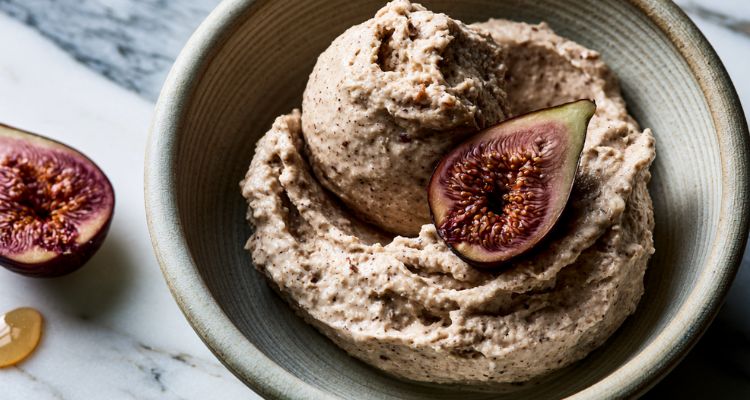
Delia Smith’s fig ice cream is a custard-based frozen dessert made with dried figs, egg yolks, double cream, and brandy. From her Christmas cookbook (1990), it takes 30 minutes of hands-on work plus freezing time.
Smith discovered this flavour in Paris and calls it “truly an inspired ice cream.” She uses dried figs simmered with brown sugar instead of fresh ones, giving a deeper, more concentrated flavour that holds up in a frozen custard.
The step most people skip is sieving the fig puree. Smith presses the blended mixture through a sieve to catch tough bits of skin. Five extra minutes, but the difference between smooth and chewy is that sieve.
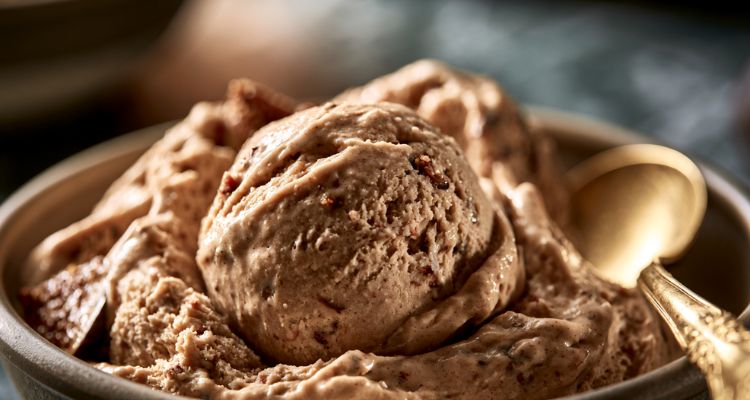
Delia Smith Fig Ice Cream
Course: DessertCuisine: BritishDifficulty: Easy6-8
servings30
minutes345
kcal4
hours30
minutesA Christmas dessert from Smith’s Christmas cookbook (1990), built on dried figs simmered with brown sugar, then pureed into a brandy-spiked custard. Rich enough to replace a traditional pudding.
Ingredients
12 oz (350 g) ready-to-eat dried figs
1 oz (25 g) soft brown sugar
1 pint (570 ml) milk
4 large egg yolks
1 rounded teaspoon custard powder
4 oz (110 g) caster sugar
½ teaspoon pure vanilla extract
2 tablespoons brandy
5 fl oz (150 ml) double cream
Directions
- Place the figs and brown sugar in a medium-sized saucepan and add 10 fl oz (275 ml) water. Bring up to simmering point and simmer gently with a lid on for about 5 minutes, then uncover and continue to simmer for a further 5 minutes or until the figs are plump and tender. Remove from the heat, replace the lid and leave them until completely cold.
- Drain off the cooking liquid, snip off and discard the tops of the figs, then place them either in a liquidiser or a food processor, along with the milk, and blend until smooth and uniform. Press the mixture through a sieve to extract any tough, resistant pieces of skin.
- Whisk the egg yolks, custard powder, caster sugar and vanilla extract thoroughly together. Bring the milk and fig mixture up to the boil, then pour it on to the egg yolk mixture. Return the whole lot to the saucepan and bring it back to the boil gently, still stirring with a whisk to keep it smooth.
- If it looks like curdling, don’t worry: just whisk it together again as it cools. The custard powder is there to keep it stabilised. Let the custard cool before combining it with the brandy and the double cream, lightly whipped until it just holds its shape.
- Place the mixture in an ice cream maker and churn according to the maker’s instructions. You will probably have to do this in two batches. If you don’t have an ice cream maker, whip it by hand as soon as it freezes.
- Pack the ice cream into a storage container and store in the freezer until ready to use. Before serving, remove it to the fridge for 30 minutes to soften.
FAQs
Can I use fresh figs instead of dried?
Fresh figs have a much higher water content and a milder flavour than dried ones. If you use them, the ice cream will taste subtler and the texture may turn icier because of the extra liquid.
Dried figs give Smith’s recipe its intensity. The simmering step rehydrates them while the brown sugar builds a caramel depth you won’t get from fresh fruit. If fresh figs are all you have, roast them at 200°C for 15 minutes with a tablespoon of honey first to concentrate their flavour before blending.
Why does Smith use custard powder in the base?
Custard powder contains cornflour, which acts as a stabiliser for the egg custard. Smith even tells you not to panic if the mixture looks like it’s curdling, because “the custard powder is there to keep it stabilised.”
Without it, a custard made from egg yolks alone can split when it hits boiling point. The cornflour in custard powder raises that threshold, so the mixture thickens smoothly instead of scrambling. It’s the same technique she uses in her cinnamon and pistachio ice creams.
Do I need an ice cream maker for this recipe?
Smith gives you both options. She prefers a machine and notes you’ll probably need to churn it in two batches because of the volume. But she adds that if you don’t have one, you should “whip it by hand as soon as it freezes.”
The hand method takes longer and requires more attention. You’ll need to check the freezer every 45 minutes or so and whisk vigorously each time to break down the crystals. Three or four rounds of whisking should give you a scoopable texture, though a machine will always produce a smoother result.
Can I leave out the brandy?
You can, but it does more than add flavour. Alcohol lowers the freezing point of the mixture, which keeps the ice cream softer and more scoopable straight from the freezer. Without it, the ice cream will freeze harder.
If you’d rather not use brandy, replace it with 2 tablespoons of dark rum or Amaretto, both of which pair well with figs. For an alcohol-free version, add an extra tablespoon of golden syrup to the custard before freezing. It won’t have quite the same effect, but it helps with texture.
How far ahead can I make this ice cream?
Smith lists this recipe in her “100 Recipes to Freeze” Christmas collection, so it’s built for making ahead. You can churn and freeze it up to a month before Christmas without losing quality.
After a month, the texture starts to deteriorate as larger ice crystals form. Press cling film onto the surface before sealing the container to slow that process down. Remember to move it to the fridge 30 minutes before serving, as Smith instructs, so it softens enough to scoop cleanly.
What can I serve alongside fig ice cream?
Smith positions this as a Christmas dessert, so it works in place of a traditional pudding. A drizzle of Pedro Ximenez sherry or a scattering of toasted walnuts would complement the figgy richness without competing with it.
For a lighter pairing, try thin almond biscotti or brandy snaps on the side. The crunch contrasts nicely with the smooth ice cream. If you’re serving this after a heavy Christmas dinner, keep the accompaniments minimal. The figs and brandy already carry enough flavour on their own.