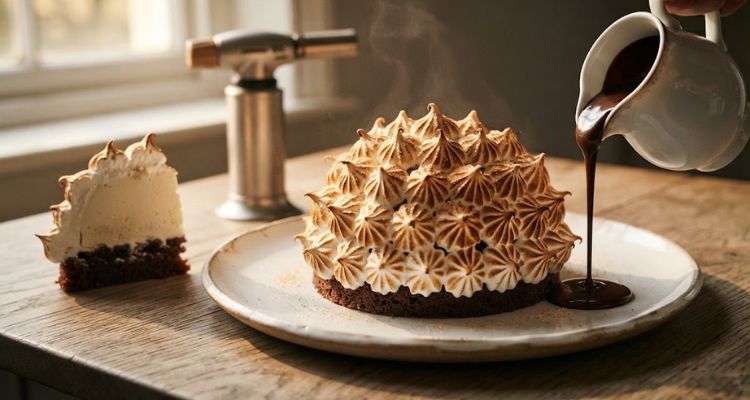
James Martin’s baked Alaska wraps a block of vanilla ice cream on an Armagnac-soaked sponge base in a proper Italian meringue, torches it golden, and serves it with a rich chocolate sauce. The meringue is made from a sugar syrup boiled to 121°C and poured into whisked egg whites, and the whole thing serves eight.
The recipe comes from BBC’s Home Comforts. Martin calls it a retro dessert and leans into the nostalgia, but his technique is genuinely professional: Italian meringue rather than the basic whisk-and-sugar kind most home recipes use. The cooked sugar makes the meringue stable, glossy and marshmallowy, so it insulates the ice cream properly and doesn’t weep.
The assembly is the showstopper moment. You coat the ice cream and sponge in meringue, pipe stars over the top, then hit it with a blowtorch until golden. The Italian meringue’s stability gives you time to work, since it won’t collapse while you’re torching, which is the whole reason professionals use it. That caramelised shell against frozen ice cream is the point.

James Martin Baked Alaska With Creamy Chocolate Sauce
Course: DessertCuisine: BritishDifficulty: Easy8
servings25
minutes10
minutes530
kcal35
minutesJames Martin’s retro baked Alaska from BBC’s Home Comforts: vanilla ice cream on Armagnac-soaked sponge, wrapped in Italian meringue, torched golden and served with a rich chocolate sauce. A showstopper that takes under 30 minutes to assemble. Serves eight.
Ingredients
- For the baked Alaska:
300g/10½oz caster sugar
6 free-range egg whites
1 small ready-made sponge flan case, halved horizontally (only 1 disc needed)
50ml/2fl oz Armagnac
1 x 500g/1lb 2oz tub firm vanilla ice cream (not soft-scoop
- For the chocolate sauce:
200g/7oz plain chocolate, roughly chopped
200ml/7fl oz double cream
Directions
- Make the sugar syrup:Bring 50ml of water and the sugar to the boil in a saucepan. Keep boiling until it reaches 121°C on a sugar thermometer. (Hot sugar is dangerous and boils over quickly; don’t leave it unattended.)
- Whisk the whites:Meanwhile, whisk the egg whites in a large clean bowl until stiff peaks form.
- Pour in the syrup:When the sugar hits 121°C, take it off the heat. With the whisk running slowly, pour the syrup into the whites in a thin stream, keeping it away from the beaters so it doesn’t splash. Whisk until all the syrup is incorporated and the mixture is glossy.
- Cool the meringue:Continue whisking at slow speed for about 5 minutes, until the meringue has almost completely cooled.
- Make the chocolate sauce:Heat the chocolate with 2 tablespoons of water over low heat until melted. Add half the cream, bring to the boil, whisking, then take off the heat and whisk until smooth. Whisk in the remaining cream. Pour into a serving jug.
- Assemble:Place the sponge disc on a heatproof plate and drizzle the Armagnac all over it. Turn the ice cream out of its tub and sit it in the centre of the sponge.
- Coat and pipe:Spread half the meringue over the ice cream and sponge with a palette knife. Pipe the rest over the top in stars using the piping bag.
- Torch:Blowtorch the meringue all over until golden. Alternatively, blast it under a grill or in the hottest oven for a few seconds.
- Serve:Serve immediately, with the chocolate sauce alongside.
Notes
- Kit: a sugar thermometer, a piping bag with a star nozzle, and a chef’s blowtorch (or a very hot oven).
FAQs
What is Italian meringue and why use it here?
Italian meringue is made by pouring a hot sugar syrup (boiled to 121°C) into whisked egg whites while they’re being beaten. The hot syrup partially cooks the whites, which gives you a meringue that’s stable, glossy and almost marshmallowy, and far more forgiving than a simple French meringue made from raw sugar and whites.
For a baked Alaska, stability is everything: the meringue has to insulate the ice cream from the heat of the torch or oven without collapsing or weeping. Italian meringue does this because its cooked structure holds firm, whereas a basic meringue can deflate, leak liquid and fail to protect the ice cream.
Do I need a sugar thermometer?
Yes, for this recipe. The sugar syrup must hit exactly 121°C, the soft-ball stage, before it goes into the whites. Too cool and it won’t cook the whites enough to set the meringue; too hot and it starts to caramelise and can burn the meringue or spin into hard threads. A thermometer takes the guesswork out.
If you don’t have one, you can test by dropping a tiny amount of the boiling syrup into cold water. At 121°C it forms a soft, pliable ball between your fingers. But a thermometer is much safer and more reliable, and it’s the professional approach Martin teaches.
Why firm ice cream and not soft-scoop?
Because soft-scoop melts fast. Martin specifies firm vanilla ice cream because it holds its shape while you coat it in meringue and torch it. Soft-scoop has more air and less fat, so it collapses quickly under even brief heat, and you’d end up with melted ice cream pooling out from under the meringue before you can serve.
Take the ice cream out of the freezer, upturn the tub onto the sponge and cut away the packaging quickly. The less time it spends out of the freezer before the meringue goes on, the better. Once sealed inside the Italian meringue, it’s insulated and won’t melt during torching.
What is the Armagnac for?
It soaks the sponge base, adding a deep, boozy, brandy warmth that stops the sponge disc being dry and flavourless against the cold ice cream. Armagnac is a French grape brandy, slightly richer and more rustic than Cognac, and its warmth sits well with the vanilla and chocolate.
For an alcohol-free version, soak the sponge in strong coffee, vanilla syrup or orange juice instead. The point is that the sponge needs moisture and flavour, since a dry disc of plain sponge under ice cream would taste of nothing and go soggy in the wrong way.
Can I use a different sauce?
The chocolate sauce is Martin’s choice and it’s a classic pairing, but baked Alaska is flexible. A caramel or toffee sauce, a fruit coulis (raspberry or passion fruit), or even just a drizzle of maple syrup all work. Martin himself has a toffee version of baked Alaska elsewhere, so he clearly sees the sauce as variable.
For this specific recipe, the chocolate sauce is rich, glossy and simple: just chocolate, cream and a little water. It’s made ahead and served warm alongside, which means you can focus entirely on the assembly and torching without any last-minute sauce work.
Can I assemble it ahead?
Partially. You can make the Italian meringue and the chocolate sauce ahead, and have the sponge disc and ice cream ready. But once you’ve coated and piped the meringue over the ice cream, you need to torch and serve immediately, since the ice cream starts melting the moment it’s out of the freezer.
The smart approach for a dinner party is to have the meringue and sauce done, the sponge on its plate, and the ice cream in the freezer. Between the main course and dessert, it takes about 5 minutes to assemble, coat, torch and bring to the table. Follow it after something like his beef bourguignon or lobster thermidor for a proper showstopper finish.