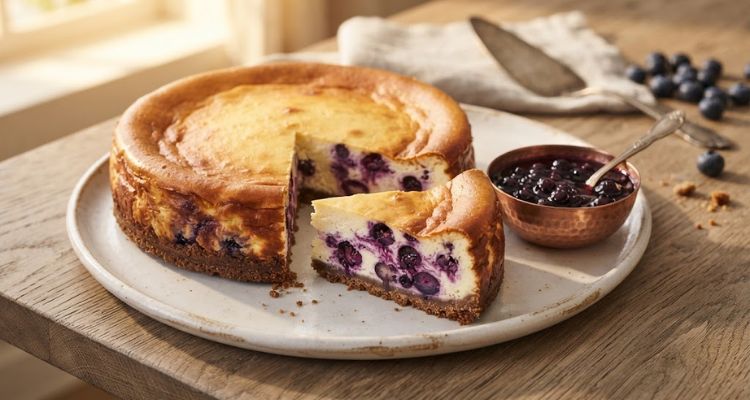
James Martin’s baked blueberry cheesecake folds whole blueberries through a vanilla, lemon and cream cheese filling on a baked digestive biscuit base, bakes it in a water bath at 180°C (gas 4), then cools it slowly in the turned-off oven for at least two hours, preferably overnight. It serves six to eight with a warm blueberry compôte alongside.
The recipe comes from BBC’s Saturday Kitchen. Martin describes it as a classic baked cheesecake with “a wallop of fruit flavour,” and the blueberries do exactly that: they go in whole, burst as they bake, and marble the filling with pockets of purple juice. The compôte on the side doubles down on the fruit for anyone who wants more.
The slow cooling is the technique that matters most. Baked cheesecakes crack when they cool too fast, because the outside contracts while the centre is still warm and soft. Martin turns the oven off and leaves the cheesecake inside for hours, so it cools gradually and evenly, setting to a smooth, crack-free surface without any drama.

James Martin Baked Blueberry Cheesecake With Blueberry Compôte
Course: DessertCuisine: BritishDifficulty: Easy6-8
servings25
minutes1
hour930
kcal1
hour25
minutesJames Martin’s Saturday Kitchen baked cheesecake: a digestive base, vanilla and lemon cream cheese filling marbled with whole blueberries, baked in a water bath and cooled slowly in the oven. With a warm blueberry compôte. Serves six to eight.
Ingredients
- For the cheesecake:
150g/5½oz butter, melted, plus extra for greasing
300g/10½oz digestive biscuits, crushed
1 vanilla pod, seeds scraped out
1 lemon, zest and juice
200g/7oz caster sugar
50g/1¾oz cornflour
850g/1lb 14oz full-fat cream cheese
375ml/13fl oz double cream
4 large free-range eggs
250g/9oz blueberries
- For the compôte:
250g/9oz blueberries
100g/3½oz caster sugar
Directions
- Prepare:Preheat the oven to 180°C/350°F/gas 4. Grease and line a 23cm springform tin with baking parchment.
- Make the base:Melt the butter, stir in the crushed digestives and press firmly and evenly into the tin. Bake for 10 minutes, then cool completely.
- Mix the filling:Whisk the vanilla seeds, lemon zest and juice, sugar, cornflour, cream cheese and cream together in a large bowl. Add the eggs, whisking continuously until smooth. Stir in the blueberries carefully.
- Bake in a water bath:Pour the filling onto the cooled base and tap the tin on the worktop to settle it. Wrap the outside of the tin in a double layer of foil if worried about leaks. Set the tin in a deep roasting tray with 2cm of hot water. Bake for 1¼-1½ hours, until golden and just set.
- Cool slowly:Turn the oven off and leave the cheesecake inside for at least two hours, or preferably overnight. Don’t open the door.
- Make the compôte:Cook the blueberries and sugar in a saucepan until the sauce thickens.
- Serve:Slice the cooled cheesecake and serve with the warm compôte.
Notes
- Cooling 2 hours minimum, overnight ideal
FAQs
Why leave it in the turned-off oven overnight?
To prevent cracking. A baked cheesecake cracks when the surface cools and contracts faster than the still-warm centre. Turning the oven off and leaving the cheesecake inside lets the whole thing cool at the same gradual rate, so there’s no tension between the outer set crust and the soft interior.
Martin says at least two hours, preferably overnight, and the overnight route is genuinely better: the cheesecake is fully set, completely crack-free and stone cold by morning, ready to slice cleanly. Opening the oven door early lets in a rush of cold air that can crack the surface, so resist the temptation.
Why bake the digestive base first?
Ten minutes in the oven sets the base into a firm, crunchy layer before the wet filling goes on top. Without pre-baking, the butter-and-crumb mixture stays soft under the heavy filling and can turn soggy by the time the cheesecake is done.
Press it down firmly and evenly, using the back of a spoon, so you get a uniform thickness. Let it cool completely before adding the filling, since pouring cold batter onto a hot base can crack the base or start cooking the bottom of the filling unevenly.
What does the cornflour do?
It stabilises the filling. The 50g of cornflour thickens the cream cheese and cream mixture as it bakes, giving the cheesecake a firmer, smoother set that holds its shape when sliced. Without it, you’d get a softer, more wobbly cheesecake that’s harder to cut cleanly.
Martin uses the same cornflour stabilisation in his American baked cheesecake, where it serves the same purpose. Think of it as insurance against a too-soft or cracked filling: the starch gels as it heats and holds everything together during the long, slow cool.
Can I use frozen blueberries?
Fresh are better here because they hold their shape in the batter and burst only partially during baking, leaving whole or semi-intact berries marbled through the filling. Frozen blueberries release more juice as they defrost, which can make the batter wetter and the finished cheesecake more marbled, almost tie-dyed, rather than studded.
If frozen is all you have, fold them in from frozen without defrosting, which minimises juice leakage. You may need a few extra minutes of baking time. For the compôte, frozen blueberries actually work perfectly, since you’re cooking them down into a sauce anyway.
How is this different from his American baked cheesecake?
They’re both baked cheesecakes from the same chef, but the approach and the feel are quite different. This Saturday Kitchen version uses a classic digestive biscuit base, bakes with fruit through the filling, and cools overnight in the oven. The American one uses a sponge base, has bourbon-soaked sultanas and Jack Daniels in the batter, and comes with caramelised bananas.
The digestive base gives a crunchier, more British foundation, while the sponge base is softer and more restaurant-style. If you want a fruit-forward, traditional British cheesecake, this is the one; if you want something boozy, richer and more American in spirit, the American version is the way to go.
What should I serve the compôte with if I have leftover?
The compôte is just blueberries and sugar cooked to a thick sauce, so it keeps in the fridge for a week and works on practically anything. Spoon it over yoghurt, porridge, vanilla ice cream, pancakes, or any plain cake or sponge.
It also makes a good match for his chocolate profiteroles in place of the chocolate sauce, if you fancy fruit over chocolate, or alongside his sticky toffee pudding for sharpness against the treacly sweetness. A good fruit compôte is one of those simple things worth always having in the fridge.