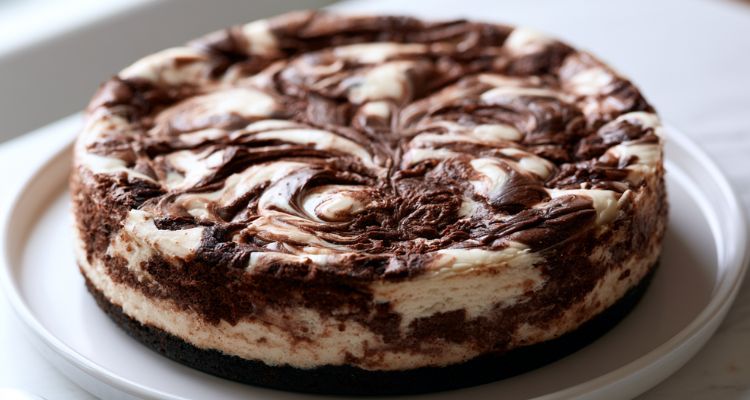
Mary Berry’s American chocolate ripple cheesecake is a baked marbled cheesecake on a chocolate digestive base. Dark chocolate swirls through a vanilla cream cheese filling, baked at 160°C (fan 140°C/325°F/Gas 3) for 1 hour in a 20cm (8 in) springform tin. It serves 8–10.
Berry warns in Baking Bible (2010) to “serve this cheesecake in small portions as it is quite sweet and rich.” She also notes to “expect the cheesecake to crack on cooling,” so she’s honest that perfection isn’t the goal here.
The marbling technique is the whole point of this recipe. You spoon half the plain filling onto the base, stir melted chocolate through the rest, then spoon chocolate mixture between the plain. A single knife swirl creates the ripple.
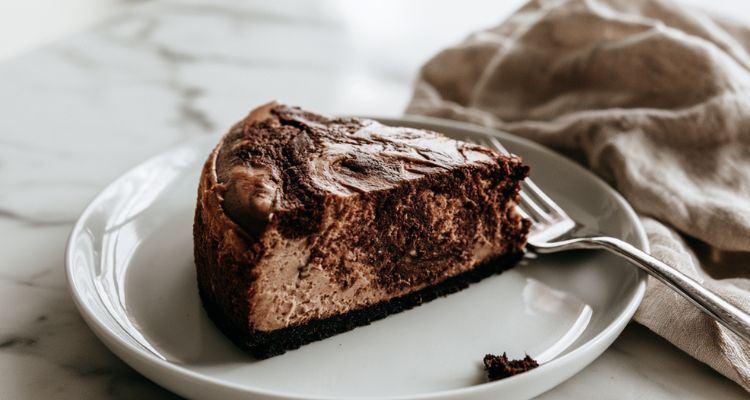
Mary Berry American Chocolate Ripple Cheesecake
Course: DessertCuisine: BritishDifficulty: Easy8-10
servings20
minutes1
hour440
kcalFrom Mary Berry’s Baking Bible (2010), this rich baked cheesecake uses dark chocolate (39% cocoa solids) marbled through a vanilla cream cheese filling. Berry also published the same recipe in her Ultimate Cake Book (2003) with a shorter 30-minute bake time.
Ingredients
- For the base:
100g (4 oz) plain chocolate digestive biscuits
50g (2 oz) butter
- For the cheesecake:
150g (5 oz) plain chocolate (39% cocoa solids), broken into pieces
700g (1½ lb) full-fat soft cheese
100g (4 oz) caster sugar
½ tsp vanilla extract
2 large eggs
Directions
- Preheat: Set the oven to 160°C (fan 140°C/325°F/Gas 3). Lightly grease a 20cm (8 in) loose-bottomed cake tin or springform tin.
- Make the base: Put the biscuits into a plastic bag and crush with a rolling pin. Melt the butter in a medium-sized pan. Remove the pan from the heat and stir in the biscuit crumbs. Press into the prepared tin and leave to set.
- Melt the chocolate: Break the chocolate into pieces and melt gently in a bowl set over a pan of hot water, stirring occasionally. Cool slightly.
- Make the filling: Measure the cheese into a large bowl and beat until soft. Add the sugar and beat again until well mixed. Beat in the vanilla extract and then the eggs, one at a time.
- Create the ripple: Spoon half the cheese mixture onto the biscuit crust, separating the spoonfuls. Add the melted chocolate to the remaining cheese mixture and stir well to mix. Spoon this chocolate mixture in between the plain mixture. Swirl the top with a knife to give a marbled effect.
- Bake: Bake for about 1 hour or until the cheesecake becomes puffy around the edges but is still very soft in the centre. Turn off the oven but leave the cheesecake in the oven to cool. Chill well and then loosen the cheesecake from the sides of the tin using a small palette knife. Serve well chilled.
FAQs
Why does Berry use 39% cocoa solids chocolate?
Berry specifies “plain chocolate (39 per cent cocoa solids)” rather than a higher percentage. This matters because higher cocoa chocolate sets harder when cold, which would create stiff ribbons in the filling rather than soft swirls. The 39% gives a strong chocolate flavour without fighting the cream cheese texture.
I tried this once with 70% dark chocolate and the marbled sections were noticeably firmer than the vanilla parts. You could feel the difference with every bite, which isn’t what Berry intends. Stick with her recommendation.
What’s the difference between this and Berry’s vanilla cheesecake?
The base recipe is almost identical to Berry’s American-style cheesecake. Both use 700g cream cheese, vanilla, eggs, and a digestive base baked at 160°C. The vanilla version adds flour, lemon, and soured cream to the filling, while this one keeps it simpler and adds melted chocolate.
The main structural difference is the absence of soured cream and flour in this recipe. That makes the filling richer and denser, which is why Berry warns about serving small portions. Without the flour to stabilise it, the chocolate ripple relies entirely on eggs for structure.
How do I get a good marbled effect?
Berry’s instruction is specific: spoon the plain mixture first, separating the spoonfuls so there are gaps. Then spoon the chocolate mixture into those gaps. One swirl with a knife is enough. Don’t over-swirl or you’ll blend the two together into a uniform brown.
The trick is restraint. I made the mistake of swirling three or four times on my first attempt and lost all definition. A single confident drag of the knife through the surface gives the best contrast between the dark chocolate and pale vanilla sections.
Why does Berry say to expect cracking?
Berry’s headnote reads “expect the cheesecake to crack on cooling,” which is unusually direct. She says this because the recipe has no flour or soured cream to add flexibility to the filling. The high proportion of cream cheese (700g) and two eggs create a filling that puffs during baking and contracts as it cools.
Her solution is simple: she doesn’t try to prevent it. Unlike her vanilla cheesecake where she covers cracks with soured cream, this recipe relies on the marbled surface to disguise any small splits. The dark and light pattern breaks up the visual, so cracks don’t show as much.
Can I use milk chocolate instead of dark?
Berry doesn’t suggest milk chocolate, and there’s a good reason. Milk chocolate melts thinner and has a higher sugar content, so it doesn’t create the same visual contrast against the vanilla filling. The marbling would be pale-on-pale rather than dark-on-light.
If you prefer a milder chocolate flavour, stay with dark but choose a bar around 35-40% cocoa solids. That’s the lower end of “plain chocolate” in UK supermarkets and it’ll give you Berry’s intended effect without being too bitter.
How long does the bake time differ between Berry’s versions?
Berry first published this in the Ultimate Cake Book (2003) with a 30-minute bake. The Baking Bible (2010) version extends it to 1 hour. The ingredients are identical across both books. This is a significant difference, and the later version is the one to follow.
The 2010 version bakes longer at the same temperature, giving a more stable set. Both versions specify turning off the oven and leaving the cheesecake inside to cool, which adds roughly another hour of gentle residual heat. Berry refined this recipe between editions, and the longer bake produces a firmer, more sliceable result.