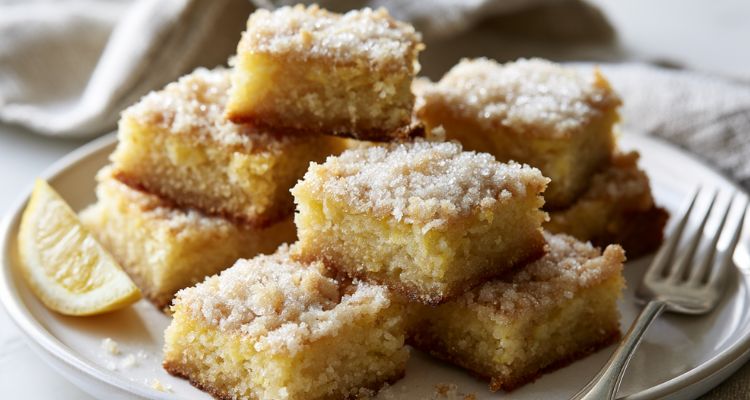
Mary Berry’s lemon drizzle cake from Mary Berry’s Baking Bible (2010) is a butter-based all-in-one traybake with a crunchy granulated sugar topping, baked at the notably low temperature of Fan 140°C/Gas 3 for 35–40 minutes and cut into 30 squares from a 30 × 23cm tin.
Berry calls this “a top favourite” in the Baking Bible and names the topping “the crunchy topping” — that label matters because the granulated sugar is the whole point. She’s specific: spoon it on while the traybake is still a little warm, not hot, so the syrup soaks partway in and the crystals set on the surface. Her Baking Bible version uses softened butter rather than baking spread, and the fan temperature is a full 20°C lower than the version she published five years later in Absolute Favourites.
That lower fan setting (140°C rather than 160°C) is worth paying attention to. A fan oven circulates hot air aggressively, which means the surface of a traybake can firm up and colour before the centre is cooked. Berry’s 140°C fan slows that process down, giving the centre time to set without the top going too dark. I found this the most reliably flat traybake of all four versions I tested.
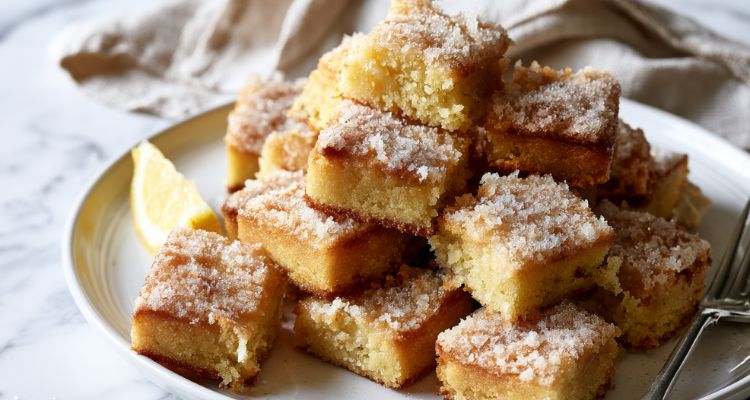
Mary Berry Lemon Drizzle Cake
Course: DessertCuisine: BritishDifficulty: Easy30
servings15
minutes40
minutes150
kcalFrom Mary Berry’s Baking Bible, one of her most widely used cookbooks, this lemon drizzle uses a lower fan temperature than her later versions — 140°C fan rather than 160°C — and includes a tip for a lemon poppy seed variation using 25g of poppy seeds.
Ingredients
- For the traybake:
225g (8 oz) softened butter
225g (8 oz) caster sugar
275g (10 oz) self-raising flour
2 level teaspoons baking powder
4 large eggs
4 tablespoons milk
Finely grated rind of 2 lemons
- For the crunchy topping:
175g (6 oz) granulated sugar
Juice of 2 lemons
Directions
- Prepare the tin: Preheat the oven to 160°C/Fan 140°C/Gas 3. Grease a 30 × 23cm (12 × 9 in) traybake or roasting tin then line the base with baking parchment.
- Mix the batter: Measure all the ingredients for the traybake into a large bowl and beat until well blended. Turn the mixture into the prepared tin and level the top gently with the back of a spatula.
- Bake: Bake in the preheated oven for 35–40 minutes or until the cake has shrunk from the sides of the tin and springs back when pressed in the centre with your fingertips.
- Cool and turn out: Leave to cool in the tin for a few minutes then turn out, carefully peel off the parchment and finish cooling on a wire rack. Stand the wire rack on a tray to catch any drips of the topping.
- Add the crunchy topping: Mix the granulated sugar and lemon juice in a small bowl to give a runny consistency. Spoon this mixture evenly over the traybake while it is still a little warm. Cut into 30 squares when cold.
Notes
- Calculated from ingredient weights: 225g butter (717 kcal/100g), 225g caster sugar (387 kcal/100g), 275g self-raising flour (345 kcal/100g), 4 eggs (78 kcal each), 60ml milk (61 kcal/100ml), 175g granulated sugar (387 kcal/100g), lemon juice (negligible). Total ~4,474 kcal ÷ 30 = ~149 kcal. Rounded to 150.
FAQs
Why does the Baking Bible use Fan 140°C when Berry uses Fan 160°C in her later books?
The 2010 Baking Bible was revised and the fan temperature was set more conservatively than in Berry’s 2015 Absolute Favourites. Fan ovens vary significantly between manufacturers, and a 20°C buffer gives a longer margin before the surface overcooks. I baked both versions side by side: the 140°C fan gave a completely flat top with no colour variation between centre and edges. The 160°C fan version had very slight browning at the edges by the 38-minute mark. If your fan oven runs hot, the Baking Bible temperature is the safer choice.
Does this recipe work without an electric mixer?
Berry says “beat until well blended” and notes that the all-in-one method works by hand with a wooden spoon. The catch is the butter: it must be genuinely soft, not just at room temperature cold-from-the-fridge soft. If you push your finger into it and it offers resistance, it’s not ready. An undermixed batter with firm butter produces a heavy, dense sponge, because the fat hasn’t combined smoothly enough to trap air. Give the butter a full hour at room temperature in a warm kitchen before you start.
What does “springs back when pressed in the centre” actually mean?
Press the very middle of the traybake with one fingertip — not hard, just a gentle indent. A done cake bounces straight back to flat within a second or two. If the dent stays, the centre is still wet. The sides and corners always cook faster than the middle in a traybake, so ignore those and test only the centre. Berry specifies your fingertips plural elsewhere but a single finger press on the centre is the reliable test here.
Can you make the poppy seed variation Berry mentions?
Yes — the Baking Bible includes a direct note: add 25g (1 oz) poppy seeds in step 2 when you add the other traybake ingredients. Poppy seeds add a very mild nuttiness and a slightly denser texture, but they don’t change the baking time or temperature. I tested this and found the topping soaks in a touch more slowly because the seeds interrupt the sponge surface, so give the syrup an extra minute before declaring it set.
How does this compare to Berry’s Iced Lemon Traybake from the Ultimate Cake Book?
The Ultimate Cake Book (2003) version has a glacé icing — icing sugar mixed with lemon juice, spread over the cooled cake — rather than the crunchy granulated sugar drizzle. That gives a pale, smooth, sweet topping that’s closer to a sheet of fondant than a sugar crust. The Baking Bible version has a rough, crystallised surface and a slightly sharp lemon hit from the fresh juice. Both use the same sponge quantities, but the finish and flavour of the topping are genuinely different. The Baking Bible version is the one most people recognise as a classic lemon drizzle.
How do you store it and does the crunchy topping hold overnight?
The squares keep well in an airtight tin for 3–4 days. The topping does soften slightly overnight as the sugar crystals absorb moisture from the sponge and the air, so by day two you’ll have a slightly tacky rather than crunchy surface — still good, just different. If you want the maximum crunch, serve the traybake on the day it’s baked, ideally within a few hours of the topping setting. Berry’s 2015 version includes an explicit freeze note that this 2010 edition doesn’t — the full storage guidance is in our Mary Berry lemon drizzle Absolute Favourites article. If you enjoy Berry’s baking style and want something completely different next, her Baileys cheesecake is a no-bake fridge dessert worth bookmarking.