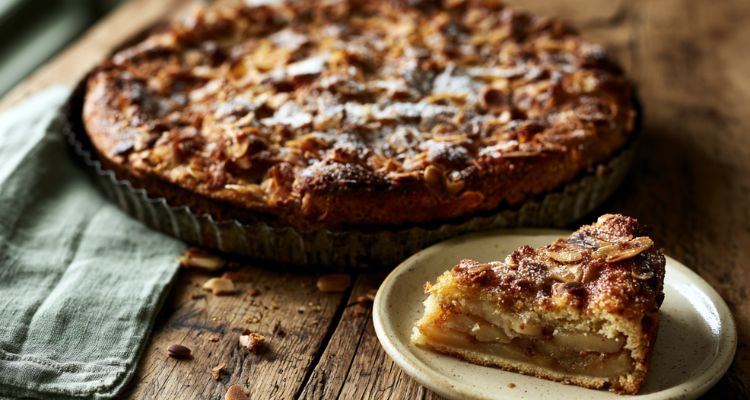
Mary Berry Apple and Almond Cake Recipe dessert cake is a dense, honey-sweetened sponge layered with thickly sliced cooking apples and topped with flaked almonds, baked at 140°C (120°C fan) for 1¼ hours in a shallow 28cm tart tin. It serves 8 and is dusted with icing sugar before serving warm with cream.
Berry’s headnote in Family Sunday Lunches (2016) calls this “a wonderful open cake full of flavour” and says it’s “perfect for using up windfall apples in season.” The honey replaces some of the sugar you’d find in her other apple cakes, which gives the sponge a rounder, deeper sweetness that doesn’t hit you the same way.
Berry slices the apples thick here, not thin like her Devonshire version. That lower oven temperature gives them over an hour to soften through without the sponge overbrowning, so you get distinct apple pieces in every slice rather than the collapsed, jammy pockets of a traybake.
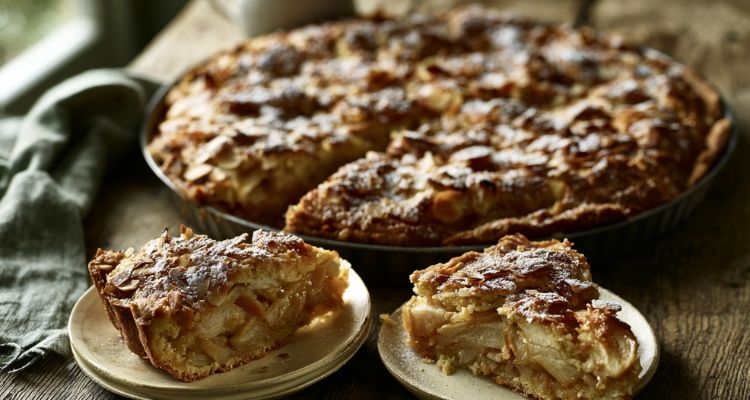
Mary Berry Apple and Almond Cake Recipe
Course: DessertCuisine: BritishDifficulty: Easy8
servings15
minutes1
hour15
minutes595
kcal1
hour35
minutesBerry designed this as a Sunday pudding, not an afternoon tea cake. It keeps for 2 days and freezes for up to 3 months, so you can bake it on Friday and have it ready for the weekend roast.
Ingredients
350g (12 oz) self-raising flour
225g (8 oz) caster sugar
4 tbsp honey
3 large eggs
1 tsp almond extract
225g (8 oz) butter, melted
450g (1 lb) cooking apples, peeled and cored
50g (2 oz) flaked almonds
Icing sugar, to serve
Directions
- Preheat: Set the oven to 140°C/120°C fan/Gas 2 (275°F). You will need a 28×4cm (11×1½ in) loose-bottomed tart tin, really well greased.
- Mix the batter: Measure the flour, sugar, honey, eggs, almond extract and melted butter into a mixing bowl. Beat with a wooden spoon or electric mixer until combined and smooth.
- Layer the cake: Spread half this mixture over the base of the tart tin. Thickly slice the apples and lay them on top of the mixture. Spoon the remaining mixture on top of the apples so they are completely covered in an even layer. Sprinkle over the flaked almonds.
- Bake: Bake in the centre of the preheated oven for about 1¼ hours, or until golden brown and the sponge is cooked.
- Serve: Dust with icing sugar and serve warm with cream.
Notes
- Calories: 350g SR flour (1,208) + 225g sugar (871) + 4 tbsp honey (258) + 3 eggs (234) + almond extract (10) + 225g butter (1,613) + 450g apples (212) + 50g flaked almonds (288) + icing sugar dusting (58) = 4,752 ÷ 8 = 595 kcal per slice
FAQs
Why is the oven temperature so much lower than Berry’s other apple cakes?
Her Devonshire Apple Cake in Baking Bible (2010) bakes at 180°C, which is 40 degrees higher for roughly the same bake time. This cake sits in a shallow tart tin with only 4cm sides, so the batter is thinner and closer to the heat from every angle. A higher temperature would dry the sponge out before the thick apple slices had time to soften through.
The honey plays a part too. It caramelises faster than caster sugar, so a hotter oven would brown the top well before the centre finishes cooking. Berry’s 140°C keeps everything gentle enough for the honey to do its job without burning.
Why does Berry thickly slice the apples when her other recipes say thin?
Her Devonshire Apple Cake uses thin slices because they’re meant to collapse and melt into the sponge during baking. This recipe does the opposite — thick slices that soften but hold their shape, so each portion has a visible, chunky apple layer sitting between the two halves of sponge.
I tried thin slices with this recipe once and they vanished into the batter completely. You couldn’t tell where the apple ended and the cake started. Thick slices give you that contrast between sweet, soft fruit and the surrounding sponge, which is what makes this feel like a proper dessert rather than a tea cake.
What type of honey works best in this cake?
Berry advises in her Ultimate Cake Book to “use a clear or runny honey in cake making, as this dissolves more quickly.” Set or thick honey won’t blend smoothly into the batter and can leave sticky, undissolved pockets in the finished sponge. Any standard clear honey from the supermarket does the job.
The honey flavour is subtle once it’s baked for over an hour — it rounds out the sweetness rather than dominating. I’ve tried it with cheap blended honey and a more expensive single-flower variety and couldn’t tell the difference in the finished cake, so save the good stuff for toast.
Can I bake this in a traybake tin instead of a tart tin?
Berry chose the 28cm tart tin for a reason. The 4cm sides keep the cake shallow, which is why she calls it an “open cake” in the headnote. A deeper traybake would make the batter thicker, and the centre would need much longer to cook through at such a low temperature. You’d end up with raw sponge around the apples.
If you only have a traybake tin, her Devonshire Apple Cake from Baking Bible (2010) uses the same melted butter base in a 30×23cm tin at 180°C and works perfectly in that shape. You’d be better off making that recipe than trying to force this one into a tin it wasn’t designed for.
How far ahead can I make this cake?
Berry’s storage notes are unusually generous here. She says it can be made up to 2 days ahead and freezes well cooked for up to 3 months. That’s one of the longest freezer times she gives for any cake, which makes it a solid choice if you want a homemade pudding without last-minute baking.
Reheat it in a low oven for about 15 minutes before serving. Berry says to serve warm with “a generous amount of cream,” and that warmth matters because it loosens the honey in the sponge and softens the apple layer back to its just-baked texture. Cold, it’s denser and the honey flavour fades into the background.
What’s the difference between this and Mary Berry’s Devonshire apple cake?
They share a melted butter base and cooking apples, but they’re built for different occasions. The Devonshire version from Baking Bible (2010) uses more sugar (350g vs 225g), adds baking powder and lemon juice, bakes hotter at 180°C, and cuts into 12 portions from a rectangular traybake tin. It’s a crowd-feeding cake for fetes and picnics.
This one is smaller, richer and designed as a pudding. The honey adds a depth the Devonshire version doesn’t have, and the shallow tart tin gives it a profile closer to a French bake than a British traybake. Berry’s headnote makes the distinction clear — “best served warm with a generous amount of cream” — not something you’d wrap in foil and take to a village hall.