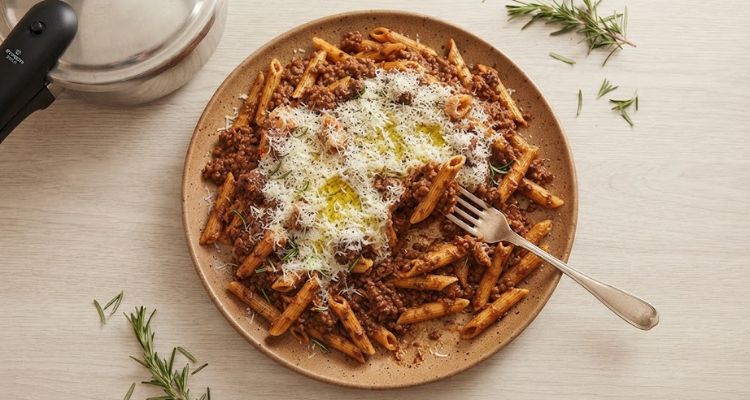
Jamie Oliver’s pressure cooker bolognese browns beef mince and frozen soffritto with rosemary, garlic, tomato purée, red wine, tinned lentils and porcini, clamps on the lid, and pressure-cooks the lot in 10 minutes flat. The pasta boils alongside, and everything tosses together with Parmesan for a weeknight dinner in 20 minutes. It serves four at 536 kcal a plate.
The recipe is from Jamie’s 20-Minute Meals (2012). The pressure cooker is the whole trick: it compresses what would normally be a 2-3 hour slow simmer into 10 minutes of pressurised cooking, breaking down the mince and vegetables into a deep, rich sauce that tastes like it’s been on the stove all afternoon.
Two details do heavy lifting. First, the lentils go in whole with their tinned liquid, and they partially collapse under pressure, thickening the sauce and adding body so the mince stretches further. Second, Oliver mashes the finished bolognese with a potato masher before tossing it with the pasta, which breaks everything into a thick, clinging ragù rather than a loose, chunky sauce.
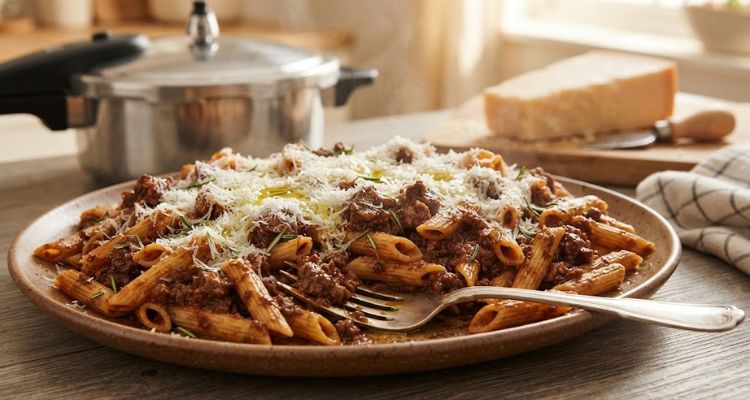
Jamie Oliver Pressure Cooker Bolognese
Course: Dinner, LunchCuisine: BritishDifficulty: Easy4
servings8
minutes12
minutes536
kcal20
minutesJamie Oliver’s 20-minute bolognese from Jamie’s 20-Minute Meals: beef mince, lentils, porcini and red wine pressure-cooked for 10 minutes into a thick ragù, tossed with penne and Parmesan. A slow-cooked taste in a fraction of the time. Serves four.
Ingredients
250g higher-welfare beef mince
250g fresh or frozen chopped mixed onion, carrot and celery
10g dried porcini mushrooms (optional)
4 sprigs of rosemary
2 cloves of garlic
4 tablespoons double concentrate tomato purée
125ml red wine
1 x 400g tin of lentils
300g dried penne pasta
30g Parmesan cheese
Directions
- Build the sauce:Put the pressure cooker on high heat with 2 tablespoons of olive oil, the mince and the chopped mixed veg. Crumble in the porcini if using, stirring regularly. Pick and finely chop the rosemary, peel and finely chop the garlic, and stir both in with the tomato purée, red wine, lentils with all their juice, half a tin’s worth of water, and a pinch of salt and pepper.
- Pressure cook:Clamp the lid on and, as soon as the steam starts to release, cook for 10 minutes on medium.
- Cook the pasta:Meanwhile, boil the penne in salted water to packet instructions. Drain, reserving a mugful of starchy cooking water.
- Mash and toss:Release the steam from the pressure cooker and carefully remove the lid. Mash the bolognese with a potato masher, loosening with a splash of reserved pasta water if needed. Season, then toss with the drained pasta.
- Serve:Pour onto a platter, finely grate over the Parmesan and finish with extra virgin olive oil.
FAQs
Do I need a pressure cooker, or can I make it without one?
The pressure cooker is what makes this a 20-minute recipe. Without one, you can make the same bolognese in a regular pan: brown the mince and veg, add everything else, and simmer uncovered on low for 45-60 minutes until thick and rich. It’ll taste even better with the longer cook, but it’s no longer a quick weeknight dinner.
A slow cooker works too: brown the mince first in a frying pan, then tip everything into the slow cooker on low for 6-8 hours. The lentils will break down completely, giving a very thick, almost pastelike sauce. Either way, the ingredients and the mashing step stay the same.
Why add lentils to a bolognese?
They stretch the mince and thicken the sauce. Oliver uses only 250g of beef mince for four people, which would normally make a thin, meagre ragù, but a whole tin of lentils (with their starchy liquid) bulks it out into something substantial. Under pressure, the lentils partially collapse and thicken the sauce without needing flour or long reduction.
It’s also a protein and fibre boost: the book’s own nutritional data shows 30g of protein and 6g of fibre per serving, more than a plain mince bolognese would deliver. The lentils don’t taste beany in the finished dish; once mashed into the sauce, they become part of its texture rather than a visible addition.
Why mash the bolognese?
It’s the step that turns a chunky sauce into a thick, clinging ragù. Pressure cooking leaves the mince and vegetables in distinct pieces, and mashing them with a potato masher after the lid comes off breaks everything down into the kind of smooth, coating consistency that a traditional bolognese gets from hours of slow simmering.
Don’t over-mash into baby food: a few strokes is enough to break the larger chunks and let the lentils collapse into the sauce. You want it thick enough to cling to the penne, not pool at the bottom of the bowl. A splash of reserved pasta water loosens it if you go too far.
What do the porcini mushrooms add?
A deep, earthy, almost meaty savouriness that punches well above their 10g weight. Dried porcini are concentrated umami bombs: they rehydrate and release their flavour under pressure, adding complexity that makes the sauce taste slow-cooked. Oliver marks them optional, but they’re worth including.
You don’t need to soak them separately here, since the liquid in the pressure cooker rehydrates them as the sauce cooks. Just crumble them straight in with the mince and veg. If you can’t find porcini, a tablespoon of mushroom ketchup or a splash of soy sauce adds similar depth in a different way.
Is double concentrate tomato purée different from regular?
Yes, and it matters. Double concentrate is cooked down further than regular tomato purée, so it’s thicker, darker and more intensely flavoured. Oliver uses 4 tablespoons of it as the tomato backbone of the sauce, which gives a deep, rich tomato flavour without the volume of liquid a tin of tomatoes would add.
If you only have regular tomato purée, use the same amount but expect a slightly thinner, less intense sauce. You could compensate by adding an extra tablespoon or two. The concentrate also caramelises faster when it hits the hot pan, building that fond of flavour on the base before the liquid goes in.
What pasta shape works best?
Oliver uses penne, and any tubular or ridged shape that catches a thick sauce works well: rigatoni, fusilli, conchiglie or casarecce all suit a meaty ragù. The mashed bolognese clings to ridges and fills tubes, so you get sauce in every bite rather than it sliding off smooth pasta.
Spaghetti or linguine would work but carry the sauce differently, coating thinly rather than trapping it. For a similar Oliver pasta supper in a completely different direction, his bread and borlotti bean soup takes the same storecupboard instinct (tins, stock, stale bread) and makes a thick Italian one-pot rather than a ragù.