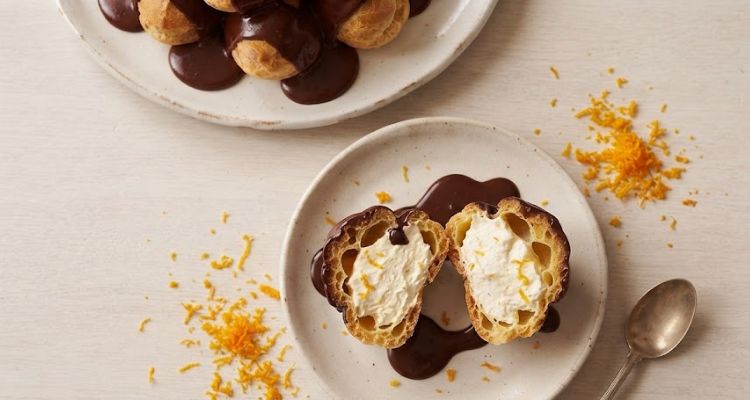
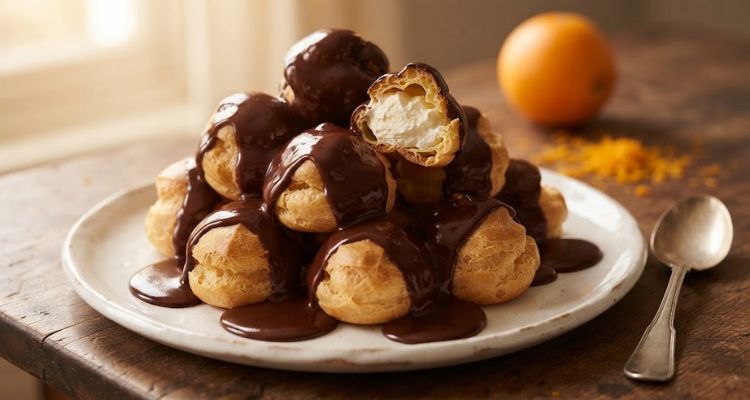
James Martin’s chocolate profiteroles pipe choux pastry into small balls, bake them until golden with steam in the oven for extra lift, fill them with orange-zested whipped cream, and drown them in a dark chocolate sauce made from a sugar syrup. The recipe makes about 20 and is built in three separate stages: pastry, filling, sauce.
The recipe comes from BBC’s Sweet Baby James, the episode themed around classic desserts Martin learned at catering college in Yorkshire. Profiteroles were one of the first things he was taught to make, and his version stays faithful to that training, with a proper choux, a proper chocolate sauce from scratch, and one twist: orange zest in the cream.
The technique that separates good profiteroles from flat, soggy ones is steam. Martin heats a roasting tin in the bottom of the oven, then pours water into it just before shutting the door. The burst of steam helps the choux puff up higher and set with a crisp shell. Without it, the pastry rises less and can collapse.
James Martin Chocolate Profiteroles
Course: DessertCuisine: BritishDifficulty: Easy20
servings30
minutes35
minutes230
kcal1
hour5
minutesJames Martin’s classic profiteroles from BBC’s Sweet Baby James, the recipe he learned at catering college. Choux buns steamed in the oven for maximum puff, filled with orange-scented cream, drowned in dark chocolate sauce. Makes about 20.
Ingredients
- For the choux pastry:
200ml/7fl oz cold water
4 tsp caster sugar
85g/3oz unsalted butter, plus extra for greasing
115g/4oz plain flour
pinch salt
3 medium free-range eggs, beaten
- For the cream filling:
600ml/1 pint double cream
1 orange, zest only
- For the chocolate sauce:
100ml/3½fl oz water
80g/3oz caster sugar
200g/7oz good-quality dark chocolate, broken into pieces
Directions
- Prepare the oven:Preheat to 200°C/400°F/gas 6 and place a small roasting tin in the bottom of the oven to heat.
- Make the choux:Put the water, sugar and butter into a large saucepan and heat gently until the butter melts. Turn up the heat, then tip in all the flour and salt in one go.
- Beat the paste:Remove from the heat and beat vigorously until a smooth paste forms and comes away from the sides of the pan. Transfer to a large bowl and cool for 10-15 minutes.
- Add the eggs:Beat in the eggs a little at a time until the mixture is smooth, glossy and has a soft dropping consistency. You may not need all the egg.
- Pipe:Lightly grease a large baking sheet. Using a piping bag with a plain 1cm nozzle, pipe small balls in lines across the sheet. Rub the top of each ball gently with a wet finger for a crisper finish.
- Bake with steam:Put the baking sheet in the oven. Before closing the door, pour half a cup of water into the hot roasting tin, then shut the door quickly. Bake for 25-30 minutes until golden. If too pale, they’ll go soggy when cool.
- Dry out:Remove from the oven and turn it off. Prick the base of each profiterole with a skewer, place them hole-up on the sheet and return to the cooling oven for 5 minutes to dry out the centres.
- Fill:Whip the cream with the orange zest to soft peaks. Once the profiteroles are cold, pipe the cream in through the base.
- Make the sauce:Heat the water and sugar in a saucepan to a boil. Reduce to a simmer and set a heatproof bowl of chocolate pieces over the pan. Stir until melted, pour the syrup into the chocolate and stir until smooth.
- Serve:Pile the filled profiteroles into a dish and pour over the chocolate sauce. Serve hot or cold.
FAQs
Why pour water into the oven?
It’s a professional bakery technique for getting maximum rise. The water hits the preheated roasting tin and flashes into steam, which keeps the surface of the choux moist during the first minutes of baking, allowing it to expand fully before the crust sets. Without steam, the outside hardens too soon and the pastry can’t puff up as high.
Martin also smooths each piped ball with a wet finger before baking, which serves the same purpose on a smaller scale: a damp surface stays flexible longer. These two small steps, the steam and the wet-finger trick, are what turn flat little choux mounds into properly risen, hollow profiteroles.
Why prick them and put them back in the turned-off oven?
To dry out the soggy centres. Even a well-baked profiterole has steam trapped inside, which will condense as it cools and make the pastry soft and claggy. Pricking the base with a skewer releases that trapped steam, and placing them hole-up in the warm, switched-off oven for 5 minutes drives out any remaining moisture.
This is the step most home recipes skip, and it’s exactly why home profiteroles so often deflate or go soft. Martin learned this at catering college, and it’s the difference between a crisp shell that shatters when you bite in and one that’s disappointingly leathery.
Why orange cream instead of plain?
It’s Martin’s personal twist on the classic. The orange zest folded through the whipped cream adds a fragrant, citrusy note that complements the dark chocolate sauce rather than competing with it. Plain whipped cream works perfectly well if you’d rather keep it traditional.
Whip the cream to soft peaks only, not stiff, since you need it loose enough to pipe through the small hole in the base of each profiterole. Over-whipped cream is too firm to pipe neatly and ends up tearing the pastry. If you enjoy orange and chocolate together, this pairing sits in the same register as his double chocolate cherry brownies, where fruit cuts through rich chocolate.
Why make the chocolate sauce with a sugar syrup?
Because it gives a glossy, pourable sauce rather than a thick ganache. Melting chocolate over a pan of sugar syrup rather than cream produces a thinner, shinier sauce that cascades over the profiteroles and pools around them, which is the classic bistro look. A cream-based ganache would be thicker and sit on top.
Use good-quality dark chocolate, since the sauce has only three ingredients and the chocolate flavour is front and centre. The syrup also helps prevent the chocolate from seizing, which can happen if you add water directly to melting chocolate, because the sugar stabilises the emulsion.
Can I make the components ahead?
Yes, and splitting the work is the smart approach. Bake the choux shells a day ahead, cool them completely and store in an airtight container at room temperature, where they’ll stay crisp. The chocolate sauce can also be made ahead and gently rewarmed.
Fill the profiteroles with the orange cream as close to serving as possible, because the cream softens the pastry over time. For a dinner party, have the empty shells and the sauce ready, then fill and assemble just before you bring them to the table. Follow with coffee, or pair them as the grand finish after a main like his beef bourguignon or lobster thermidor.
How do I get the right choux consistency?
The paste should be smooth, glossy and drop reluctantly from a spoon when shaken, holding its shape briefly on the baking sheet before settling. Martin says you may not need all the beaten egg, so add it gradually, checking the consistency after each addition, and stop as soon as it reaches that soft dropping point.
Two common mistakes: adding the flour before the butter has fully melted (lumpy paste), and adding the eggs while the paste is still too hot (cooked egg in the mixture). Cool the paste for 10-15 minutes after beating in the flour, then add the eggs slowly. If the mixture is too stiff, add a tiny bit more egg; if too runny, you’ve gone past the point and the profiteroles will spread flat.