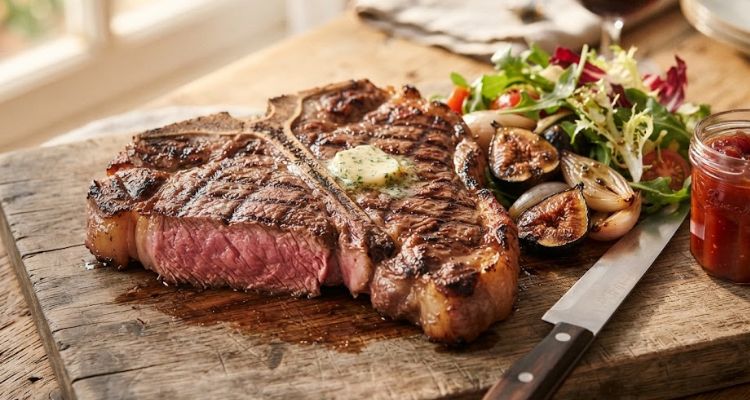
James Martin’s chargrilled T-bone steak is seared on a searing-hot griddle, rested, and served with charred banana shallots and figs in a lemon-balsamic dressing, alongside a spiced tomato chilli chutney made weeks in advance. The steaks cook in about 8 minutes, the chutney simmers for 20-30 minutes but improves over 2-3 weeks, and it serves four.
The recipe comes from Martin’s BBC recipe archive, from his long Saturday Kitchen era. The standout element isn’t the steak but the tomato chilli chutney, which he tells you to make 2-3 weeks ahead because the flavour deepens as it sits. Charring fresh figs and shallots on the same griddle turns a plain steak into a proper plated dish.
The steak technique is where the “chargrilled” promise is won or lost. You rub the oil onto the steak rather than the pan, sear it on a fiercely hot griddle, then turn it 90 degrees halfway through each side to get the crosshatched bar marks, before resting it. A T-bone is really two steaks in one, so the bone-side timing matters.

James Martin Chargrilled T-bone Steak
Course: Dinner, LunchCuisine: BritishDifficulty: Easy4
servings15
minutes30
minutes1000
kcal45
minutesJames Martin’s chargrilled T-bone from his BBC recipe collection, paired with a matured tomato chilli chutney and a warm charred fig and shallot salad. The chutney is the make-ahead star; the steak is a fast, high-heat griddle job. Serves four, best in fig season.
Ingredients
- For the tomato chutney:
275ml/9½fl oz malt vinegar
225g/8oz soft brown sugar
1.5kg/3lb 5oz ripe tomatoes, very roughly chopped
200g/7oz onions, roughly chopped
4 red chillies, chopped
2 garlic cloves, finely chopped
1 tbsp finely chopped fresh root ginger
1 tsp ground coriander
sea salt and freshly ground black pepper
- For the steak:
4 T-bone steaks, at room temperature
2 tbsp olive oil
4 banana shallots, skin on, cut in half lengthways
4 fresh figs, cut in half lengthways
1 tbsp balsamic vinegar
½ lemon, juice only
3 tbsp extra virgin olive oil
1 round lettuce, separated into leaves
salt and freshly ground black pepper
Directions
- Start the chutney (2-3 weeks ahead): Put the malt vinegar and sugar in a large saucepan, bring to the boil and cook for 3-4 minutes until the sugar has melted. Add all the other chutney ingredients, bring to the boil and cook for about 20-30 minutes, stirring frequently. If the tomatoes are very juicy, cook a little longer until it thickens, but keep it chunky and don’t let it break down to a purée.
- Store it: Cool the chutney, then spoon into sterilised jars and keep in the fridge for 2-3 weeks, where the flavour improves over time.
- Sear the steaks: Heat a griddle pan until searing hot. Rub the steaks with a little olive oil and season with salt and pepper. Sear for 2 minutes, then turn each steak 90 degrees on the same side and sear for another 2 minutes. Flip and repeat on the other side. Remove and rest on a plate.
- Char the shallots and figs: Meanwhile, rub the shallots with the remaining olive oil and griddle cut-side down for 3-4 minutes. Add the figs cut-side down and cook for another minute, until everything is tender and charred.
- Dress the salad: Whisk the balsamic vinegar, lemon juice and extra virgin olive oil together and season. Just before serving, toss the lettuce, shallots and figs in the dressing.
- Serve: Serve each steak with the salad alongside and a spoonful of chutney.
Notes
- Chutney (make ahead) 2-3 weeks before
FAQs
What exactly is a T-bone steak?
It’s a large steak cut across the whole sirloin, taking in two prized muscles separated by a T-shaped bone. On one side of the bone sits a piece of tender fillet, and on the other a larger, meatier piece of sirloin, so you get the best of both textures in a single steak. That’s what makes it such a generous, sharing-sized cut.
It’s closely related to a porterhouse, which is cut from further back and has a bigger fillet section. The bone in the middle helps conduct heat and adds flavour as the steak cooks. Because the leaner fillet cooks faster than the sirloin, position the fillet side slightly away from the fiercest heat if your griddle has a hotter spot.
How do I get those chargrill bar marks?
Heat and patience. Get the griddle properly searing hot before the steak goes anywhere near it, and crucially rub the oil onto the steak rather than into the pan, which prevents smoking and sticking. Lay the steak down and don’t move it, so the ridges have time to brand dark, caramelised lines into the meat.
The crosshatch comes from the turn. After 2 minutes, rotate the steak 90 degrees on the same side and cook for another 2 minutes, which lays a second set of bars across the first. Only then do you flip and repeat. Moving or nudging the steak too early smears the marks and stops that proper chargrilled crust forming.
How do I know when it’s cooked, and why rest it?
Martin’s timing, roughly 2 minutes plus 2 minutes each side, suits a thick T-bone cooked to around medium-rare, but steaks vary, so judge by feel or a thermometer rather than the clock alone. A rare steak feels soft and springy, medium-rare has a little more resistance, and firmer means more well done.
Resting is not optional, and his method builds it in: setting the steak aside on a plate lets the juices redistribute so they don’t run out the moment you cut in. Rest it for a few minutes, roughly as long as it cooked. Remember the fillet side cooks faster than the sirloin, so a T-bone naturally gives you two slightly different degrees of doneness.
Why make the chutney 2-3 weeks ahead?
Because it genuinely tastes better for it. Martin is clear that the chutney’s flavour improves over time, as the harsh edge of the malt vinegar mellows and the tomato, chilli, ginger and sugar meld into something rounded and deep. Freshly made, it tastes sharp and raw by comparison.
Keep it chunky by not over-cooking it: he warns against reducing it so far that the ingredients collapse into a purée, so stop while there’s still texture. Cool it, jar it in sterilised jars and keep it in the fridge for 2-3 weeks. It’s a make-ahead condiment, so it’s worth doing a big batch, which this recipe’s 1.5kg of tomatoes gives you.
Why serve steak with figs and shallots?
For balance. A rich, fatty T-bone wants something sweet and something sharp alongside, and charring the figs and banana shallots on the griddle caramelises their natural sugars into a soft, jammy foil for the beef. The lettuce keeps it fresh and stops the plate feeling heavy.
The dressing does the sharpening. A quick whisk of balsamic, lemon juice and extra virgin olive oil cuts through the beef’s richness and lifts the charred sweetness of the fruit. Figs are at their best in late summer and early autumn, which is when this dish makes most sense, so treat it as seasonal.
Can I cook it on a barbecue or without a griddle?
Yes, and a barbecue actually suits a T-bone beautifully. The fierce, direct heat of hot coals chars the exterior and crisps the fat much like a griddle, and the bone stands up well to grilling, so cook it over the hottest part and rest it exactly as in the recipe.
Without a griddle, a heavy cast-iron frying pan gets hot enough to sear well, though you’ll miss the bar marks. For a very thick T-bone, sear it hard on all sides first, then move it somewhere gentler, or briefly into a hot oven, to finish cooking through without burning the crust, then rest.