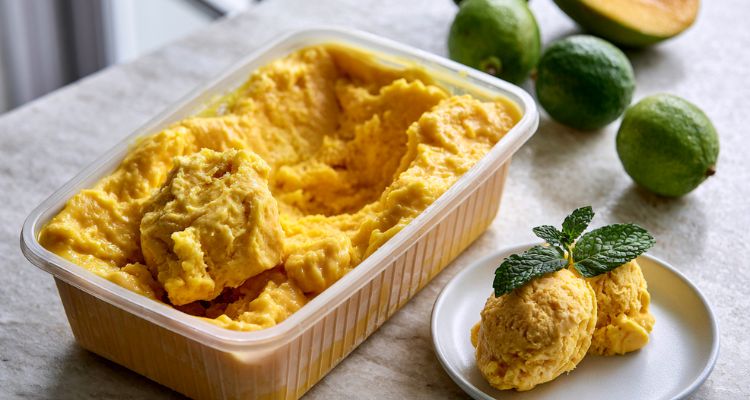
Delia Smith’s lime and mango ice cream is a no-custard frozen dessert made with fresh mango puree, lime juice, sugar syrup, and creme fraiche. From her Winter Collection (1995), it makes 2 pints (1.2 litres) with 20 minutes of active work plus freezing.
Smith calls this “a beautiful ice cream” but warns the mangoes must be “extremely ripe, almost bordering on over-ripe.” A ripe mango feels heavy in the hand and gives off a strong scent through the skin. Under-ripe fruit makes a flat ice cream no amount of sugar fixes.
What sets this apart is its simplicity: no eggs, no custard, no cornflour. Just four ingredients folded together. The creme fraiche adds natural tang that sharpens the mango without the heaviness of a cream-and-egg base.

Delia Smith Lime and Mango Ice Cream
Course: DessertCuisine: BritishDifficulty: Easy8
servings20
minutes175
kcal5
hours20
minutesThe simplest ice cream in Smith’s collection, from her Winter Collection (1995). No eggs, no custard, just ripe mangoes, lime, sugar syrup, and creme fraiche. Filed under her Thai recipes, which explains the tropical pairing.
Ingredients
3 large, extremely ripe mangoes
3-4 limes, to yield 4 fl oz (110 ml) juice
4 oz (110 g) granulated sugar
1 x 200 ml tub creme fraiche
- Equipment
Shallow plastic box measuring 10 x 6 x 2 inches (25.5 x 15 x 5 cm), with lid
Directions
- Dissolve the sugar in 5 fl oz (150 ml) water over a low heat until all the grains of sugar have disappeared, then turn the heat up a little and simmer gently for 15 minutes, without allowing the liquid to evaporate. Remove from the heat and leave to cool slightly.
- Slice the mangoes in half along the length of the stone on either side of it, with a plate underneath to catch all the precious juice. Use a spoon to scrape all the flesh away from the skin, then place into a liquidiser. Using a sharp paring knife, remove the skin from the flesh around the stone, then scrape all the flesh from this into the liquidiser, leaving the stone and any fibrous threads behind.
- Liquidise the mangoes until you have a smooth puree. If you don’t have a liquidiser or processor, place a plastic sieve over a bowl and push the flesh through. This should yield about 1 pint (570 ml) puree. Add the lime juice and the sugar syrup and combine thoroughly.
- Spoon the creme fraiche into another bowl and whip it lightly until it increases in volume and thickness. Use a metal spoon to fold the fruit puree into the creme fraiche.
- Place the mixture in the plastic box and put it in the coldest part of the freezer for about 2 hours, or until it is beginning to freeze around the edges. Using an electric hand whisk, whisk the frozen edges into the middle, replace the lid and return to the freezer for another 2-3 hours, then repeat the whole process.
- Freeze again until quite frozen. Before serving, place the box in the main body of the fridge for about 1 hour. If you have an ice cream maker, freeze-churn according to the maker’s instructions.
FAQs
How do I know when mangoes are ripe enough for this recipe?
Smith gives two tests that work together. First, hold the mango and check that it feels heavy for its size. Second, smell it: a ripe mango gives off “a powerful and fragrant aroma through the skin.” If both tests pass, it’s ready.
If your mangoes fail either test, Smith says to place them “in a brown paper bag and left to ripen in the dark at room temperature.” This traps ethylene gas, which speeds up ripening. It usually takes 2-3 days. Don’t refrigerate unripe mangoes, as cold stops the ripening process dead.
Can I use frozen mango instead of fresh?
Frozen mango chunks work in a pinch, but the flavour won’t be as intense as fresh, ripe fruit. Commercial frozen mango is picked before full ripeness and blanched before freezing, which strips some of the fragrance Smith considers essential.
If you do use frozen, thaw the chunks completely and drain off any excess liquid before blending. You’ll need about 570 ml of puree, so start with roughly 700 g of frozen chunks. Add an extra tablespoon of lime juice to compensate for the milder flavour. Smith’s blackcurrant ice cream uses a similar fruit-puree-and-cream method, so that’s a good one to try next if you enjoy this technique.
Why does Smith use creme fraiche instead of cream?
Creme fraiche has a natural tang that plain cream doesn’t. In this recipe, that sharpness works with the lime juice to balance the sweetness of the mango and sugar syrup. Double cream would make the ice cream richer but flatter in flavour.
It also keeps the calorie count lower. At 175 kcal per serving, this is one of Smith’s lightest ice creams. Compare that to her fig ice cream, which uses double cream and egg yolks for a much richer 345 kcal per serving. The creme fraiche gives body without the heaviness.
Can I make this in an ice cream maker?
Yes. Smith includes this option at the end of her method: “If you have an ice cream maker, freeze-churn according to the maker’s instructions.” At 1.2 litres, it fits comfortably in most domestic machines, unlike her lemon meringue ice cream which is too large for standard makers.
Churn the combined puree and creme fraiche mixture until it reaches soft-serve consistency, then transfer to the plastic box and freeze until firm. The machine method gives a smoother result because it incorporates air continuously, but the hand-whisking method produces a denser, more intensely fruity texture.
How long does mango ice cream keep in the freezer?
This ice cream is best within two weeks. The high fruit content means it develops ice crystals faster than custard-based versions, because fruit puree contains more water than a cream-and-egg base.
Press cling film directly onto the surface before replacing the lid. That prevents freezer burn on top. Move the box to the fridge a full hour before serving, as Smith instructs. If you like tropical fruit ice creams, Smith’s coconut ice cream with lime syrup makes a good companion: serve a scoop of each side by side for a mango-coconut pairing.
What other fruit ice creams does Delia Smith make?
Smith has several fruit-based ice creams across her books. Her blueberry crumble ice cream uses a fromage frais base with baked cinnamon crumble folded through, and her blackcurrant version follows a similar fruit-puree-and-cream method to this mango recipe.
The key difference between her fruit ice creams and her custard-based ones is richness. The fruit versions are lighter and sharper because the fruit does the flavouring work, while custard versions like her cinnamon ice cream rely on cream and egg yolks for depth. If you’re serving a heavy main, the fruit ice creams make a better finish.