Mary Berry’s smoked haddock and egg mousse is a set starter made with undyed smoked haddock, boiled eggs, crème fraîche and sheet gelatine. From her Foolproof Cooking cookbook, it serves 8, bakes at 180°C (160°C fan) for 15 minutes, then chills for 3 hours.
Berry calls these “intense-flavoured little mousses” in Foolproof Cooking (2016) and pairs them with a caper vinaigrette of Dijon mustard, olive oil and whole capers. This is one of her few fish mousses that uses gelatine, giving a firm set for unmoulding.
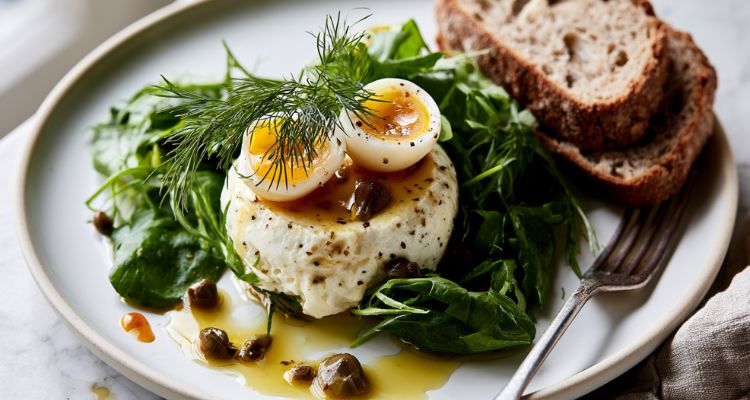
The chopped boiled eggs folded through the mixture are what make this version special. They add texture that breaks up the smoothness, so each bite has soft mousse and small chunks of egg. Berry tops each one with halved quail’s eggs for a striking presentation.

Mary Berry Smoked Haddock and Egg Mousse
Course: AppetizersCuisine: BritishDifficulty: Easy8
servings30
minutes15
minutes295
kcalOne of Berry’s more refined starters from Foolproof Cooking, this uses gelatine for a clean unmould and includes a sharp caper dressing that cuts through the richness. Serve with quail’s eggs, salad leaves and brown bread.
Ingredients
- For the mousse:
300g (11oz) undyed smoked haddock fillets
Butter, for greasing
2 eggs
2 leaves (4g) of gelatine
200ml (7fl oz) full-fat crème fraîche
100ml (3½fl oz) full-fat mayonnaise
2 tbsp lemon juice
2 tbsp finely chopped dill, plus extra sprigs to serve
2 tbsp drained capers, chopped
3 tbsp boiling water
Salt and freshly ground black pepper
- For the caper vinaigrette:
1 tsp Dijon mustard
6 tbsp olive oil
2 tsp caster sugar
1 tbsp chopped capers with their brine
1 tbsp drained whole capers
- To serve:
8 quail’s eggs
Salad leaves
Brown bread
Directions
- Preheat the oven to 180°C/160°C fan/Gas 4. Line eight ramekins with cling film.
- Place the haddock on a sheet of buttered foil, season with a little salt and pepper (bearing in mind that smoked haddock can be quite salty) and wrap into a parcel. Put the foil-wrapped fish on a baking tray and bake for about 15 minutes or until cooked through, then set aside to cool.
- Bring a pan of water to the boil and boil the two hen’s eggs for 10 minutes, then rinse under cold water, peel and roughly chop into small chunks. Boil the quail’s eggs in another pan for 1½ minutes, then drain and leave to cool in cold water before peeling and cutting in half.
- Soak the gelatine in cold water and leave for 5 minutes to become pliable.
- Whisk all the vinaigrette ingredients together and season to taste.
- Measure the crème fraîche and mayonnaise into a bowl with the lemon juice, dill and capers. Add the chopped hen’s eggs. Peel the skin from the haddock and flake it into the bowl. Season with salt and pepper and stir to combine.
- Measure the boiling water into a bowl. Squeeze all the water from the soaked gelatine, add it to the bowl, and stir to dissolve completely. After 2 minutes, add to the fish mixture and mix in gently but thoroughly. Spoon into the lined ramekins and level the tops. Cover with cling film and set in the fridge for at least 3 hours.
- Turn each mousse out of its ramekin on to a plate and top with two quail’s egg halves and a sprig of dill. Add some salad leaves, pour the caper vinaigrette around the mousse and serve with brown bread on the side.
FAQs
Why does this mousse use gelatine when Berry’s others don’t?
Berry’s smoked salmon mousse and smoked haddock mousse both set without gelatine because they use soft cheese or whipped cream, which firms up when chilled. This recipe uses crème fraîche and mayonnaise instead, which stay loose in the fridge.
The gelatine also serves a practical purpose. Berry wants these to turn out cleanly from ramekins, so they need enough structure to hold their shape on a plate. Without gelatine, you’d end up with a puddle rather than a neat dome.
How do I use sheet gelatine if I’ve never tried it?
Berry’s tip in Foolproof Cooking is straightforward. Soak the leaves in cold water for 5 minutes until they’re soft and floppy. Squeeze out all the water, then dissolve them in 3 tablespoons of boiling water.
The key mistake is adding the gelatine while it’s still too hot. Let the dissolved gelatine cool for 2 minutes before mixing it into the fish base, as Berry instructs. If you pour it in hot, it can cook the crème fraîche and create lumps instead of a smooth set.
Can I substitute powdered gelatine for the sheets?
Berry specifies 2 leaves (4g) of sheet gelatine. If you only have powdered, use about 1½ teaspoons sprinkled over 3 tablespoons of cold water. Let it bloom for 5 minutes, then heat gently until dissolved.
Powdered gelatine tends to set slightly firmer than sheets, so your mousse may have a bouncier texture. Berry clearly prefers sheets in her recipes, and she mentions in the tip that different brands of sheet gelatine vary in strength. For the closest match to Berry’s result, sheet gelatine is worth seeking out at larger supermarkets.
What’s the best way to boil quail’s eggs?
Berry gives clear timings: 1½ minutes in boiling water, then straight into cold water to stop them cooking. That gives you a just-set yolk with a bright yellow centre that looks stunning cut in half on top of the mousse.
Peeling quail’s eggs can be fiddly because the shells are thin and fragile. Berry mentions this in her Christmas Collection, where she suggests tapping them all over on a hard surface before peeling under running water. The shell comes away much more easily when the membrane underneath gets wet.
How does this compare to Berry’s simpler haddock mousse?
Berry’s Smoked Haddock Mousse in the Complete Cookbook uses only six ingredients: haddock, soft cheese, mayo, lemon, turmeric and seasoning. No gelatine, no eggs, no vinaigrette. It’s a weeknight version you can throw together in about 15 minutes of hands-on work.
This Foolproof Cooking version is the dinner party upgrade. The caper vinaigrette adds a sharp contrast, the quail’s eggs make it look professional, and the gelatine gives a clean unmould. Both are genuine Berry recipes, but they suit very different occasions and skill levels.
Can I make a vegetarian version of this mousse?
Berry doesn’t offer a vegetarian swap in the book, and the gelatine makes this unsuitable for vegetarians as standard. You could try agar agar as a plant-based setting agent, but it behaves differently from leaf gelatine and may produce a firmer, more brittle set.
For the fish itself, there’s no true vegetarian substitute that captures the smoky flavour Berry builds this dish around. A better option would be Berry’s Asparagus Mousse from Mary Berry Cooks. It uses leaf gelatine with asparagus, spinach and cream for an equally impressive plated starter.