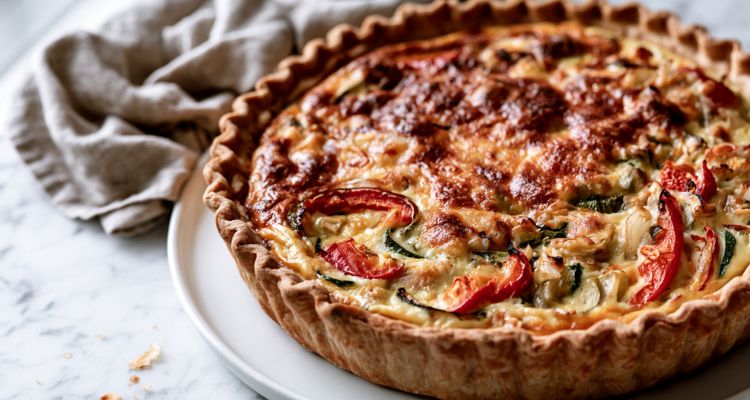
Mary Berry’s roasted vegetable quiche is a large shortcrust tart filled with roasted onions, red peppers and courgettes in a Gruyère cream custard. It bakes in a 28cm tin at 180°C (160°C fan/Gas 4) for 25-35 minutes and serves 10-12 as a main dish.
Berry’s headnote in Foolproof Cooking (2016) explains her approach: “roasting the vegetables ensures that it is very tasty too.” She roasts them separately at 200°C for 30-40 minutes first, which concentrates their flavour and drives off moisture. Raw vegetables in a quiche release water as they bake, but roasted ones don’t.
The detail most recipes skip is Berry’s pastry repair tip. She says to fill any cracks after blind-baking with leftover raw dough, sealed with egg mixture. Cracks in the base let filling leak underneath during baking, and once that happens the base never crisps properly.
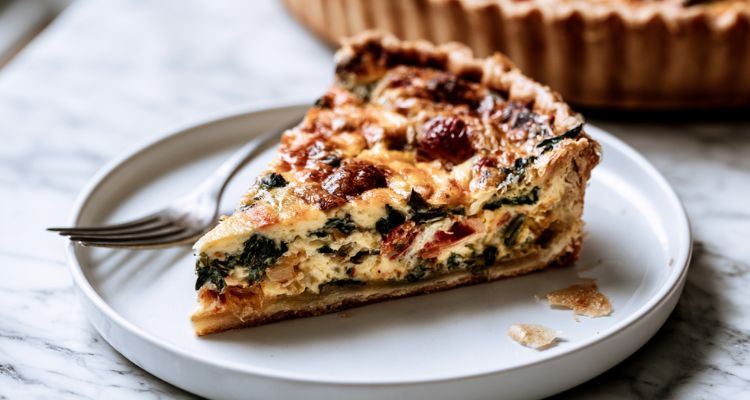
Mary Berry Roasted Vegetable Quiche
Course: BreakfastCuisine: BritishDifficulty: Easy10-12
servings30
minutes1
hour20
minutes425
kcalFrom Foolproof Cooking (2016), Berry’s largest quiche designed to feed a crowd at a summer buffet. Chunky roasted vegetables in a Gruyère custard with her signature pastry-crack repair technique.
Ingredients
- For the pastry:
225g (8 oz) plain flour, plus extra for dusting
175g (6 oz) cold butter, cubed
1 egg, beaten
- For the filling:
2 onions
2 red peppers
200g (7 oz) baby courgettes
1-2 tbsp olive oil
300ml (10 fl oz) double cream
4 eggs
180g (6 oz) Gruyère cheese, grated
Salt and freshly ground black pepper
Directions
- Make the pastry: Blitz the flour and butter in a food processor (or place in a mixing bowl and rub the butter into the flour with your fingertips). Once combined, add the egg and 1 tablespoon of cold water and pulse until combined.
- Line the tin: You will need a 28cm (11 in) round, loose-bottomed fluted tart tin and some baking beans. Roll out the dough on a lightly floured, cold work surface to a circle large enough to line the tart tin and about 3mm (⅛ in) thick, leaving a generous edge to allow for shrinking in the oven. Prick the base and sides of the pastry in the tin and chill in the fridge for 15 minutes.
- Blind-bake: Preheat the oven to 180°C/160°C fan/Gas 4 (350°F). Line the chilled pastry with baking paper, fill with baking beans and bake in the oven for 10 minutes. Remove the beans and paper and put the pastry case back in the oven to bake for another 10-15 minutes. Remove from the oven and set aside to cool. Increase the oven temperature to 200°C/180°C fan/Gas 6 (400°F).
- Roast the vegetables: Peel and quarter both onions, then halve each quarter lengthways. Deseed and cut the peppers into chunky strips and halve the courgettes lengthways. Place on a large baking tray, drizzle with olive oil and season generously with salt and pepper. Roast in the oven for 30-40 minutes, turning the vegetables over halfway through cooking, until tender and golden.
- Make the custard: Whisk together the cream, eggs and half the grated cheese and season well with salt and pepper.
- Fill the case: Once the vegetables are roasted, sprinkle the remaining cheese on to the base of the pastry case, pile in the vegetables, spreading them out so that they are evenly distributed, and pour over the cream mixture.
- Bake: Reduce the oven temperature back down to 180°C/160°C fan/Gas 4 (350°F) and bake the quiche for 25-35 minutes or until the filling is set and golden on top. Take out of the oven and allow to cool slightly before removing from the tin and transferring to a serving plate. Serve warm.
FAQs
Why does Berry roast the vegetables before adding them to the quiche?
Roasting at 200°C for 30-40 minutes does two things raw vegetables can’t. It caramelises the natural sugars in the peppers and onions, creating a deeper, sweeter flavour. It also drives off moisture so the vegetables don’t release water into the custard during baking.
I tested this once with raw peppers to save time and the custard never set properly in the centre. The vegetables steamed inside the filling instead of staying distinct. Berry’s roasting step adds 40 minutes but it’s the reason this quiche has bold, concentrated flavour rather than watery, bland filling.
Can I use different vegetables?
Berry’s combination of onions, peppers and courgettes is chosen because they all roast at the same temperature and time. If you swap in vegetables with different moisture levels, such as mushrooms or aubergine, you’ll need to adjust. Mushrooms release a lot of liquid and should be roasted until completely dry.
Butternut squash, sweet potato and beetroot all work well because they hold their shape and roast without weeping. Cut them to similar sizes so they cook evenly. Avoid anything raw or high-moisture like tomatoes or cucumber. Berry’s Spinach Quiche in Mary Berry Cooks uses wilted spinach instead, squeezed dry before adding.
How do I get the quiche out of the tin without breaking it?
Berry says to “allow to cool slightly before removing from the tin,” which is key. A hot quiche is fragile because the custard hasn’t fully set. Give it at least 15 minutes. Then place the tin on a can or jar and let the outer ring drop down.
Use a palette knife to loosen the base if needed, then slide the quiche on to a serving plate. The loose-bottomed tin makes this straightforward. Berry’s crustless quiche from Simple Comforts uses a fixed-base tin instead and requires a full flip-out, which is trickier.
What is the best tin size for this recipe?
Berry specifies a 28cm (11 in) round, loose-bottomed fluted tart tin, which is larger than the 20-23cm tins she uses for her other quiches. This size is deliberate because the recipe serves 10-12 people and has a generous amount of chunky roasted vegetables that need space.
If you only have a 23cm tin, reduce the filling by about a third or you’ll overfill it. The pastry quantity would also need reducing. For a smaller gathering, Berry’s Quiche Lorraine from Cook Up a Feast comes in a 20cm size that serves six, which is more practical for a weeknight.
Can I make the pastry case ahead of time?
Berry specifically says the “pastry case can be made a day in advance and stored in an airtight container before filling.” This is one of her most useful prepare-ahead tips because it splits the work across two days. Blind-bake the case on Saturday, fill and bake on Sunday.
Store the cooled, blind-baked case in its tin, wrapped loosely or in an airtight container at room temperature. Don’t refrigerate it because the condensation can make the pastry soft. Berry also notes the raw pastry freezes well if you want to get even further ahead.