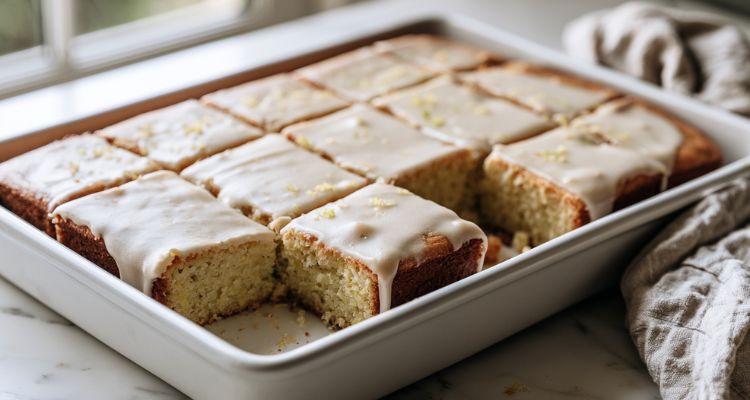
Mary Berry’s iced lemon traybake from Mary Berry’s Ultimate Cake Book (2003) is an all-in-one soft margarine sponge with a smooth lemon glacé icing made from 225g icing sugar and about 3 tablespoons of fresh lemon juice, baked at 180°C/Gas 4 for 35–40 minutes in a 30 × 23cm tin and cut into 21 pieces.
In the Ultimate Cake Book, Berry presents this as a variation on her Basic All-in-one Sponge Traybake, noting that “you can vary a basic traybake quite simply — in this case by adding a subtle lemon flavour and a lemon glacé icing.” That word “subtle” is telling. The flavour here is gentler than the sharp, crunchy drizzle versions she published later. The margarine base and the sweet glacé icing together produce a softer, more classic school-cake result.
This version uses soft margarine rather than butter, and that choice matters because the glacé icing sits on top of a cooled cake — unlike the drizzle versions where the syrup needs a warm sponge to soak in. Margarine produces a slightly lighter, more even crumb that holds a smooth iced surface well. The whole cake cools fully in the tin before the icing goes on, which makes this the most forgiving of all four versions in terms of timing.
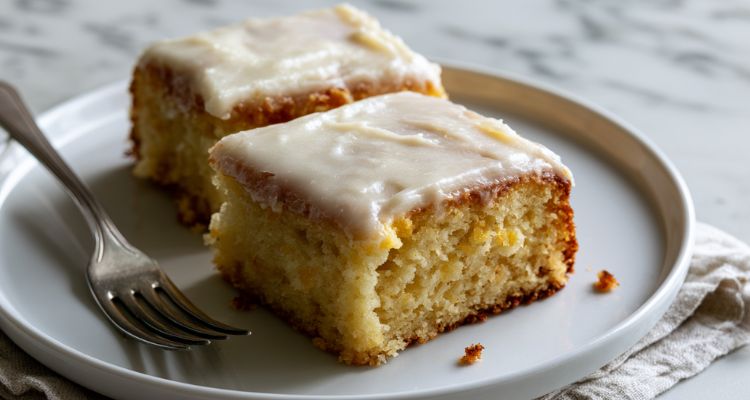
Mary Berry Iced Lemon Traybake
Course: DessertCuisine: BritishDifficulty: Easy21
servings15
minutes40
minutes220
kcalThis is Berry’s 2003 take on lemon traybake, using margarine rather than butter and a glacé icing rather than a crunchy sugar drizzle. The icing goes on cold — the opposite of the later drizzle versions — which makes it easier to manage for beginners and ideal for cutting into neat, clean pieces.
Ingredients
- For the traybake:
8 oz (225g) soft margarine
8 oz (225g) caster sugar
10 oz (275g) self-raising flour
2 teaspoons baking powder
4 eggs
4 tablespoons milk
Grated rind of 2 lemons
- For the icing:
About 3 tablespoons lemon juice
8 oz (225g) icing sugar, sifted
Directions
- Prepare the tin: Preheat the oven to 180°C/350°F/Gas 4. Grease and base line a 12 × 9 in (30 × 23cm) roasting tin with greased greaseproof paper.
- Mix the batter: Measure all the ingredients into a large bowl and beat well for about 2 minutes until well blended. Turn the mixture into the prepared tin and level the top.
- Bake: Bake in the preheated oven for about 35–40 minutes or until the cake has shrunk from the sides of the tin and springs back when pressed in the centre with your fingertips.
- Cool completely: Leave to cool in the tin. Do not rush this step — the icing goes on a cold cake.
- Ice the cake: Mix together the lemon juice and icing sugar to give a runny consistency. Spread out evenly over the cold cake and leave to set.
Notes
- Calculated from ingredient weights: 225g soft margarine (717 kcal/100g), 225g caster sugar (387 kcal/100g), 275g self-raising flour (345 kcal/100g), 4 eggs (78 kcal each), 60ml milk (61 kcal/100ml), 225g icing sugar (387 kcal/100g), ~45ml lemon juice (negligible). Total ~4,663 kcal ÷ 21 = ~222 kcal. Rounded to 220. Sat fat estimated for margarine — lower than butter versions.
FAQs
What is the actual difference between glacé icing and a crunchy drizzle topping?
Glacé icing is icing sugar dissolved in liquid, spread over a cold cake and left to dry to a smooth, firm finish. The drizzle topping in Berry’s later books is granulated sugar stirred into lemon juice and spooned over a warm sponge, where it soaks partway in and crystallises on the surface. The glacé icing stays on top of the crumb entirely — you get a clean, pale layer rather than a sugary crust. The flavour is sweeter and milder; the texture is smoother. Berry’s own headnote calls the flavour here “subtle,” which is the right word.
Why does this recipe use soft margarine when Berry’s later lemon traybakes use butter?
The 2003 Ultimate Cake Book was written when baking margarine was the standard fat for all-in-one traybakes. Berry explains in the same book that soft baking margarine is “of the correct consistency even when taken straight from the fridge,” which makes it more reliable for the all-in-one method than butter, which must be genuinely soft before use. By 2010 and 2015, Berry’s books reflect a shift toward butter and baking spread, likely because readers had access to better quality baking spreads and more confident oven management.
Does the icing set firm enough to cut cleanly into 21 pieces?
It does, but only if you wait long enough. At room temperature, a glacé icing this thin needs at least 30–45 minutes to set to the point where a knife cuts through it without dragging. Cut too early and you drag the icing across the surface rather than through it. The clean way is to let the icing set fully, then use a sharp knife and wipe it between cuts. Berry cuts into 21 pieces, which she describes in the book as “small” — roughly 5 × 4cm each.
Can you use butter instead of margarine in this recipe?
You can, and the texture will be slightly richer and more crumbly, but you need to soften the butter properly first. The all-in-one method relies on the fat being the right consistency from the start — if the butter is too firm, it won’t combine smoothly with the other ingredients in two minutes of beating, and you’ll end up with a lumpy batter that bakes unevenly. If you only have butter, cut it into cubes and leave them in a bowl of lukewarm water for five minutes, then dry thoroughly before using.
How does this compare to a Victoria sponge in terms of technique?
Both use the all-in-one method with the same basic ratio of fat, sugar, flour, and eggs — Berry points this out in the Ultimate Cake Book when she describes traybakes as a one-tin version of the same principle. The key difference is that a Victoria sponge bakes in two sandwich tins and is assembled after cooling, while this traybake bakes in a single deeper tin and is iced in place. Berry notes in the book that two traybakes sandwiched together work well for a cricket tea, which is an efficient way to scale up for large gatherings.
Is there a prepare-ahead or freezing note for this version?
Berry does not include a specific prepare-ahead or freeze note for this traybake in the 2003 Ultimate Cake Book, unlike her 2015 Absolute Favourites version, which explicitly allows freezing for up to 1 month. Glacé icing does not freeze well in general — it tends to weep and go sticky when thawed. If you need to make ahead, bake the sponge and freeze it plain, then make the icing fresh and apply it after the sponge has thawed completely. The sponge itself freezes well for up to a month. If you enjoy Berry’s baking style and want something fridge-set rather than oven-baked next, her Baileys cheesecake is worth bookmarking.