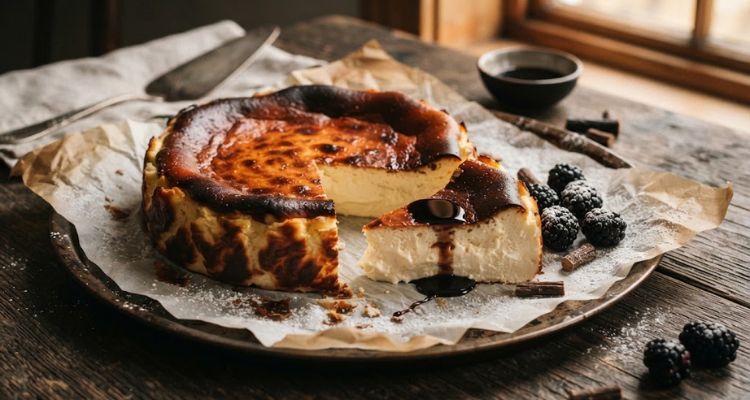
Nigella Lawson’s Basque burnt cheesecake is a crustless, deliberately scorched cheesecake of cream cheese, sour cream, sugar, eggs and cornflour, soft under its burnt top, with an optional liquorice sauce. It bakes at 200°C in 50 minutes and cuts into 8 to 12 slices.
In Cook, Eat, Repeat (2020) she calls it a total joy: easy to make, luscious to eat, soft under a scorched “tortoiseshell” top. The liquorice sauce comes from Basque chef Nieves Barragán Mohacho at Sabor in London, who shared her recipe, though Nigella says liquorice-loathers can simply leave it out.
The step that makes it is pulling it from the oven while it still looks far too jiggly under the burnt top. It carries on cooking as it cools and settles to a soft, tender set. Overbake it and you lose that oh-so-tender centre entirely.
Nigella Lawson Basque Burnt Cheesecake
Course: DessertCuisine: BritishDifficulty: Easy8-12
servings15
minutes50
minutes350
kcal1
hour5
minutesNigella’s crustless, scorched-top cheesecake from Cook, Eat, Repeat: cream cheese, sour cream and cornflour baked hot and fast to a soft molten centre, with an optional dark liquorice syrup and berries. Cuts into 8 to 12.
Ingredients
- For the cheesecake:
600g full-fat cream cheese (at room temperature)
175g caster sugar
3 large eggs (at room temperature)
300ml sour cream (at room temperature)
¼ teaspoon fine sea salt
25g cornflour
- For the sauce:
90g caster sugar
300ml water
pinch of fine sea salt (optional)
- To serve:
blackberries or other berries of your choice
Directions
- Line the tin:Heat the oven to 200°C/180°C fan/400°F. Line a 20cm springform tin with two long sheets of baking parchment laid perpendicular, with a 5 to 7cm overhang, pushed into the base. Don’t smooth out the pleats and creases, as that crumpled look is the point. Weigh the paper down while you mix.
- Beat the base:Beat the room-temperature cream cheese with the sugar until light and smooth, at least 2 minutes in a mixer or 5 minutes by hand.
- Add the wet:Beat in the eggs one at a time, letting each incorporate. Then, still beating, pour in the sour cream.
- Thicken:Slow the mixer, beat in the salt, then the cornflour a teaspoon at a time. Scrape down and stir well.
- Fill and tap:Pour into the tin, leaving nothing in the bowl, then rap the tin on the surface about five times to knock out air bubbles.
- Bake:Bake for 50 minutes, until burnished bronze to chestnut on top and risen like a dense soufflé, but still very jiggly. Cool on a wire rack; it will sink in the middle, which is traditional.
- Make the sauce:Put the liquorice (whole or pulverised) in a small pan with the water. Stir in the sugar and warm over a low heat until dissolved, nudging occasionally. Turn up and bubble until reduced to 150ml, up to 20 minutes in a small pan. Stir in a pinch of salt if you like, and cool to a syrup.
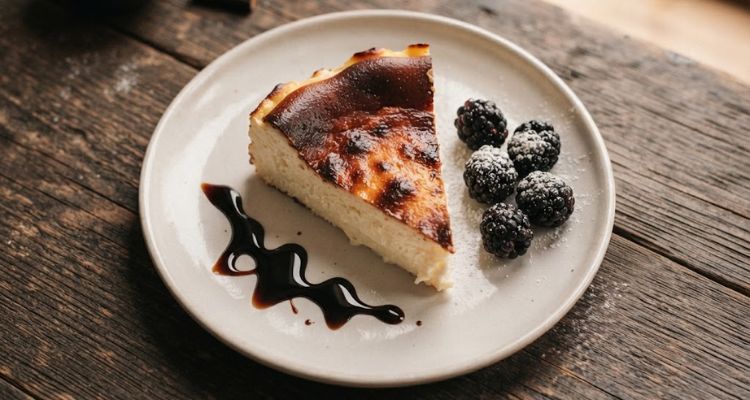
- Serve:Unclip the tin and lift the cheesecake out by the parchment onto a board. Peel the paper back and serve rustically with the berries, drizzling a little liquorice syrup over each slice.
Notes
- (room temperature): Everything must be at room temperature before you start, especially the cream cheese, or it won’t beat smooth.
- (the parchment “Look”): The pleats, creases and wrinkles in the lining are deliberate, giving the cheesecake its rustic sides. Don’t fight them.
- (when to serve): It’s best eaten on the day you make it, once cooled to room temperature (about 3 hours). If you must chill it first, do so for no more than 30 minutes, or it sets too solid and loses its tender texture.
- (make ahead): The liquorice sauce can be made up to 1 week ahead. Cover and refrigerate, then bring back to room temperature before serving.
- (store): Refrigerate cheesecake leftovers, covered, for up to 3 days. The sauce keeps, covered, for up to 3 months.
- (freeze): Freeze cheesecake leftovers in an airtight container for up to 1 month; defrost overnight in the fridge and eat within 24 hours. The sauce freezes for up to 6 months, defrosted overnight in the fridge.
- Cooling: About 3 hours to room temperature
FAQs
Why take it out while it’s still so jiggly?
Because that wobble is the whole character of a Basque burnt cheesecake. It looks alarmingly underdone under its dark top, but it keeps cooking in the residual heat as it cools and settles into a soft, creamy, just-set centre rather than a firm, dense one. Bake it until the middle looks fully set and you’ve overcooked it.
So trust it and pull it at 50 minutes, when the top is bronze and it’s risen like a soufflé but still trembles. It will sink in the middle as it cools, which is exactly how it should look. This soft-set is what makes it so different from a firm, no-bake cheesecake like Nigella’s white chocolate cheesecake.
Why must everything be at room temperature?
Nigella stresses this twice, and it matters. Cold cream cheese stays firm and lumpy no matter how long you beat it, and those lumps won’t smooth out later, leaving you a bobbly batter. At room temperature it beats into a silky, light cream that the eggs and sour cream fold into evenly.
Room-temperature eggs and sour cream also blend in without seizing the mixture or trapping it cold, so the cheesecake bakes evenly. Take the cream cheese, eggs and sour cream out of the fridge well ahead, an hour or two before you start. It’s the single easiest thing to get right and the easiest to rush.
How do I line the tin, and why the crumpled parchment?
Line a 20cm springform with two long sheets of baking parchment laid across each other at right angles, so the whole tin is covered, with a generous 5 to 7cm overhang. Push them well into the base and up the sides, and sit something heavy inside to hold the paper while you make the batter.
Don’t try to smooth out the pleats and folds. Those creases press into the sides of the cheesecake as it bakes, giving it the rustic, crinkled edges that are part of its charm, what Nigella calls “The Look”. The overhang is also how you lift the whole thing out cleanly once it’s baked.
What is the liquorice sauce, and do I have to make it?
It’s an intense, darkly glinting liquorice syrup that Nigella first tasted on this cheesecake at Sabor in London, where the Basque chef Nieves Barragán Mohacho makes it. She kindly shared the recipe, and it reduces a little liquorice, sugar and water down to a glossy syrup you drizzle over each slice.
It’s entirely optional, though. If you’re a liquorice-loather rather than a lover, leave it out, as Nigella says. The cheesecake is wonderful with just some berries, or paired with a rhubarb compote. Put the syrup on the table so the hardcore liquorice fans can spoon over more as they eat.
When is the best time to serve it, and what goes with it?
It’s at its best on the day you make it, served at room temperature once it’s had about three hours to cool. That’s when the texture is at its most tender. If you need to chill it before serving, keep it to no more than 30 minutes, since longer sets it too solid and it loses that soft, molten quality.
Blackberries or other berries and the liquorice syrup are the classic finish, but it needs little. A scoop of something cold alongside, like Nigella’s make-ahead no-churn matcha ice cream, turns it into a fuller pudding. Serve it rustically, lifted from the paper onto a board.
Can I make it ahead, store it or freeze it, and is it gluten-free?
The sauce is the make-ahead friend here, keeping up to a week in the fridge; just bring it back to room temperature before serving. The cheesecake itself is best fresh, but leftovers keep covered in the fridge for up to 3 days, and it freezes for up to a month, defrosted overnight and eaten within 24 hours. The sauce keeps 3 months chilled or 6 months frozen.
It’s also naturally gluten-free, since there’s no biscuit base and the batter is thickened with cornflour rather than wheat flour, which makes it a handy dinner-party dessert for mixed tables. For another crowd-pleasing Nigella pud, her sticky toffee pudding is a warm contrast, and there’s more on the Nigella Lawson recipes page.