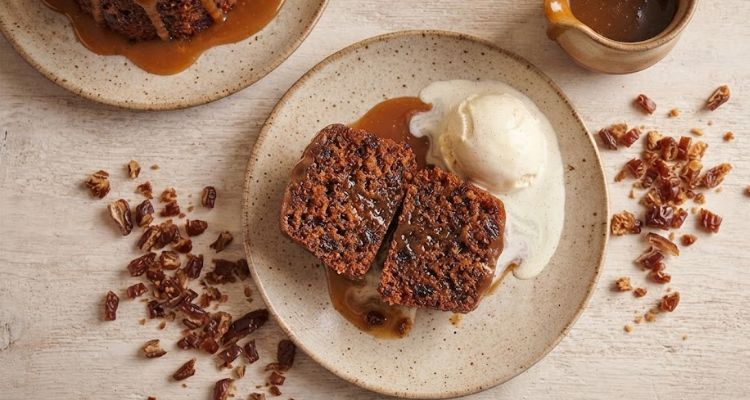
James Martin’s sticky toffee pudding bakes a moist date sponge, made with demerara sugar, golden syrup and black treacle, in individual moulds, then drowns each one in a muscovado toffee sauce. The whole thing comes together quickly in a food processor, bakes at 200°C (gas 6) for 20-25 minutes, makes six, and is served with a scoop of vanilla ice cream.
The recipe comes from BBC’s Saturday Kitchen Best Bites. Sticky toffee pudding is a Lake District icon, and Martin’s take is the fast, fuss-free version: cream, blitz and combine, then bake in individual moulds for a neat, dinner-party finish. His sponge uses demerara sugar, saving the deeper, darker muscovado for the sauce.
The step that gives it that signature moist, dark crumb is the dates. You blitz them with boiling water into a smooth purée, then stir in bicarbonate of soda, which reacts with the hot mixture to soften the dates further and lighten the sponge. Fold that into the batter and you get tenderness, not a dense cake.
James Martin Sticky Toffee Pudding
Course: DessertCuisine: BritishDifficulty: Easy6
servings15
minutes20
minutes650
kcal40
minutesJames Martin’s quick individual sticky toffee puddings from BBC’s Saturday Kitchen Best Bites: a demerara date sponge under a rich muscovado, treacle and cream toffee sauce. All made in a food processor, served hot with vanilla ice cream. Makes six.
Ingredients
- For the puddings:
55g/2oz butter, plus extra for greasing
170g/6oz demerara sugar
1 tbsp golden syrup
2 free-range eggs
2 tbsp black treacle
200g/7oz self-raising flour, plus extra for flouring
200g/7oz pitted dates
290ml/10fl oz boiling water
1 tsp bicarbonate of soda
½ tsp vanilla extract
- For the sauce:
110ml/4fl oz double cream
55g/2oz butter, diced
55g/2oz dark muscovado sugar
2 tbsp black treacle
1 tbsp golden syrup
vanilla ice cream, to serve
Directions
- Prepare:Preheat the oven to 200°C/400°F/gas 6. Grease and flour 6 individual pudding moulds.
- Make the batter:Cream the butter and demerara sugar in a food processor until pale and fluffy. Add the golden syrup, treacle and eggs a little at a time, blending until smooth, then add the flour and blend on low until combined. Transfer to a bowl.
- Purée the dates:Meanwhile, blend the dates and boiling water in a food processor to a smooth purée. Stir in the bicarbonate of soda and vanilla.
- Combine:Pour the date mixture into the batter and stir until well combined.
- Bake:Divide between the moulds and bake for 20-25 minutes, until the tops are springy and golden.
- Make the sauce:Heat all the sauce ingredients in a pan, stirring occasionally, until boiling.
- Serve:Turn the puddings out onto 6 plates, pour over the sauce and serve with a scoop of vanilla ice cream
FAQs
What is sticky toffee pudding, and where’s it from?
It’s a classic English dessert: a moist sponge cake studded with dates, covered in a rich toffee sauce, usually served with ice cream or custard. The sponge is light and almost muffin-like rather than heavy, and the dates are what give it that dark, fudgy, caramelised character even though the pudding itself isn’t especially date-forward in flavour.
It’s strongly associated with the Lake District in northwest England, where it’s something of a culinary symbol, with Cartmel and the Sharrow Bay hotel both laying claim to popularising it. So Martin’s version sits in a long British tradition, which is part of why it feels like such a comforting, familiar pudding.
Why demerara sugar in the sponge but muscovado in the sauce?
The two sugars do different jobs. Demerara is a coarse, golden sugar with a mild caramel note, which keeps the sponge itself a touch lighter in colour and flavour, letting the dates and treacle lead. It dissolves into the creamed butter while still carrying that toffee edge.
Dark muscovado, by contrast, is soft, damp and intensely molasses-rich, which is exactly what you want in the sauce, where deep, treacly darkness is the whole point. Splitting them this way gives you contrast between a slightly lighter sponge and a very dark, glossy sauce, rather than one uniform note throughout.
Why blitz the dates and add bicarbonate of soda?
This is the heart of a good sticky toffee pudding. Blending the dates with boiling water breaks them down into a smooth purée that disperses evenly through the batter, so you get moisture and sweetness in every bite rather than chewy lumps of date. The hot water starts softening them straight away.
Stirring bicarbonate of soda into the hot date mixture is what really counts. It reacts with the warm, slightly acidic dates, helping to break them down further and aerating the batter so the sponge bakes up light and moist rather than dense. Skip the bicarb and you lose that characteristic tender, springy crumb.
Can I make one large pudding instead of individual moulds?
Yes. The individual moulds are mainly for a neat presentation and a quicker bake, but the same batter works in a single ovenproof dish. Bake it at the same temperature for longer, roughly 30-40 minutes, until the top is springy and a skewer comes out clean, then serve it in scoops with the sauce poured over.
Individual puddings are handy for portion control and look impressive turned out onto a plate, while a big baked pudding is more relaxed and homely. Either way, keep an eye on the bake and judge by the springy top rather than the clock, since dish depth changes the timing.
Can I make it ahead or freeze it?
Sticky toffee pudding is famously make-ahead friendly, which is one of its great strengths. You can bake the sponges in advance, cool them, and reheat gently in a low oven or briefly in the microwave with a little sauce spooned over, and they come back moist and warm as if freshly made.
The puddings also freeze well: cool completely, wrap and freeze for up to a few months, then defrost and reheat. The sauce keeps in the fridge for several days and simply needs warming through, thinning with a splash of cream if it thickens. That makes this an ideal dessert to prep ahead for a dinner party.
What should I serve it with besides ice cream?
Martin serves his with vanilla ice cream, and the contrast of cold, melting ice cream against the hot, sticky pudding is a big part of the appeal. That hot-and-cold combination is the classic way to eat sticky toffee pudding.
If you’d rather, pouring cream, thick clotted cream or a jug of proper custard all work beautifully and lean into the comforting, old-fashioned side of the dish. Whatever you choose, keep plenty of the warm toffee sauce coming, since a generous pour over the top is really non-negotiable with a good sticky toffee pudding.FAQs
What is sticky toffee pudding, and where’s it from?
It’s a classic English dessert: a moist sponge cake studded with dates, covered in a rich toffee sauce, usually served with ice cream or custard. The sponge is light and almost muffin-like rather than heavy, and the dates are what give it that dark, fudgy, caramelised character even though the pudding itself isn’t especially date-forward in flavour.
It’s strongly associated with the Lake District in northwest England, where it’s something of a culinary symbol, with Cartmel and the Sharrow Bay hotel both laying claim to popularising it. So Martin’s version sits in a long British tradition, which is part of why it feels like such a comforting, familiar pudding.
Why demerara sugar in the sponge but muscovado in the sauce?
The two sugars do different jobs. Demerara is a coarse, golden sugar with a mild caramel note, which keeps the sponge itself a touch lighter in colour and flavour, letting the dates and treacle lead. It dissolves into the creamed butter while still carrying that toffee edge.
Dark muscovado, by contrast, is soft, damp and intensely molasses-rich, which is exactly what you want in the sauce, where deep, treacly darkness is the whole point. Splitting them this way gives you contrast between a slightly lighter sponge and a very dark, glossy sauce, rather than one uniform note throughout.
Why blitz the dates and add bicarbonate of soda?
This is the heart of a good sticky toffee pudding. Blending the dates with boiling water breaks them down into a smooth purée that disperses evenly through the batter, so you get moisture and sweetness in every bite rather than chewy lumps of date. The hot water starts softening them straight away.
Stirring bicarbonate of soda into the hot date mixture is what really counts. It reacts with the warm, slightly acidic dates, helping to break them down further and aerating the batter so the sponge bakes up light and moist rather than dense. Skip the bicarb and you lose that characteristic tender, springy crumb.
Can I make one large pudding instead of individual moulds?
Yes. The individual moulds are mainly for a neat presentation and a quicker bake, but the same batter works in a single ovenproof dish. Bake it at the same temperature for longer, roughly 30-40 minutes, until the top is springy and a skewer comes out clean, then serve it in scoops with the sauce poured over.
Individual puddings are handy for portion control and look impressive turned out onto a plate, while a big baked pudding is more relaxed and homely. Either way, keep an eye on the bake and judge by the springy top rather than the clock, since dish depth changes the timing.
Can I make it ahead or freeze it?
Sticky toffee pudding is famously make-ahead friendly, which is one of its great strengths. You can bake the sponges in advance, cool them, and reheat gently in a low oven or briefly in the microwave with a little sauce spooned over, and they come back moist and warm as if freshly made.
The puddings also freeze well: cool completely, wrap and freeze for up to a few months, then defrost and reheat. The sauce keeps in the fridge for several days and simply needs warming through, thinning with a splash of cream if it thickens. That makes this an ideal dessert to prep ahead for a dinner party.
What should I serve it with besides ice cream?
Martin serves his with vanilla ice cream, and the contrast of cold, melting ice cream against the hot, sticky pudding is a big part of the appeal. That hot-and-cold combination is the classic way to eat sticky toffee pudding.
If you’d rather, pouring cream, thick clotted cream or a jug of proper custard all work beautifully and lean into the comforting, old-fashioned side of the dish. Whatever you choose, keep plenty of the warm toffee sauce coming, since a generous pour over the top is really non-negotiable with a good sticky toffee pudding.