Nigella Lawson’s rice pudding cake is a British reworking of the Italian torta di riso, made by cooking Arborio rice in lemony milk, then folding it with whisked eggs and baking into a tender, nutmeg-scented cake. It bakes in a 20cm springform tin at 160°C (140°C fan) for 45 minutes and gives 8-12 slices, served warm with a bright jam sauce.
The recipe is from Cook, Eat, Repeat (2020), and she made it on the series finale of the BBC Two show. Nigella calls it a torta di riso “refracted through the prism” of a British rice pudding lover. Where Italians stud theirs with candied peel and eat it cold, she grates over nutmeg and serves hers gently warm.
The technique that turns pudding into cake is the eggs. You whisk the whites stiff and fold them into the rice base in thirds, which lightens a dense mixture into something with lift and a set, wobble-free top. Get that folding right and you have cake; skip it and you have baked rice pudding.
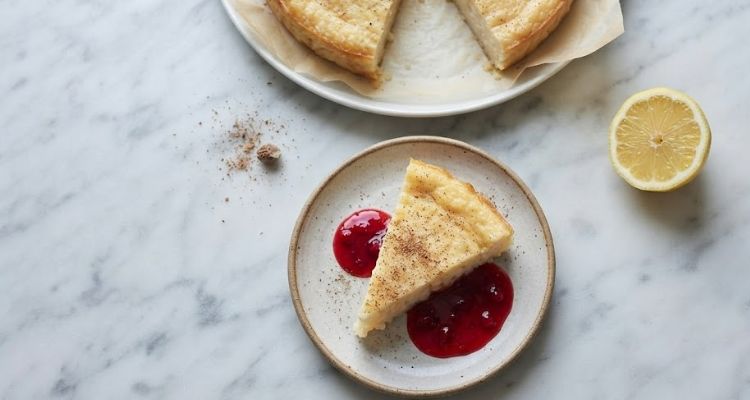
Nigella Lawson Rice Pudding Cake
Course: DessertCuisine: BritishDifficulty: Easy8-12
servings1
hour30
minutes45
minutes170
kcal2
hours15
minutesNigella’s torta di riso from Cook, Eat, Repeat, a rice pudding lightened with whisked egg whites into a delicate baked cake. Arborio rice, not pudding rice, for a better texture, and best served just-warm with a raspberry jam sauce. Time-consuming but not difficult.
Ingredients
150g Arborio rice
700ml full-fat milk
¼ tsp fine sea salt
1 lemon
75g soft unsalted butter, plus more for greasing
3 large eggs, at room temperature
75g caster sugar
2 tsp vanilla extract
Nutmeg, for grating
Directions
- Cook the rice: Put the rice, milk and salt into a heavy saucepan (Nigella uses an 18cm one) and grate in the lemon zest. Over high heat, stirring regularly, bring it to just before boiling, but don’t let it boil. Turn to low and cook for about 30 minutes, stirring now and then, until the rice is soft and the milk absorbed. Watch that it doesn’t boil or stick.
- Cool the base: Off the heat, stir in the butter until melted, then scrape everything into a large bowl and leave about an hour to reach room temperature. Once cooled, heat the oven to 160°C/140°C fan and butter the springform tin.
- Whisk the eggs: Separate the eggs, whites into a large grease-free bowl, yolks into a jug. Whisk the whites until stiff and set aside. Whisk the sugar into the yolks, by hand with a balloon whisk, until pale and moussy.
- Combine the base: Add the vanilla and 2 teaspoons of juice from the zested lemon to the yolks, then pour gradually into the cooled rice, folding well as you go.
- Fold in the whites: Stir a large spoonful of the stiff whites into the rice to lighten it, then gently fold in the remaining whites a third at a time, thoroughly but carefully, until all are incorporated. Pour and scrape into the prepared tin.
- Bake: Grate nutmeg generously over the top and bake for 45 minutes, until the top has set with no wobble underneath.
- Cool and unmould: Rest on a wire rack for about an hour until just slightly warm. Run a small spatula around the edge, unclip the tin and transfer the cake, still on its base, to a plate. It’s tender when warm, so lifting it off the base risks damage.
- Serve: Serve each slice warm, drizzled with the jam sauce or a seasonal rhubarb compote.
FAQs
Can I use ordinary pudding rice instead of Arborio?
You can, but Nigella prefers you didn’t. She specifically chooses Arborio, the risotto rice, because its larger grains give the cake a far better texture. Pudding rice works and is more traditional for a British rice pudding, but the result is softer and less defined in the slice.
The rice is cooked risotto-style, slowly absorbing the milk over about 30 minutes, so a grain that holds its structure pays off. Keep the heat low and stir so it never boils, since boiling milk can catch and split, and the rice can stick and scorch on the base.
Why serve it warm rather than cold?
Warmth is when it’s at its most tender. Nigella insists that first time out it must be served gently warm, nearer room temperature than hot, when the crumb is still delicate and yielding. Italians traditionally eat torta di riso cold, but she finds the just-warm version more comforting.
This tenderness is also why she cautions against lifting the cake off its metal base while warm, since it can break. She admits she risks it herself for the sake of a clean-looking plate, using a wide flat lifter, but for most people leaving it on the base is the safe choice.
How far ahead can I make it?
Not very, and there’s a food-safety reason. Nigella’s team advises baking it no more than about 2 hours before its first warm serving, since the cake firms up once refrigerated and loses that tender quality. Chilling changes the texture as much as the timing.
More importantly, rice and eggs are both higher-risk foods to reheat, so making the cake itself well in advance isn’t recommended. Bake it the day you want it warm. Leftovers are a different matter and should be refrigerated within 2 hours of baking, then eaten cold, which Nigella loves for breakfast.
What sauce should I serve with it?
Nigella’s most frequent choice is a jam sauce: heat 200g of seedless raspberry jam with 2 tablespoons of lemon juice until glossy, and consider a splash of Chambord too. The bright, sharp fruit cuts through the mild, milky cake beautifully.
She offers two alternatives from the same book: a rhubarb compote when it’s in season, or the blood orange syrup she drizzles over her pavlova. That last one is easy to borrow if you’re already making her prodigious pavlova, since the syrup does the same job here, adding bright acidity to a soft dessert.
My egg whites deflated when I folded them in. What went wrong?
Usually it’s over-mixing or dirty equipment. The whites must be whisked in a grease-free bowl to reach stiff peaks, and any fat, even a trace of yolk, stops them holding air. Nigella separates carefully for exactly this reason, letting whites fall into their own clean bowl.
The folding order matters too: stir in one spoonful first to slacken the heavy rice mixture, then fold the rest in thirds, gently but thoroughly. Dumping all the whites in at once forces you to overwork them, knocking out the air that gives the cake its lift. Use a light hand and stop as soon as no streaks remain.
What’s the difference between this and a torta di riso?
It’s a British translation of the Italian original. The classic torta di riso is studded with candied peel, often baked in a tin lined with breadcrumbs or crushed amaretti, and eaten cold. Nigella keeps the rice-and-egg structure but swaps the flavourings for the ones she associates with British rice pudding.
So out go the candied peel and amaretti, and in comes a generous grating of nutmeg over the top, plus that just-warm serving temperature. It sits in the same comforting-but-elegant register as her chocolate raspberry pudding cake, another Nigella dessert that’s soft-set and best eaten warm.