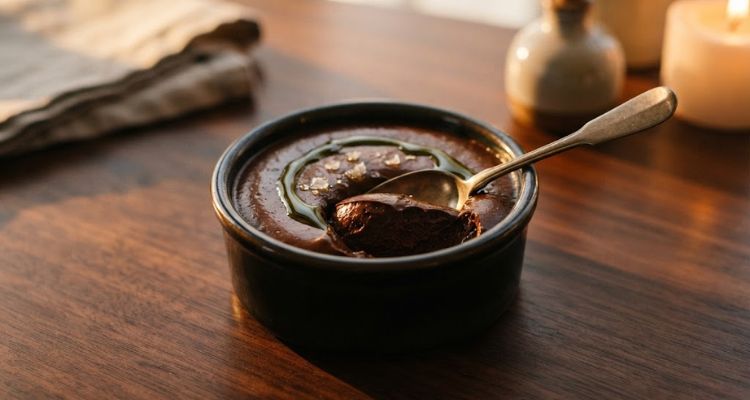
Nigella Lawson’s chocolate olive oil mousse is a voluptuously soft, rich dark chocolate mousse made with extra virgin olive oil in place of cream or butter. It’s a five-ingredient, no-cook dessert for 6, from her book At My Table.
She first tasted a version at Morito in London, one of her favourite places to eat, then started finding it everywhere. The olive oil isn’t just for its resonant flavour: it’s what creates the mousse’s smooth, soft, satiny texture in place of the usual dairy.
The key is the olive oil itself. Nigella wants a smooth but still spicy extra virgin olive oil, rather than a raspingly peppery one, and the very best quality you can find, since with so few ingredients its flavour comes right through.

Nigella Lawson Chocolate Olive Oil Mousse
Course: DessertCuisine: BritishDifficulty: Easy6-8
servings20
minutes260
kcal1
hour20
minutesNigella’s dairy-free mousse from At My Table: dark chocolate and good extra virgin olive oil folded through whisked eggs into a soft, satiny, richly chocolatey pudding. Serves six.
Ingredients
150g dark chocolate, 70% cocoa solids (roughly chopped)
100ml extra virgin olive oil
4 large eggs, at room temperature (separated)
pinch of Maldon salt, plus ¼ teaspoon
50g caster sugar
Directions
- Melt the chocolate:You’ll need 6 x 100ml ramekins or 8 espresso cups. Melt the chocolate in the microwave or in a bowl over simmering water (not touching it), taking it off the heat just before fully melted, then stir so the last pieces dissolve. Cool 10 minutes, then stir in the olive oil and set aside.
- Whisk the whites:Whisk the egg whites with a pinch of Maldon salt in a grease-free bowl to firm peaks. Set aside
- Whisk the yolks:In a large bowl, whisk the yolks, sugar and ¼ teaspoon of Maldon salt until pale, thick and roughly doubled in volume. (No need to clean the beaters between whites and yolks.)
- Combine:Gradually pour the chocolate-oil mixture into the yolks and fold to mix completely. Fold in a third of the whites vigorously to lighten (no need to be delicate). Then gently fold in the next third, and finally the last third, leaving behind any liquid at the bottom of the whites bowl. No white streaks should remain.
- Set:Freeform-spoon the mousse into the ramekins or glasses. For the right soft, satiny texture, either chill for 20 minutes and eat straight away, or chill for exactly one hour then bring to room temperature for 40 minutes before eating.
Notes
- (food safety): This recipe contains raw or lightly cooked eggs, so it may not be suitable for those with compromised or weak immune systems, such as young children, the elderly or pregnant women.
- (make ahead / store): The mousse keeps in the fridge, loosely covered with cling film, for up to 3 days. If making ahead, take it out 40 minutes before serving to come to room temperature, though the texture won’t be quite as consistently light.
FAQs
Why olive oil instead of cream or butter?
The olive oil is the whole point of the recipe, and it does two jobs. It gives the mousse its smooth, soft, satiny texture in place of dairy, and it brings its own resonant, gently fruity flavour that grounds the sweetness of the chocolate and makes the pudding feel sophisticated rather than merely rich.
It also, happily, makes the mousse dairy-free. Because there’s so little else, the oil’s quality really shows, so Nigella insists on using the best extra virgin olive oil you can, one that’s smooth and spicy rather than aggressively peppery, which could turn bitter against the chocolate.
What chocolate should I use?
Good dark chocolate at 70% cocoa solids is essential, since chocolate is the main flavour and there’s nowhere to hide. Its bitterness balances the small amount of sugar and stands up to the olive oil, giving a deep, grown-up chocolate flavour. Cheap chocolate can seize or taste flat.
Melt it gently and, crucially, take it off the heat just before it’s fully melted, then let the residual warmth finish the job, so it doesn’t overheat and split. Cool it for 10 minutes before combining, so it doesn’t scramble the egg yolks. It’s the same care that makes Nigella’s chocolate cheesecake style desserts work.
How do I fold the egg whites in without losing the air?
The whisked whites are what make it light, so folding is key. Nigella’s clever method is to add the first third vigorously, even roughly, purely to slacken and lighten the dense chocolate-yolk base, since you’re not trying to keep air in that first lot.
Then you fold in the second and third portions gently, to keep as much air as possible, until no white streaks remain. Leave behind any watery liquid at the bottom of the whites bowl. This two-speed approach, rough then gentle, is what gives a light but not deflated mousse. Whisk the whites in a spotlessly grease-free bowl or they won’t hold peaks.
How set should it be, and how do I get the texture right?
This is a soft, satiny mousse, not a firm, traditional set one, and Nigella gives you two ways to hit that texture. Either chill it for just 20 minutes and eat straight away while it’s at its softest, or chill it for exactly an hour, then let it come back to room temperature for 40 minutes before serving.
Both give that voluptuous, spoonable softness. What you don’t want is to leave it setting hard in the fridge, which makes it dense and firm rather than pillowy. Serving it around room temperature also lets the olive oil flavour come through, which cold mutes.
Can I make it ahead, and is it suitable for everyone?
You can make it up to 3 days ahead, kept loosely covered in the fridge, which makes it a handy dinner-party dessert. Take it out 40 minutes before serving to come to room temperature, though Nigella notes the texture won’t be quite as consistently light as when freshly made.
One important caveat: it contains raw egg, so it isn’t suitable for anyone with a weak immune system, including young children, the elderly or pregnant women. For a chocolate pudding without raw egg, Nigella’s baked chocolate tiramisù style desserts are alternatives. There’s more on the Nigella Lawson recipes page.
What do I serve it with?
It’s rich, so the small serving size is deliberate, and it needs very little. A few flakes of sea salt over the top plays up the chocolate, or a light dusting of cocoa. Fresh raspberries or orange segments cut the richness beautifully, and a crisp biscuit or some toasted nuts add contrast.
A little pour of extra virgin olive oil and a pinch of salt on top, restaurant-style, echoes the flavours and looks elegant. Serve it in small ramekins or espresso cups as Nigella suggests, since a little goes a long way. It’s a fittingly grown-up end to a dinner.