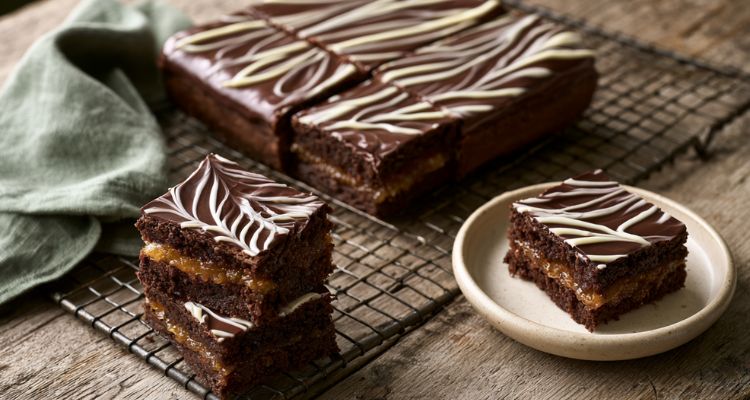
Mary Berry’s rich chocolate tray bake is a cocoa sponge topped with milk chocolate ganache and feathered with piped white chocolate, baked at 180°C (160°C fan) for 30 to 35 minutes in a 30×20cm tin. It cuts into 21 slices and Berry says it keeps for up to a week in a cake tin.
Berry published this in Mary Berry Cooks (2014) and designed it specifically for children: “This is a great cake for a birthday party for the young as they love the sweetness of milk chocolate.” She uses milk chocolate for the ganache rather than dark, and adds that if you’re making it “for a more sophisticated occasion, use dark chocolate with about 40 per cent cocoa solids.”
The feathered decoration sounds complicated but Berry breaks it down to three steps: pipe white chocolate in lines across the ganache, then drag a cocktail stick through the lines in alternating directions. That’s it. The drag creates the curved feather pattern, and the ganache needs to be freshly poured so the white chocolate sinks in just enough to hold.
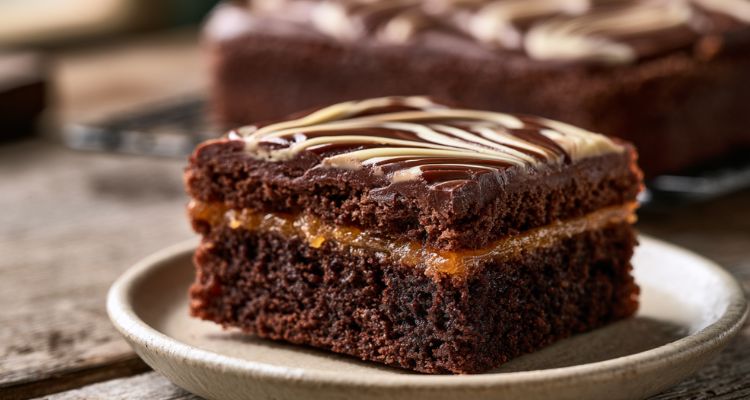
Mary Berry Rich Chocolate Tray Bake with Feathered Icing
Course: DessertCuisine: BritishDifficulty: Easy21
servings20
minutes30
minutes225
kcal55
minutesBerry’s ganache version of her chocolate traybake, designed for birthdays and parties. She says to “make the icing the day before or at least in the morning so it has time to set,” so plan ahead if you want clean slices.
Ingredients
- For the sponge:
50g (2 oz) cocoa powder
6 tablespoons boiling water
100g (4 oz) baking spread or softened butter
275g (10 oz) caster sugar
3 eggs, beaten
125ml (4 fl oz) milk
175g (6 oz) self-raising flour
1 teaspoon baking powder
3–4 tablespoons warmed, sieved apricot jam
- For the icing:
100ml (4 fl oz) double cream
200g (7 oz) milk chocolate for baking, finely chopped or grated
50g (2 oz) white chocolate, chopped
Directions
- Preheat: Set the oven to 180°C/160°C fan/Gas 4 (350°F). Grease a 30×20cm (12×8 in) traybake or roasting tin and line the base with baking paper. You will also need a small plastic piping bag.
- Mix the sponge: Measure the cocoa into a bowl, add the boiling water and mix until smooth. Add the baking spread or butter and beat into the cocoa until smooth, then add the sugar, eggs, milk, flour and baking powder and mix until combined. This can be done in a mixer or by hand.
- Bake: Pour into the prepared tin, spread evenly and bake in the oven for 30–35 minutes until well risen, just firm to the touch and shrinking away from the sides of the tin. Leave to cool in the tin for 10 minutes then turn out onto a wire rack and peel off the paper. Brush the top of the cake with the warmed jam and leave to cool completely.
- Make the ganache: Warm the cream in a small pan until hot, then add the milk chocolate and stir until completely melted and smooth. Leave to cool a little so that it is a thick pouring consistency. Pour the icing over the cake, spreading it out with a palette knife to cover the cake completely.
- Feather the icing: Melt the white chocolate in a small bowl set over a pan of gently simmering water, then place in a small piping bag. Snip the end off the bag and pipe in lines down the length of the cake about 1cm (½ in) apart. Drag a cocktail stick through the white chocolate in opposite directions across the cake to give a feathered effect.
Notes
- Calories: Sponge: cocoa (114) + 100g spread (717) + 275g sugar (1,064) + 3 eggs (234) + 125ml milk (76) + 175g SR flour (604) + jam (125). Icing: 100ml cream (449) + 200g milk choc (1,070) + 50g white choc (270) = 4,723 ÷ 21 = 225 kcal per slice
FAQs
Why does Berry use milk chocolate instead of dark for the ganache?
She’s thinking about her audience. Berry writes that “many children find dark chocolate too bitter” and that “this milk chocolate version is utterly delicious and will pour over the cooled cake.” Milk chocolate melts smoother, sets softer and tastes sweeter, which is exactly what she wants for a birthday cake.
She also adds a practical note: “Look for a good quality milk chocolate from the baking section of the supermarket, rather than a confectionery bar.” Baking chocolate has a higher cocoa butter content, which gives a glossier, more pourable ganache. A Dairy Milk bar would work in a pinch, but the finish won’t be as smooth.
How do I create the feathered effect on top?
The timing matters more than the technique. Pour the milk chocolate ganache over the cake and immediately pipe the white chocolate lines while the ganache is still wet. If the ganache starts to set before you pipe, the white chocolate sits on top rather than sinking in, and the cocktail stick drags through it instead of creating clean feathered curves.
Pipe straight lines about 1cm apart down the full length of the cake, then drag a cocktail stick across the lines in one direction. Move 2cm along and drag in the opposite direction. Keep alternating until you’ve covered the cake. The opposing drags create the classic feather pattern. Work quickly and don’t go back over your lines.
Can I use baking spread or does it have to be butter?
Berry lists both: “baking spread or softened butter.” Her Ultimate Cake Book explains that baking spread “is of the correct consistency even when taken straight from the fridge,” which makes the all-in-one method easier. Butter needs to be properly soft first or the batter won’t come together smoothly.
The cocoa and the chocolate ganache dominate the flavour so strongly that most people can’t tell the difference between spread and butter in the finished cake. I’ve tested both and the butter version has a very slightly richer taste, but the spread version rises a fraction more because it incorporates air more easily. Either works.
How is this different from Berry’s Iced Chocolate Traybake?
The Iced Chocolate Traybake from the Ultimate Cake Book (2003) uses a simpler icing made from melted plain chocolate, water and icing sugar, which sets hard like a glaze. This ganache version stays softer and fudgier because it’s made with double cream and milk chocolate, with no icing sugar at all.
The sponge recipes differ too. The older version uses more flour (275g vs 175g), soft margarine instead of butter or spread, and no milk. This Rich version adds 125ml milk to the batter, which makes a moister, more tender crumb. Berry kept the cocoa-dissolved-in-water technique across both, though the water went from “hot” to “boiling” between editions.
Why does Berry say to make the icing the day before?
The ganache needs time to set properly. Berry writes: “If you want to serve the cake the day it is made, make sure you make the icing the day before or at least in the morning so it has time to set.” A milk chocolate ganache sets slower than a dark chocolate one because milk chocolate has a lower cocoa butter content.
If you cut the cake before the ganache firms up, it smears across the knife and the slices look messy. Making it the night before and refrigerating it gives you clean, sharp edges when you cut. Take the cake out of the fridge 30 minutes before serving so the ganache softens just enough to eat without being hard.
How do I store this cake?
Berry gives unusually specific storage notes. The cake keeps for up to 1 week in a cake tin, which is longer than most sponges because the cocoa and the ganache both help retain moisture. It also freezes iced for up to 3 months, “though the appearance won’t be quite as shiny once it has thawed.”
I freeze individual slices wrapped in cling film, which means I can pull one out at a time without defrosting the whole cake. The feathered pattern does lose its crispness after freezing, so if presentation matters, ice the cake fresh and only freeze the sponge on its own.