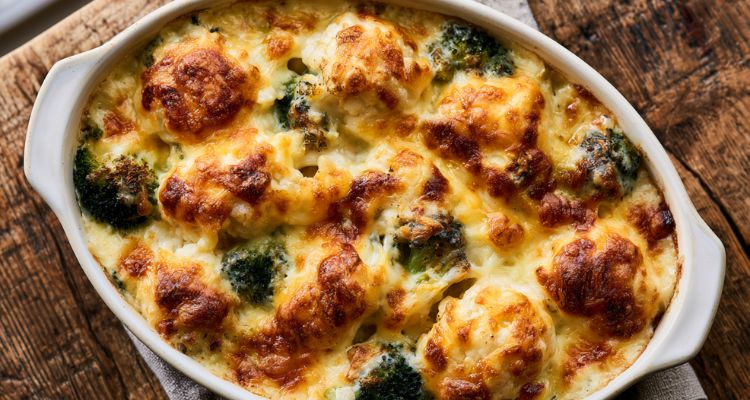
Mary Berry’s cauliflower cheese bakes blanched cauliflower and broccoli florets under a two-cheese sauce made with Parmesan, Cheddar and Dijon mustard. It serves four, takes 20 minutes at 200°C, and the cheese sauce needs under five minutes on the hob.
Her version in Cooking with Mary Berry (2016) blanches the two vegetables in stages so neither overcooks. Berry writes in the same book that she usually boils cauliflower “or cover it in a cheese sauce if I’m feeling a little more indulgent.” This is her indulgent version.
The sauce depends on one detail Berry repeats across her books: use hot milk, not cold. Her Foolproof Tip in Foolproof Cooking (2016) explains that hot milk “enables the roux to absorb the milk quickly,” which stops lumps before they start.
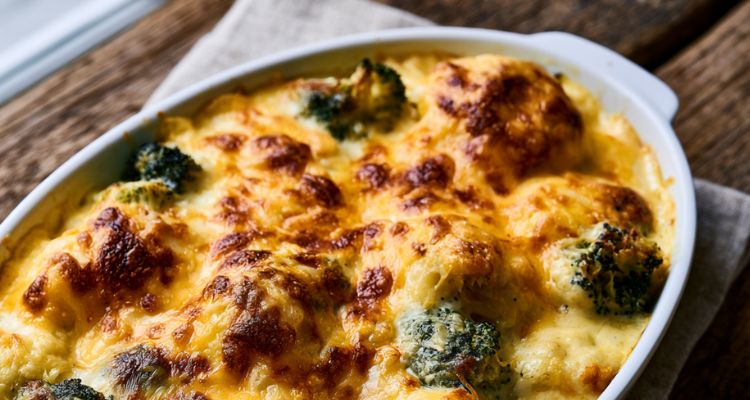
Mary Berry Cauliflower Cheese Recipe
Course: DinnerCuisine: BritishDifficulty: Easy4
servings10
minutes20
minutes520
kcal30
minutesBerry’s vegetable gratin from the Sides chapter of Cooking with Mary Berry (2016), blanched, sauced and baked golden in under 30 minutes.
Ingredients
- For the vegetables:
1 cauliflower, weighing about 500g (1lb)
1 head of broccoli, weighing about 500g (1lb)
salt and black pepper
butter, for greasing
- For the cheese sauce:
60g (2oz) butter
60g (2oz) plain flour
600ml (1 pint) milk
60g (2oz) Parmesan cheese, grated
60g (2oz) mature Cheddar cheese, grated
2 tsp Dijon mustard
- For the topping:
60g (2oz) mature Cheddar cheese, grated
Directions
- Set the oven to 200°C/180°C fan/Gas 6 (400°F).
- Trim off and discard any thick, woody cauliflower and broccoli stalks. Break the heads into large florets, then cut off the thin, tender stalks and reserve.
- Bring a saucepan of salted water to the boil. Add the cauliflower florets with all of the reserved stalks and bring back to the boil. Boil for 2 minutes, then add the broccoli florets and boil for another 2 minutes, or until the vegetables are just cooked but still firm to the bite (they should not be soft). Drain and rinse under cold running water. Drain again, then spread out in a buttered, shallow ovenproof dish with the florets facing upward.
- Melt the butter in a saucepan, sprinkle in the flour, and cook, stirring, for 1 minute. Remove from the heat and gradually blend in the milk. Bring to the boil, stirring constantly until thickened. Simmer for 2–3 minutes, remove from the heat, and stir in the Parmesan and Cheddar cheeses. Add the mustard, season with salt and pepper, and stir until combined.
- Pour the sauce over the vegetables and sprinkle with the Cheddar cheese. Bake for 20 minutes or until golden and bubbling. Serve hot.
Notes
- Calories: Cauliflower (500g): 125. Broccoli (500g): 170. Butter for greasing (~5g): 36. Butter for sauce (60g): 430. Plain flour (60g): 218. Milk (600ml): 366. Parmesan (60g): 249. Cheddar in sauce (60g): 241. Cheddar topping (60g): 241. Dijon mustard (10g): 15. Total: 2,091 ÷ 4 = 523 → rounded to 520 kcal per serving. Berry’s published figure: 513 kcal.
FAQs
Can I make this without the broccoli?
Yes, use a full 1kg (2lb) of cauliflower instead and keep the blanching time the same. Berry’s own page file for this recipe is titled “Cauliflower_cheese” even though she adds broccoli. It works as pure cauliflower cheese without any changes to the sauce.
Her Salmon Fillets with Cauliflower Cheese Topping in Simple Comforts (2020) takes a different approach entirely. She processes the cauliflower in a food processor until it “look like couscous” and mixes it with cream cheese instead of a roux sauce.
Why does Berry use hot milk for the cheese sauce?
She gives the same advice in Cooks the Perfect Step by Step (2014): “I find the roux absorbs it better than cold milk.” Her béchamel guide in that book adds another step. She infuses the milk with a bay leaf and peppercorns before straining it into the roux for background flavour.
I’ve tested both ways and cold milk does work if you whisk constantly and add it slowly. But hot milk catches faster and thickens without lumps, so it saves effort when you’re juggling the blanching at the same time.
Can I prepare cauliflower cheese ahead?
Berry doesn’t include a Prepare Ahead note with this recipe, which is unusual for her cheese bakes. Her Baked Macaroni Cheese in Foolproof Cooking (2016) uses the same sauce technique and says it “can be assembled up to 12 hours ahead.” Her Smoked Haddock and Cauliflower Gratin in Mary Berry Everyday (2017) gives a similar six-hour window.
I’d assemble the whole dish up to 8 hours before baking and keep it covered with cling film in the fridge. Add 5 extra minutes to the baking time since the dish goes in cold. The sauce will set a little thicker than when baked fresh.
Why does Berry use two types of cheese?
The Parmesan adds a saltier, sharper edge that stops the flour and milk from dulling the flavour. A single-Cheddar sauce can taste bland under heavy vegetables. That’s why she splits it between two types and adds Dijon mustard to lift the whole thing.
Her Smoked Haddock and Cauliflower Gratin in Mary Berry Everyday (2017) uses Gruyère instead, which melts more smoothly but costs more. If you want to swap, use the same total weight of cheese and keep the Cheddar on top for browning.
How do I stop the cauliflower going mushy under the sauce?
The cold water rinse after blanching halts the cooking instantly. The cauliflower keeps cooking in the oven under hot sauce, so it needs to go into the dish slightly firm.
Her cauliflower curry in Cooks the Perfect (2014) gives a cutting tip that applies here too. She says to “slice the cauliflower in half lengthways, then cut out the hard, tough central core.” That way all the florets end up the same size and cook at the same rate.
What do you serve with cauliflower cheese?
Berry puts this in her Sides chapter, so it’s built to sit next to a main rather than stand alone. A roast chicken, grilled chops or sausages are the classic British pairings, and it holds its own alongside a Sunday roast without needing anything extra.
Include mains like his sirloin steak and Tuscan chicken that pair well with a rich cheese side. Or serve the cauliflower cheese on its own with crusty bread for a lighter supper.