Jamie Oliver’s mango crème brûlée is a silky baked custard of double cream, tinned mango purée, egg yolks, sugar and lime, finished with a torched caramel top. It’s a Ravneet Gill recipe from Jamie: Fast & Simple, and it serves 5 to 6.
Ravneet Gill, the pastry chef Jamie calls a “queen of puddings”, created it for the show and it comes from her book Baking For Pleasure (2023). Her twist is tinned mango purée, a store-cupboard hero she reaches for year-round, with lime juice cutting through to stop it cloying.
The step that makes or breaks any brûlée is the bake, and hers leans on a bain-marie. The water bath surrounds the dish with gentle heat, so the custard sets slowly and silky. Pull it while the very centre still has the faintest wobble, never a firm set.
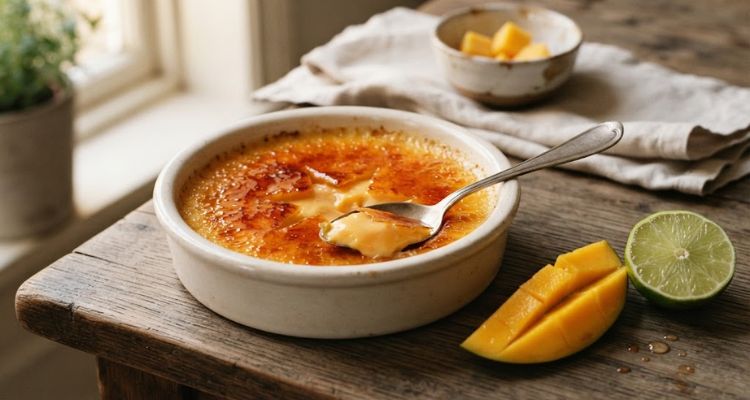
Jamie Oliver Mango Crème Brûlée
Course: DessertCuisine: BritishDifficulty: Easy5-6
servings15
minutes45
minutes470
kcal1
hourRavneet Gill’s five-ingredient brûlée from Jamie: Fast & Simple: a tinned-mango custard baked gently in a water bath and finished under a crackly torched caramel top. Serves five to six.
Ingredients
400ml (14 fl oz) double cream
200ml (7 fl oz) mango purée (fresh or canned)
90g (3¼ oz) caster sugar, plus 4 tablespoons for the brûlée
juice of ½ lime
100g egg yolks (approx. 5 yolks)
Directions
- Set up the bain-marie:Preheat the oven to 130°C fan/150°C/gas 2 and boil the kettle. Sit a 600ml ovenproof dish inside a roasting tray it fits comfortably in.
- Warm the base:In a saucepan, heat the cream, mango purée, 45g of the sugar and the lime juice over low heat until steaming, stirring occasionally.
- Temper the yolks:Whisk the egg yolks with another 45g of sugar. Pour the steaming cream mixture over the yolks and whisk to combine.
- Bake in water:Pour the custard into the dish. With it sitting in the roasting tray, pour hot water into the tray to reach halfway up the sides of the dish. Bake for 45 minutes, until set on top with a faint jiggle in the very centre, never wet.
- Cool:Leave it in the hot water a few minutes, then lift out and cool. Chill in the fridge until cold, as it’s best served cold.
- Brûlée:Blot any surface moisture, sprinkle 2 tablespoons of sugar over the top and wipe the edges clean. Torch until caramelised, then cool completely before repeating with the last 2 tablespoons. Let the caramel set hard and serve.
Notes
- (no blowtorch): Put the dish under a high grill until the sugar bubbles golden in a few places, then remove at once. Cool completely before the second sugar layer and repeat. Chill for 10 minutes before serving, as the grill warms the custard.
- (the dish): You need a 600ml baking dish. To check, put it on scales, zero them and pour in 600ml of water. It should reach about 1cm below the rim.
- (mango): Find tinned mango pulp or purée in many large supermarkets and Indian grocers.
- (yolks): Weigh the yolks if they look small. You want about 100g total, and egg sizes vary.
- (get ahead): The custard can be baked, cooled and chilled up to 3 days ahead. Brûlée it just before serving.
- (scaling up): For a big dinner party, double it and bake longer, watching for the signs it’s done.
FAQs
Why bake it in a bain-marie?
Custard is delicate, and direct oven heat cooks its edges long before the middle sets, giving you a grainy, scrambled ring around a runny centre. The water bath buffers all that. It holds the dish at a steady, gentle temperature so the whole custard sets slowly and evenly into something silky.
Fill the tray with hot, not cold, water so the bake starts at the right temperature, and take it up to halfway up the dish. Pour carefully, keeping water well away from the custard itself. A single splash into the mix will spoil the top.
How do I know when the custard is set?
Go by movement, not time alone. When it’s ready, the surface should look set and matte rather than wet, and the very middle should jiggle ever so slightly if you nudge the dish, like a gentle wobble rather than a ripple. The edges should feel softly set to a light fingertip.
It’s meant to look slightly underdone in the centre, because it keeps cooking in the residual heat and firms up a lot as it chills. If you wait for the middle to set solid in the oven, it’ll be overcooked and stiff by the time it’s cold. Trust the wobble.
Why tinned mango, and what does the lime do?
Tinned mango purée, especially Alphonso, is intensely sweet and deeply flavoured, more reliably so than most fresh mango you can buy out of season. That’s why Ravneet champions it. The lime juice is the counterweight, its sharpness cutting the sweetness so the custard tastes bright rather than sugary.
Fresh mango works too if it’s ripe and fragrant, just blitz it to a smooth purée first. If you’d rather turn mango into a different pudding, it also bakes beautifully into a tart with reliable sweet shortcrust pastry.
Why two thin layers of sugar for the top?
One thick layer of sugar caramelises unevenly, burning on top before the sugar underneath has melted, and it can crack into a soft, uneven shell. Two thin layers, torched one at a time with a cooling stage between, build a thicker, glassier caramel that shatters cleanly under the spoon.
Wipe the edges of the dish before torching, since stray sugar there just scorches. Move the flame steadily so no spot sits too long. That satisfying crack over silky custard is the whole reason to make a brûlée, so it’s worth the extra layer.
Can I flavour it with other fruit?
The method suits any smooth, thick fruit purée, so it’s an easy one to riff on once you’ve made it. Passion fruit is a natural, its sharpness playing the role the lime does here, and raspberry or a good tinned apricot purée both work well.
Keep the quantity the same, around 200ml, so the custard still sets, and taste for sweetness, since some purées are tarter than mango. Very watery purées can loosen the set, so reduce those down in the pan first. The cream, yolk and sugar base stays exactly as it is.
What do I serve it with?
It’s a proper dinner-party pudding that needs almost nothing alongside, since the contrast of hot-cracked caramel and cold custard is the point. A few fresh mango cubes, some berries or a little mint keep it light and pretty on the plate.
Serve it the moment the caramel has set hard, as the top softens within a couple of hours. If you’d like a warmer, homelier pudding another time, pear and blackberry crumble is a good contrast.