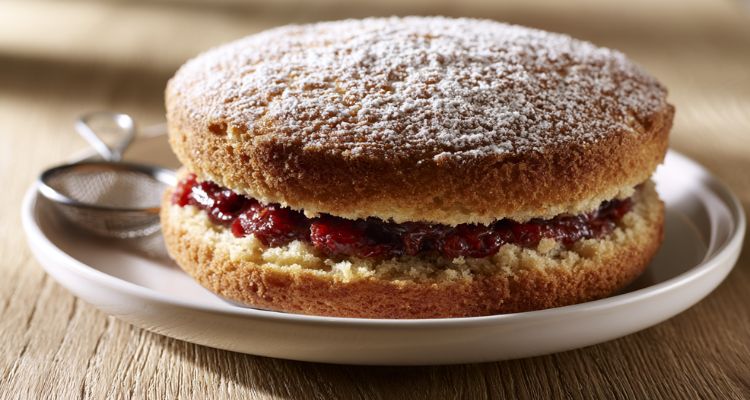
Mary Berry’s Victoria sandwich from Mary Berry’s Ultimate Cake Book (2003) is made with soft margarine rather than butter, combined with caster sugar, self-raising flour, four eggs, and baking powder, baked at 180°C/Gas 4 for 25 minutes in two 8-inch (20cm) greased and lined sandwich tins.
The Ultimate Cake Book version predates Berry’s switch to butter in later editions, and she specifies soft baking margarine throughout. In her method notes for the all-in-one technique in the same book, she explains why: “There is no need for any creaming or rubbing in of the fat and no danger of the mixture curdling because of the egg being added too quickly.” The margarine’s consistent softness, even straight from the fridge, is what makes the method reliable.
What this version does not have is a fan oven setting. Published in 2003, before fan ovens became standard in British kitchens, the temperature is given as 180°C/350°F/Gas 4 only. If you’re using a fan oven, reduce by 20°C to 160°C fan, which matches what Berry specifies in her later books for this same recipe and tin size.
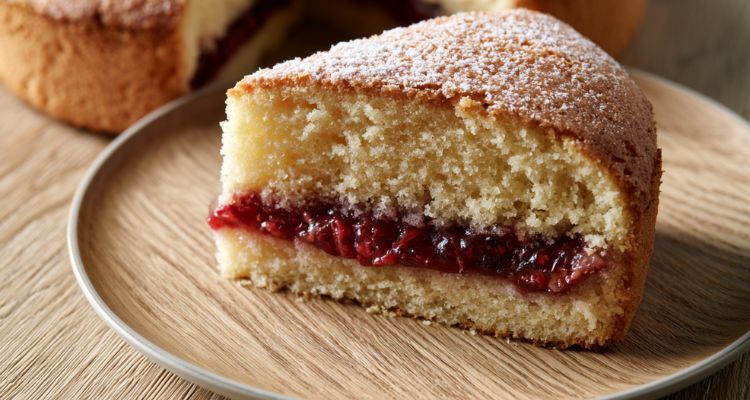
Mary Berry Victoria Sandwich Recipe
Course: DessertCuisine: BritishDifficulty: Easy8
servings15
minutes25
minutes465
kcalFrom Mary Berry’s Ultimate Cake Book (2003), this is Berry’s earliest widely published version of the recipe, using imperial measurements first and soft margarine throughout. One of over 200 recipes in the book, it’s in the Family Cakes chapter alongside her Swiss Roll and Battenburg, which Berry places together as “those one might expect to find in the cake tin.”
Ingredients
- For the sponge:
8oz (225g) soft margarine
8oz (225g) caster sugar
4 eggs
8oz (225g) self-raising flour
2 teaspoons baking powder
- For the filling and topping:
About 4 tablespoons raspberry or strawberry jam
A little caster sugar
Directions
- Preheat: Pre-heat the oven to 180°C/350°F/Gas 4. Grease and base-line 2 × 8in (20cm) sandwich tins with greased greaseproof paper.
- Mix: Measure the margarine, sugar, eggs, flour, and baking powder into a large bowl and beat well until thoroughly blended. Divide the mixture evenly between the tins and level out.
- Bake: Bake in the pre-heated oven for about 25 minutes, or until well risen and the tops of the cakes spring back when lightly pressed with a finger. Leave to cool in the tins for a few moments, then turn out, peel off the paper, and finish cooling on a wire rack.
- Assemble: When completely cold, sandwich the cakes together with the jam. Sprinkle with caster sugar to serve.
Notes
- Calculation: 225g soft margarine (1,620 kcal) + 225g caster sugar (871 kcal) + 4 eggs (312 kcal) + 225g self-raising flour (776 kcal) + 60g jam (150 kcal) = 3,729 kcal ÷ 8 = 465 kcal. Caster sugar topping excluded as negligible.
FAQs
Why does this recipe use margarine instead of butter?
The Ultimate Cake Book was published in 2003, when soft baking margarine was standard in British cake recipes and butter was typically reserved for richer, creamed-method bakes. Berry explains in her method notes for the all-in-one technique: soft baking margarine “is of the correct consistency even when taken straight from the fridge,” which removes one variable entirely. Butter at fridge temperature is too firm to blend smoothly in the all-in-one method. The margarine’s consistent softness is what makes this version so reliable, particularly for less experienced bakers.
What is the all-in-one method and why does it prevent the batter curdling?
In a traditional creamed cake, butter and sugar are beaten first, then eggs are added gradually. Adding eggs too quickly at that stage causes the fat-sugar emulsion to split, producing a curdled batter that affects the final texture. The all-in-one method bypasses this entirely by placing every ingredient in the bowl at once and beating together. Berry explains in the Ultimate Cake Book: “There is no need for any creaming or rubbing in of the fat and no danger of the mixture curdling because of the egg being added too quickly.” The self-raising flour and extra baking powder compensate for the air that isn’t built in during an initial creaming stage.
Can I swap the margarine for butter in this recipe?
Yes, but the butter must be genuinely soft. Berry’s own note in the Ultimate Cake Book states: “You can use block margarine or butter for this method of cake-making but it must be really soft, not oily.” Butter straight from the fridge won’t blend evenly, leaving small lumps that create uneven pockets in the baked sponge. Leave it at room temperature for at least an hour before you start, or cut it into small cubes and leave in a bowl of lukewarm water for 10 minutes. By her Baking Bible (2010), Berry had switched the primary recipe to softened butter throughout, so the swap is one she made herself.
Does this recipe work in a fan oven even though no fan temperature is given?
It works, but you need to adjust. The Ultimate Cake Book was published in 2003 and gives only a conventional temperature of 180°C/Gas 4, because fan ovens weren’t yet standard in most British homes. In her later books, Berry gives 160°C fan for this same recipe and tin size, so that is the right conversion. Running a fan oven at 180°C will bake the sponge around 10–15% faster and risk browning the outside before the centre is fully set. Check at 20 minutes rather than 25, and use the spring-back test rather than the timer to judge when it’s done.
How do I scale a Victoria sponge for a smaller tin using this recipe?
Berry includes a “Secrets of Success” scaling guide directly below this recipe in the Ultimate Cake Book. For a 15cm (6in) tin, use 2 eggs and 100g each of margarine, caster sugar, self-raising flour, plus 1 teaspoon of baking powder; bake in two 15cm tins for about 20 minutes. The rule behind it is simple: the weight of each main ingredient matches the weight of the eggs. Two eggs weigh roughly 100g, so all three dry-measure ingredients scale to 100g. Three eggs give you 175g of each, and four eggs give you 225g, which is the full-size recipe here.