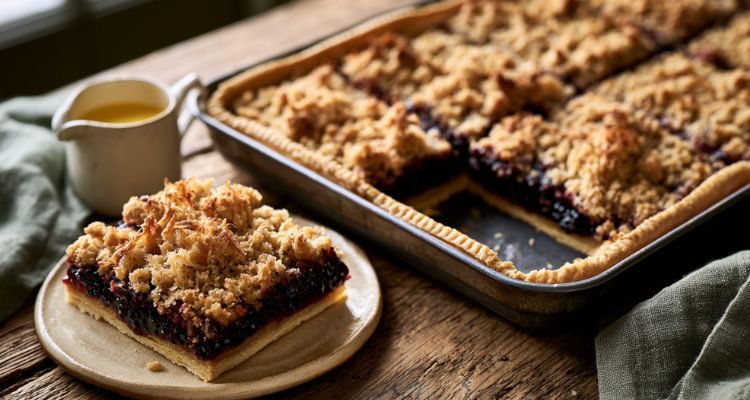
Mary Berry’s blackberry and apple crumble pie is a shortcrust pastry base topped with a cornflour-thickened blackberry and apple filling, finished with a grated semolina crumble, baked at 200°C (180°C fan) in a 25×30cm traybake tin. It serves 8 and cuts into neat squares.
Berry published this in Everyday (2017) and her headnote makes it clear this is a different beast to a standard crumble: “This is a slightly different sort of pie as it has a pastry base and crumble topping.” She designed it for a crowd, either hot with custard after Sunday lunch or cold on a picnic.
The technique that sets this apart is how Berry handles the crumble. She mixes the topping into a dough with melted butter, chills it for at least 30 minutes, then coarsely grates it over the filling like you’d grate cheese. It gives the top a rough, shaggy texture that crisps up faster than scattered breadcrumbs and covers the fruit more evenly.
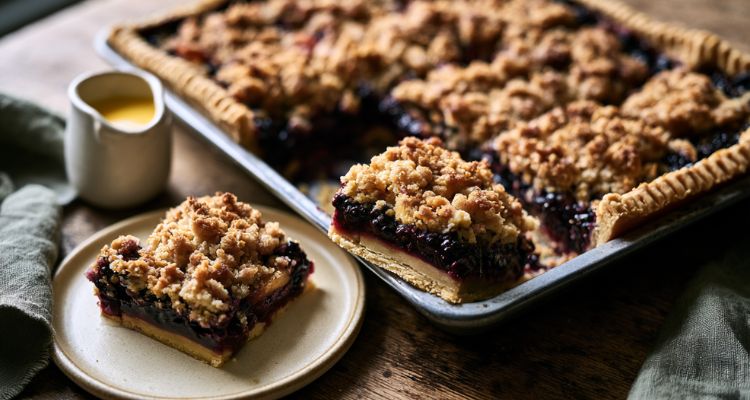
Mary Berry Blackberry and Apple Crumble Pie
Course: DessertCuisine: BritishDifficulty: Easy8
servings30
minutes40
minutes385
kcal1
hour15
minutesBerry pre-cooks the fruit and thickens the juice with cornflour before it goes anywhere near the pastry. Her tip is blunt: “This prevents the pastry from having a soggy bottom!” The filling goes in cold, so the pastry stays crisp from base to edge.
Ingredients
- For the crumble topping:
75g (3 oz) butter, melted, plus extra for greasing
75g (3 oz) self-raising flour
40g (1½ oz) semolina
40g (1½ oz) caster sugar
- For the shortcrust pastry:
175g (6 oz) plain flour, plus extra for dusting
2 tbsp icing sugar
100g (4 oz) cold butter, cubed
- For the filling:
2 large Bramley apples, peeled, cored and coarsely grated
400g (14 oz) blackberries
3 tbsp caster sugar
2 tbsp cornflour
Directions
- Make the crumble: Measure all the ingredients for the crumble topping into a small bowl and mix with a table knife to combine. Use your hands to bring together into a ball. Wrap in cling film and place in the fridge to chill for a minimum of 30 minutes or until needed.
- Make the pastry: Measure the flour, icing sugar and butter into a food processor and whizz until the mixture resembles breadcrumbs. Alternatively, place the dry ingredients in a mixing bowl and rub in the butter with your fingertips. Add 1 tablespoon of cold water and pulse until smooth, adding another tablespoon of water if the dough seems too stiff. Roll into a ball, wrap in cling film and place in the fridge to chill for 30 minutes.
- Make the filling: Put the grated apple and the blackberries in a saucepan. Cover with a lid and simmer over a low heat for about 10 minutes. Tip the fruit into a sieve set over a bowl and use a wooden spoon to gently push all the liquid through the sieve, reserving the fruit. Pour the liquid back into the pan, add the sugar and gently heat. Place the cornflour in a small bowl, add 1 tablespoon of water and mix until smooth. Add the cornflour mixture to the pan and quickly whisk until smooth and thickened. Remove from the heat, return the fruit to the pan and set aside to cool.
- Preheat: Set the oven to 200°C/180°C fan/Gas 6 (400°F). You will need a 25×30cm (10×12 in) traybake tin with 2cm (¾ in) sides, greased with butter.
- Line and blind bake: Roll out the chilled pastry on a floured worktop into a rectangle slightly bigger all round than the tin, with enough to come up the sides and overlap slightly, and the thickness of a £1 coin. Line the tin with the pastry, crimping around the top edge and pricking the base with a fork. Line with baking paper and add baking beans, then bake blind for about 10–15 minutes. Remove the beans and paper and return to the oven for a further 5 minutes.
- Fill and finish: Add the cold filling and spread out over the base of the pastry in the tin. Coarsely grate the chilled crumble topping all over the top, covering the fruit filling well. Bake for a further 15 minutes until golden.
- Serve: Set aside to cool a little, then cut into 8 portions and serve hot with custard or ice cream.
FAQs
Why does Berry grate the crumble topping instead of scattering it?
The crumble for this recipe is made with melted butter, not rubbed-in butter, so it forms a dough rather than breadcrumbs. Berry chills it into a solid block, then grates it coarsely over the filling. The shreds of dough spread out during baking and crisp up into an uneven, craggy topping with more texture than a standard crumble.
It also solves a practical problem. A scattered crumble over a pastry case can leave gaps where the filling scorches, which is why Berry’s tip says to “cover the fruit filling well with the crumble mix, right to the edges of the pastry case.” Grating gives better, more even coverage than spooning and scattering, especially over a large traybake.
Why does Berry drain the fruit and thicken it with cornflour?
Her tip is direct: “This prevents the pastry from having a soggy bottom!” Raw fruit releases liquid as it bakes, and in a standard crumble that juice just pools harmlessly at the bottom of the dish. In a pie with a pastry base, that liquid turns the crust to mush. Berry cooks the fruit first, drains off the juice, thickens it with cornflour, then combines it back with the fruit.
She uses the same logic in her Cookery Course (2015) double-crust apple pie, where she writes that “fruit baked in a pie with sugar can create a lot of liquid” and uses cornflour mixed with the sugar to thicken the juices as they’re released. The approach here is even more thorough because she separates and thickens the liquid before it touches the pastry at all.
Can I use ground rice instead of semolina in the crumble?
Berry says so herself in her tips: “If you can’t get semolina, use ground rice instead.” It’s a straight swap at the same weight, 40g for 40g. Both do the same job of adding grit and crunch to the topping, and both absorb moisture from the filling to keep the crumble crisp.
I’ve tried both and the difference is subtle. Semolina gives a slightly sandier texture and a faintly wheaty taste. Ground rice is smoother and more neutral. Either works, and most supermarkets stock at least one of them in the baking aisle. Berry uses semolina in her Apple and Blackberry Crumble from Simple Comforts (2020) too, so it’s clearly her preference.
What’s the difference between this and a regular blackberry and apple crumble?
Berry’s Apple and Blackberry Crumble in Simple Comforts (2020) is the traditional version — raw fruit in a dish, crumble scattered on top, baked together. No pastry, no pre-cooking, no cornflour. It’s simpler, faster and serves 6 from a round ovenproof dish.
This pie version is more involved but feeds more people (8 portions), holds its shape when cut, and works cold as well as hot. The pastry base means you can slice it into clean squares, wrap them in foil and take them on a picnic, which Berry specifically mentions in the headnote. A regular crumble needs a bowl and a spoon. This one works in your hand.
Why does Berry grate the apples instead of slicing them?
Grating the Bramleys means they break down almost completely during the 10 minutes of simmering, creating a thick, jammy filling that spreads evenly over the pastry base. Sliced apples would leave chunks sitting on the crust, making the pie harder to cut into neat squares and creating uneven portions.
It also helps the draining step work properly. Grated apple releases its juice faster and more completely than slices, so when you tip the cooked fruit into the sieve, the liquid separates cleanly. Berry’s Devonshire Apple Cake uses thinly sliced apples because they’re meant to stay intact inside the sponge. Here she wants the opposite — apple that melts into the blackberries so the filling is uniform.
How far ahead can I make this pie?
Berry gives two options. It can be made up to a day ahead and reheated, and the cooked dish freezes well. That makes it one of the more make-ahead-friendly desserts in her books, partly because the pastry base stays crisp thanks to the cornflour-thickened filling, and partly because the grated crumble topping holds its texture better than a scattered one when reheated.
I reheat slices in the oven at 160°C for about 10 minutes rather than microwaving them, because the microwave softens the crumble and the pastry. If you’re freezing the whole thing, wrap the tin tightly in cling film then foil. It keeps for a good two months and defrosts at room temperature in about 3 hours.