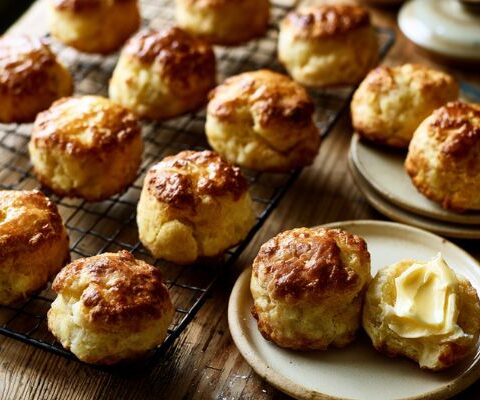
Mary Berry’s buttermilk and sultana scones are light, golden scones made with a full carton of buttermilk, self-raising flour, butter and eggs, studded with sultanas and baked at 200°C (Gas 7) for 12 to 15 minutes. The recipe makes 12 using a 6cm fluted cutter.
This is the only scone recipe across all 28 of Berry’s cookbooks that uses buttermilk as the liquid. She published it in Mary Berry at Home, noting that “buttermilk gives a lovely, light texture to these scones,” and adds that you can omit the sultanas if you’d rather have them plain.
Berry rolls these thicker than her other scones, a full 2.5cm instead of her usual 1 to 2cm. That extra height, combined with the acidity in the buttermilk reacting with the baking powder, is what gives them a taller rise than you’d get with milk alone.
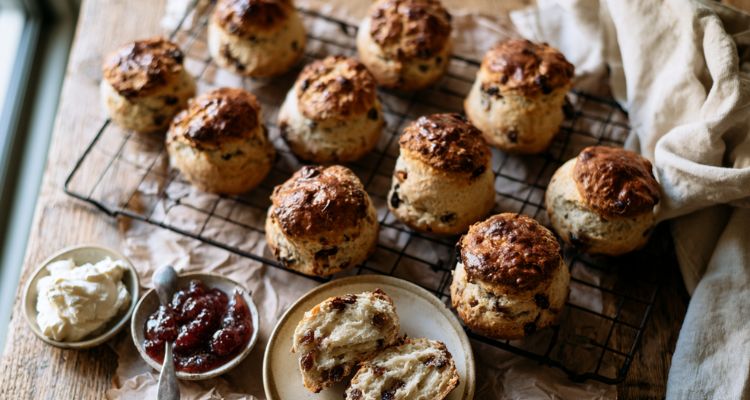
Mary Berry Buttermilk and Sultana Scones
Course: DessertCuisine: BritishDifficulty: Easy12
servings15
minutes12
minutes245
kcal33
minutesBerry’s only buttermilk scone recipe. The buttermilk replaces milk entirely and creates a softer, tangier crumb than her standard Very Best Scones from Baking Bible (2010).
Ingredients
450g (1 lb) self-raising flour
2 heaped teaspoons baking powder
75g (3 oz) butter, cubed
75g (3 oz) caster sugar
100g (4 oz) sultanas
2 large eggs, beaten
1 × 284ml carton buttermilk
- To serve:
Cream
Jam
Directions
- Preheat: Set the oven to 200°C/200°C fan/Gas 7 (400°F). Line a baking sheet with baking parchment.
- Rub in: Measure the flour, baking powder and butter into a bowl. Rub with your fingertips until the mixture looks like breadcrumbs. Stir in the sugar and sultanas, or do this in a food processor.
- Mix the dough: Mix the eggs and buttermilk together in a jug and pour all but 1 tablespoon into the flour bowl and lightly mix together until combined. It should be a fairly moist dough.
- Shape: Lightly sprinkle the worktop with flour and gently knead the dough until smooth and soft. Roll the dough to about 2.5cm (1 in) thick. Using a 6cm round fluted scone cutter, stamp out 12 scones.
- Bake: Arrange the scones on the baking sheet and brush the tops with the reserved egg and milk mixture. Bake in the preheated oven for about 12–15 minutes until risen and lightly golden.
Notes
- Calories: 450g SR flour (1,553) + 75g butter (538) + 75g sugar (290) + 100g sultanas (299) + 2 eggs (156) + 284ml buttermilk (114) = 2,950 ÷ 12 = 245 kcal per scone
FAQs
What does buttermilk do to scones that milk doesn’t?
Buttermilk is acidic, and that acid reacts with the baking powder to produce extra carbon dioxide, which is what pushes the dough upward in the oven. Berry explains in her Ultimate Cake Book that buttermilk is “pasteurized skimmed milk treated with a culture to produce an acidity ideal for certain breads and scones.” It’s not just a swap for flavour, it changes the chemistry of the rise.
The texture is different too. Buttermilk scones have a softer, more tender crumb because the acid weakens the gluten strands in the flour. I noticed the difference immediately when I tested these side by side with Berry’s Very Best Scones, which use milk. The buttermilk version was noticeably lighter and less chewy.
Can I make these without the sultanas?
Berry says so herself in the headnote: “Omit the sultanas if you prefer plain scones.” Nothing else changes. The quantities, method and bake time all stay the same, so you can treat this as her buttermilk plain scone recipe if you’d rather skip the fruit.
If you do leave them in, make sure they’re evenly distributed through the dough. I stir them into the dry ingredients after rubbing in the butter, before the buttermilk goes in. That way they don’t clump together in one section of the dough.
Why does Berry say not to twist the scone cutter?
She’s consistent about this across every scone recipe she’s published. In Mary Berry Cooks (2014) she writes: “Make sure you don’t twist the cutter or the scones will not rise evenly.” Twisting seals the cut edges of the dough, which stops them from expanding freely in the oven. A straight push down and lift gives you clean, open edges that puff outward as the baking powder works.
Berry also says to push the cutter “straight down into the dough, as opposed to twisting it, then lifting it straight out” in her Very Best Scones from Baking Bible. It sounds like a small thing, but it’s the difference between scones that rise tall and straight versus ones that lean to one side or barely lift at all.
How do I store buttermilk scones?
Berry says these are “best made on the day, but they can be made up to a day ahead and reheated.” She also confirms they freeze well cooked. In her Teatime Scones from Mary Berry Cooks (2014) she gives a specific reheating method: “heat them gently in a hot oven (220°C/200°C fan/Gas 7) just for a few minutes to refresh them.”
I freeze them individually on a tray first, then stack them in a freezer bag once solid so they don’t stick together. Defrost at room temperature and give them 5 minutes in a hot oven before serving. They come back close to freshly baked if you eat them within a month of freezing.
What’s the difference between these and Berry’s Very Best Scones?
Her Very Best Scones from Baking Bible (2010) use milk instead of buttermilk, less sugar (50g vs 75g), softened butter instead of cubed, and no fruit. They’re rolled thinner at 1 to 2cm and bake hotter at 220°C conventional, making about 20 smaller scones from a 5cm cutter.
The buttermilk version is richer and sweeter, with a tangier flavour and a taller rise from the thicker roll-out and the acid-baking powder reaction. Berry’s Very Best Scones are plainer and closer to a traditional cream tea scone, while these feel more like a standalone treat you’d eat without needing jam and cream to carry the flavour.
Can I use yoghurt instead of buttermilk?
Berry doesn’t mention it for this recipe, but she does suggest “half milk and half yoghurt” as a buttermilk substitute in her Irish Soda Bread. Mix 140ml natural yoghurt with 140ml milk to get roughly 284ml, which matches the carton size she calls for here. The acidity won’t be identical, but it’s close enough to give a similar rise and tenderness.
I’ve tested this swap and the scones turned out slightly denser, though still softer than the milk-only version. Full-fat natural yoghurt works better than low-fat because it has more body. Greek yoghurt is too thick on its own, so thin it down with milk to match the consistency of buttermilk, which should pour easily from a jug.